On writing aspects: 7 preludes for magnetic resonator piano, and the related workshop held at LHÍ in June 2025
Spooky Actuation at a Distance

Spooky Actuation at a Distance
On writing aspects: 7 preludes for magnetic resonator piano, and the related workshop held at LHÍ in June 2025
Rory Murphy
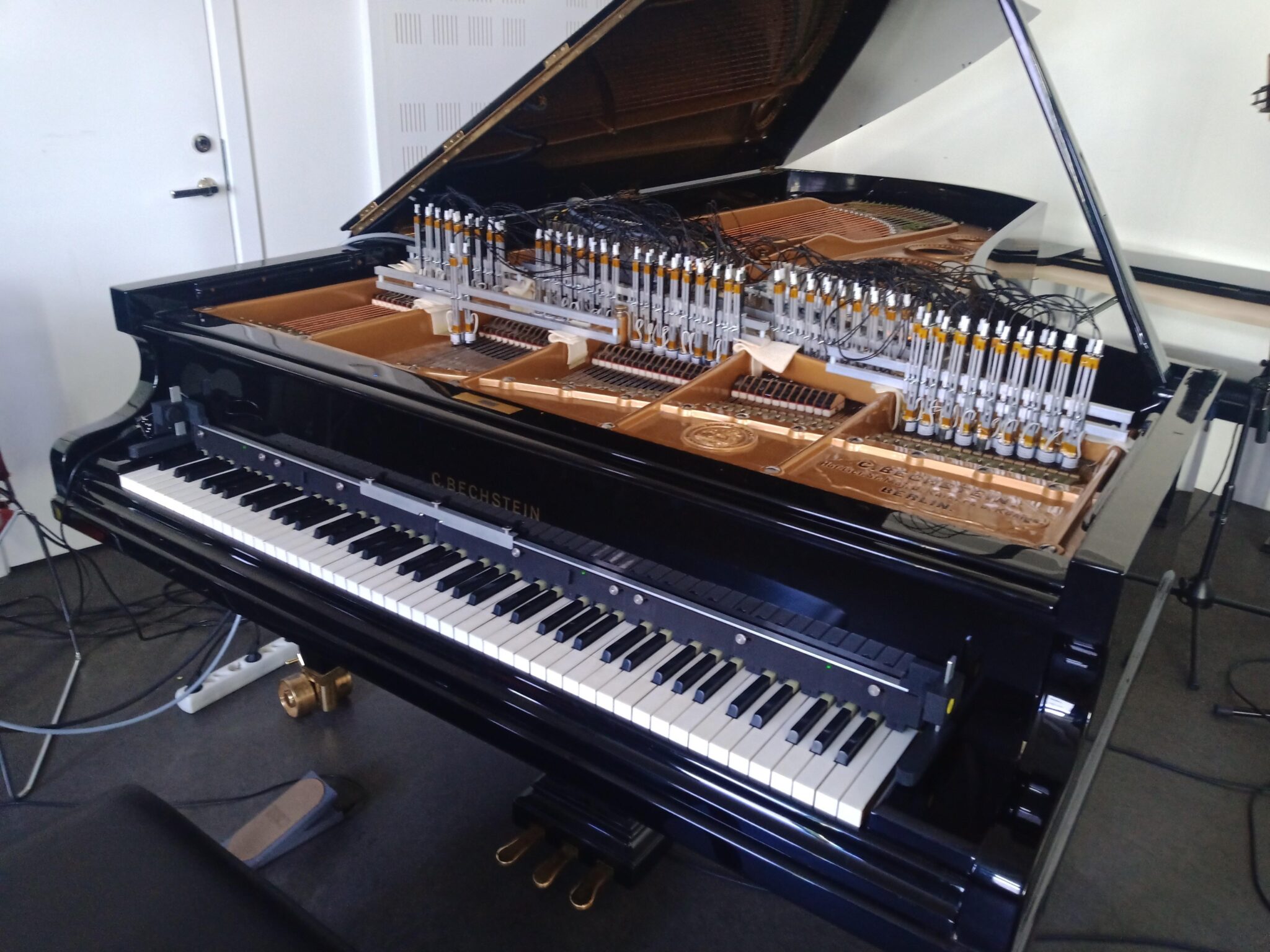 Figure 1. The magnetic resonator piano installed in Fræðastofa 1 at LHÍ, Music Department.
1 Introduction
The following text will present the „magnetic resonator piano“ (MRP), and will discuss its potential and practicalities through the case study of aspects, my set of seven preludes written for the instrument. The preludes were written in June 2023 over the course of a week, using the MRP which was obtained by the Intelligent Instruments Lab in 2021 while they were based at Listaháskóli Íslands. I will consider how the instrument’s idiosyncrasies and affordances influenced my compositional ideas, as well as my approaches to notating its unique capabilities. In June 2025 I held a workshop based around the MRP and aspects in the music department at Listaháskóli Íslands, so to conclude I will discuss the workshop and questions raised during that time.
1.1 On the magnetic resonator piano
The magnetic resonator piano is an apparatus designed by Andrew McPherson in 2009 which is installed on a grand piano and uses 88 electromagnetic actuators to induce vibrations in the strings, allowing for indefinite[1] sustain, crescendi, harmonics, pitch bends, and more. „When current is passed through an actuator, the string is pulled upward; when the current is turned off, the string returns to its original position. By modulating the current at the frequency of the string or one of its harmonics, the string is made to vibrate sympathetically without ever having been struck by the hammer.“[2]
The magnets are controlled by a scanner bar which measures the positions of the keys, giving the player the opportunity to continuously control the volume of individual notes, in addition to maintaining traditional hammered playing. While the sustained sounds from the strings are reminiscent of synthesised sounds, all sounds produced are acoustic and no speakers are involved. This makes the MRP a kind of elaborate piano preparation rather than an electronic instrument, and is the key to its distinct and immersive sound. Since the magnets are controlled digitally, however, this allows for some special techniques to be programmed. Here are paraphrased descriptions of some of these techniques as given in the score to aspects: 7 preludes for magnetic resonator piano:
„harmonic shimmer“ (used in all 7 preludes)
By tapping a key rapidly and lightly (in a kind of non-hammered tremolo), harmonic partials can be produced, in ascending order. There is a limit, at which point the key must be released and the technique repeated in order to activate it again. It is possible to stop tapping and hold the key to sustain any partial.
“glitching“ (used in preludes V and VII)
This is a sub-technique of the shimmer, whereby short digital-sounding pitch sweeps are produced as an artefact. This effect was not programmed intentionally, and therefore can be tricky to activate, but it is generally found when shimmering a held note or chord slightly while it is somewhat depressed already (unlike the normal shimmer, which taps very lightly on a key without properly depressing), and is easier on higher pitches.
pitch bend (used in all preludes save IV)
When holding one key, depressing a neighbouring semitone gradually will cause the original note to bend towards it.[3] In this case the magnets are programmed to increase/decrease the frequency of the original note, so the neighbouring note’s strings are not directly activated, and it is possible therefore to create a bend which transitions into a dyad. These bends can be fluctuated in both directions while held (i.e. bent up and down between the starting pitch and the one being bent towards).
expression/volume pedal (used in preludes I, IV, V and VI)
The MRP has its own pedal, which controls the overall volume/intensity, and this operates separately to the individual volumes of the notes which are controlled by the degree of key depression. It can be changed while playing, or left at a consistent volume.
The MRP provides many new avenues for interacting with the piano, and opens up considerations which were before unavailable to pianists. For example, it provides them not only with a way to produce sustained tones but with the means to bring sensitivity and focus to the shape of these tones over time, bringing the pianist into a completely new tactile and temporal relationship with the piano. There is more to each gesture; to pressing, to holding, to releasing, as they are tied to fine gradations of sound. There are also new gestures entirely, in quivering for harmonic sweeps, leaning into and out of pitch bends, or combining all possible hammered attacks with the new non-hammered techniques. Some fingers may be moving, some kept still, or all moving at slightly different rates, each movement affecting a sound. Stillness itself becomes more than an impression; while a pianist playing on an ordinary piano might freeze their movements during a sustained (i.e. decaying) sound, they may still move their hands without affecting the sound, so long as they produce no new sounds. The nature of the MRP, however, precludes this kind of performative leisure; stillness must be very intentional, and absolute, in order to avoid slight variation in the sound which is still being produced. The release of the hands from the keys is now the actual means of ending a sound, rather than simply a gesture of finality, and there are musical implications of this; for example, in the context of swelling MRP sounds to or from nothing, the natural sustain and decay of hammered attacks become sonic markers, a constant against which to measure the swells.
2 On notation, and how the MRP influenced compositional ideas
My approach in writing aspects was to create notation which may appear familiar to pianists and yet contain elements which are completely new, like the MRP itself. In this spirit, the notation may embody other traits of the apparatus; it may be temperamental, volatile, and generally unpredictable… And yet, finite in its capabilities and able to be learned, adapted to, and eventually intuited. The apparatus comes to the player as a static artefact, whose fundamental nature cannot be easily changed, therefore the quirks of its programming become elements of its design and use, just as interesting and available as its (more-)intended features („glitching“ is one example of this).
In aspects, notes which are hammered normally are given standard noteheads, while MRP notes are given diamonds (I used both black and white diamonds, depending on the piece). In notating sustained sounds, I settled on using duration bars, which emerge from the notehead. These are common in the repertoire of „proportional“ or „space-time“ notation[4], in which physical space on the score corresponds to duration (either in strict proportion/scale, or as in the case of some of these preludes in local proportions only, and subject to variations in scale). The MRP is an instrument which takes a little time to respond, and whose sonic details are most readily appreciated when time and attention are given. This was my approach, and the reason for the ponderous nature of the music as well as the choice of duration bars rather than metric rhythm.
On the other hand, because of the fear of burning out a magnet, I rarely sustained single notes for very long, so the resulting music tended to be something which was always morphing. This provided the balance needed for the notation, because maintaining several duration bars for a long time can become visually confusing. In two instances I used white ledger lines, as they needed to be seen through duration bars. The exception is movement „VI. thermocouple“ (see Fig. 2 below), which utilises some longer durations to the extent that the resulting mass of black duration bars was unreadable. My solution was to colour the bars, yellow for spaces and blue for lines. Two others features aid reading here; „note-off“ text which indicates note names for keys releases, and „currently held pitches“ shown at the end of each system (these features prevent one having to look back or turn pages to verify pitches, either during performance or in rehearsal).
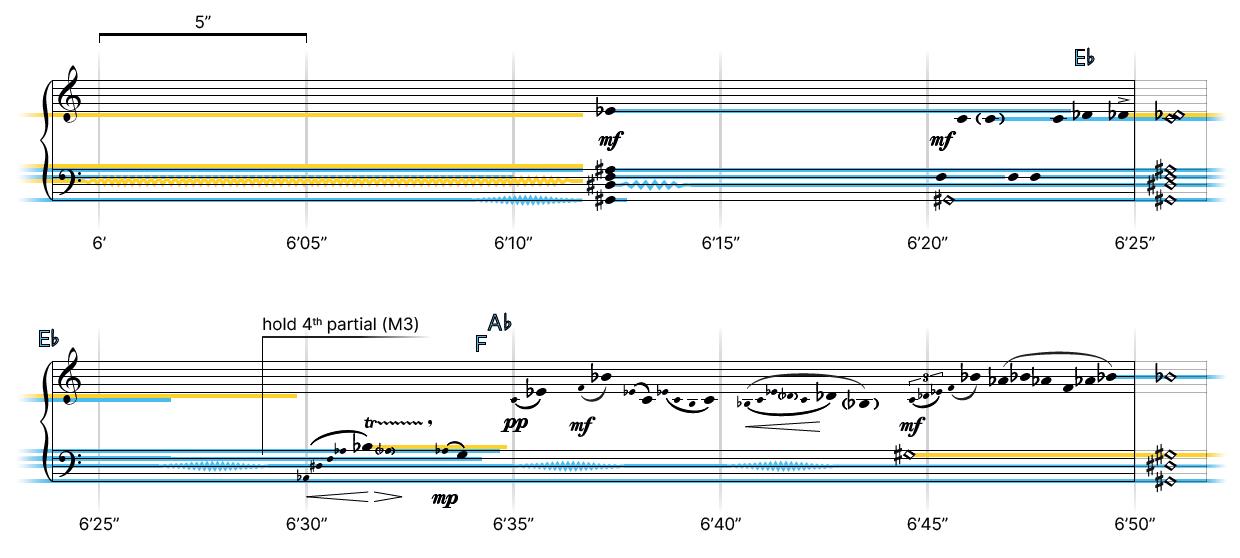 Figure 2. Page 3 of „VI. thermocouple“, showing letter name note-offs (Eb, F, Ab) and currently held pitches at the ends of each system.
2.1 On notating „harmonic shimmer“ and pitch bends
The harmonic shimmer technique I notated by zig-zagging the duration bars, with a wider zig-zag representing more intense shimmering. The intensity corresponds to the depth to which the key is depressed, with the maximum being just short of hammering the key (since the shimmering is done quickly, it can be easy to accidentally hammer the key), as well as the speed, although key depth and speed are usually entangled. In some parts of the score a specific partial is desired, at which point the player should stop shimmering and hold the key. In these instances, the zig-zag returns to a straight duration bar to indicate the sustain of the note. Where no specific partial is desired, the partial sustained after the zig-zag becomes straight again is indeterminate.
Pitch bends were usually notated with the text indication of „p.b.“ written above the note towards which the pitch should bend, but generally these are descriptions rather than directions, as when pressing the notated key the pitch bend will be produced automatically (the „p.b.“ is not given in preludes III. or VII., for instance). However, it helps for the player to be aware of upcoming pitch bends, since a gentle and intentional approach produces better results, and prepares for potential fluctuations in the degree of bending and harmonic shimmers of bent pitches, both of which are occasionally asked for in aspects (e.g. Fig. 3 below).
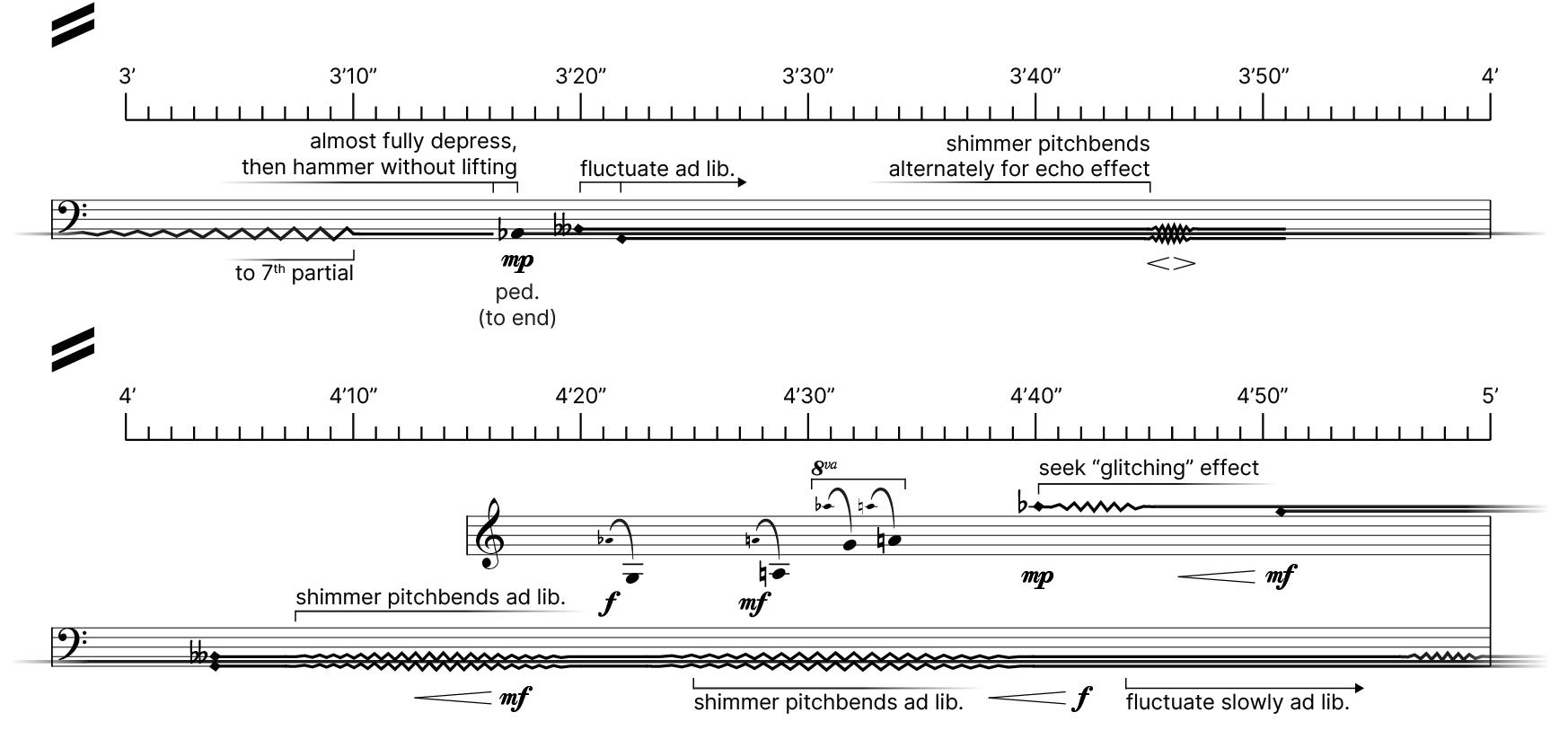 Figure 3. Section from page 2 of „VII. mezzaluna“ showing harmonic shimmer and pitch bends (unmarked, but with further instructions).
2.2 On other notational possibilities
There were some notations which I began to develop but did not use in the final selection of pieces. One example is piano roll notation (static or animated), which could correspond to the OSCController interface of the MRP (this is visible on the controller laptop located nearby, and depicts all inputs to the sensor bar on a piano roll). Another option is the use of beams, whose length would indicate duration rather than the usual metric connection to another note (as for example in Takemitsu’s 1971 piece Voice for flute[5]). With such a system, I imagined that variables in the beam design (such as length, hue, angle, thickness, etc.) could be used to represent various parameters of MRP playing (such as key depression, volume pedal depression, duration, etc.). This method has two obvious advantages; firstly, angling the beams allows one to avoid the parallel placement of duration bars on staff lines, and secondly, it changes a familiar notation symbol (the beam) into a new one, rather than introducing something which may be completely new to players, and pianists in particular (the duration bar).
A more open example would be to provide information for a set of continuous key positions and techniques, but without pitch information. This could describe the detailed behaviour of individual fingers acting on any freely chosen keys over the course of a given duration, with a focus on the changes occurring within the pitches rather than the pitches themselves. One could also vary the piano roll notation by bringing it into the third dimension, with the pitches on one axis, time on another, and key depression on the third. This can be seen in the example in Fig. 4 below, where the entire piece would be visible on the page, and varying the duration will vary the resolution of the mountainous key-depression shapes.
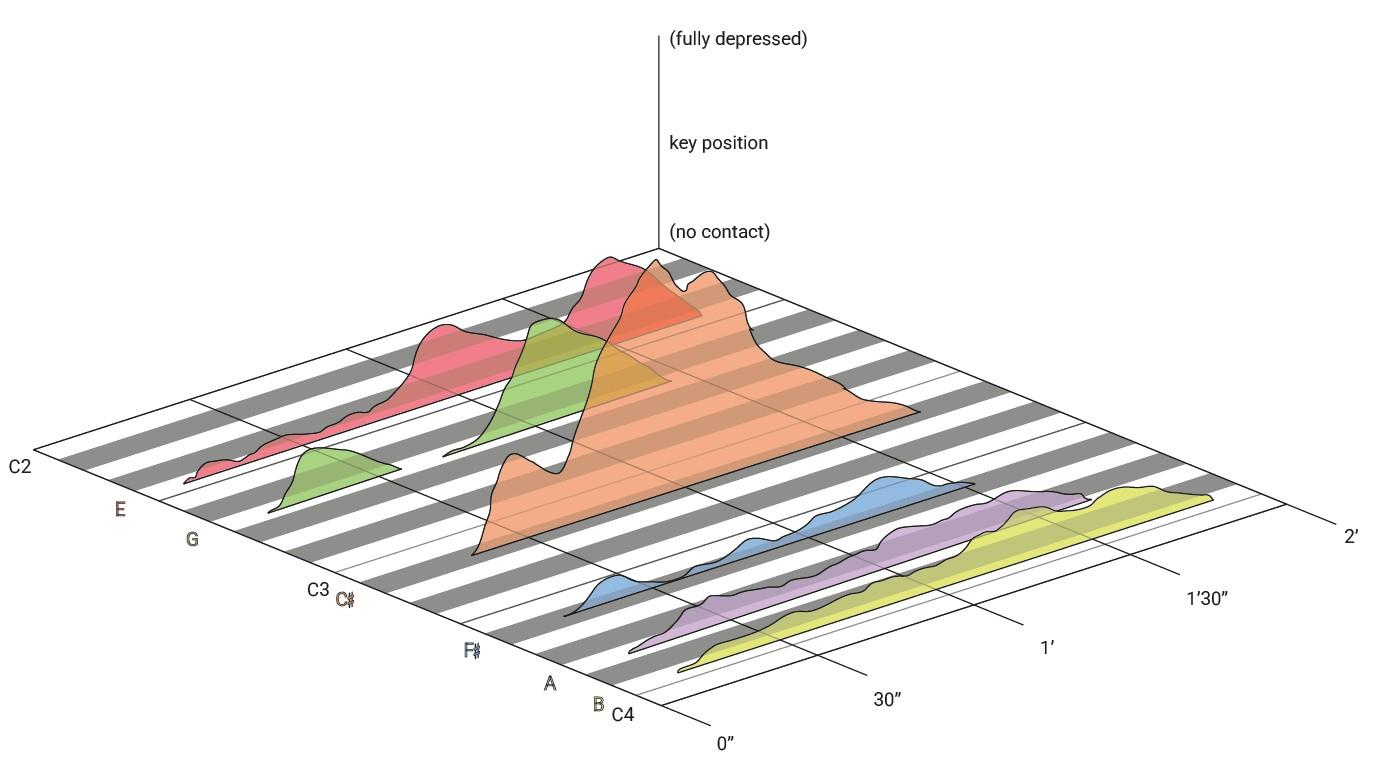 Figure 4. 3D graph notation, depicting key depression depths (inverted!) for one hexachord along a piano roll.
3 On the workshop, and questions raised
In June 2025 I held a workshop focused on the MRP and aspects at the music department at Listaháskóli Íslands. This was an occasion to introduce the MRP to people who hadn’t had a chance to try it before, as well as to introduce aspectsboth as an example of notational possibilities for composers and as a medium through which pianists might approach the new instrument. Participants had the opportunity to spend time with the instrument, and to take part in a concert planned for the end of the week. Thanks to the attendance of a mix of composers and pianists, the concert contained performances of two preludes from aspects as well as several new compositions and improvisations.
The discovery of the MRP and the variety of approaches to it raised several questions and considerations on a variety of subjects, some of which are here grouped under three headings: composition, playing and listening, and improvisation.
3.1 Playing and listening
pianism
Even within the very well-developed canon and heritage of standard piano practice, each pianist grows into their own personal approach. How does this variety of pianism manifest in the context of MRP playing? Are there certain „types“ of piano players which are more suited to MRP playing from the off, and how can various instrumental practices be adapted or tempered to suit the MRP? And what sorts of aptitudes shine through in MRP playing, from both pianists and non-pianists? In terms of moving between instruments, this is a similar consideration to „what happens when a guitarist picks up a cello?“
listening
What kinds of things are we listening for on the MRP? When we play a chord, up to ten or more pitches[6], how do we hear the interactions between pitches as they change over time? How does the possibility of long sustain and continuous note shaping affect the „orchestration“ of what is still piano music? How do we deal with the increase in harmonic detail, focus on partials and resonance, interaction with hammered attacks, etc.?
polyphony
Is the MRP the only acoustic instrument which offers continuous note shaping in polyphony? With other instruments there may be a choice between polyphony without shaping (piano, organ) or shaping without polyphony (violin, flute). Of course, there are double stops, multiphonics, etc., but these are more homophonic or contrapuntal, in the sense that the pitches cannot easily be controlled independently (particularly in numbers greater than two).
organology
Perhaps due to the fact that the instrument is still in some ways a work-in-progress, there can be much variety between individual MRP kits. I found that some techniques which were easy for me to play on the MRP in Listaháskóli Íslands were difficult, if not completely precluded by software differences, on the MRP in the Sonic Arts Research Centre in Belfast. Is there cause for standardisation, for settling into a „finished version“? Or is each iteration of the MRP to be considered a unique instrument of its own?
3.2 Composition
attention
Some notations, such as the 3D graph above, may contain so many parameters which need to be „read“ concurrently that the nuance of very small movements may occur simply as a byproduct. In other words, baking into the score the degree of attention taken from the performer may provide an avenue for controlling the details without the player having to actively consider them.
idiomatic writing
In terms of the affordances of the instrument, how do we assess what exactly it is that the MRP can do, and how do we go about developing the skills to use it? In terms of composition, how does the concept of „idiomatic“ writing emerge? Is this something that can be actively developed with a new instrument, and can its inevitable subversion be taken into account? Is it possible to arrive at the sort of occasion on which that subversion becomes the target of derision (as in the famous case of the opening bassoon solo of Stravinsky’s Rite of Spring), or is it the case that our minds are now so open as to preclude such reactions? Even in the context of total openness, surely there will remain artistic choices which can be brought into reasonable doubt.
the piano after MRP
How do we approach writing for the piano after the MRP? Is it a paradigm shift, in the same sense that prepared piano was? Or should we simply consider the MRP to be a very involved preparation, and belonging to the same category? One argument against this idea of a shift is the scarcity of MRP kits compared to the typical materials of piano preparation, and resulting lack of widespread adoption; it is a specially designed, expensive, proprietary piece of equipment, whereas „traditional“ piano preparations can be quite effectively made with common household objects.
3.3 Improvisation
What does improvisation look like on this instrument, particularly in comparison to improvisation on the piano (which yet remains present)? How do we approach something new, like the MRP? Improvisation is very much a practice of listening; even when the practice is split up into various kinds (as Pauline Oliveros does, for example; „free“, „historical“, „conscious“, and „unconscious“)[7], improvisation still always needs listening to function (and not just in the trivial sense that the result is supposed to be heard). When playing the MRP for the first time, we do not know how it will feel, even if we have an idea of how it will sound. At this beginning, listening is very much an observational tactic; a searching over something witnessed without interpretation, input to which we don’t respond. Perhaps this is pre-improvisation; what we play with an unfamiliar instrument is new, yes, but since it is learning it must temper intention. The intention in using a new tool is limited by the current state of learning (considered distinct, of course, from the „intention to learn“). How could it be an attempt to „compose“ (in the improvisatory sense of the word) while it is still an act of discovery? This exploration could of course be taken as the very definition of improvisation (at its root meaning „unforeseen“), but this does bring us now to an interesting distinction between varieties of foresight.
We might consider a new instrument and what one might play on it at the first interaction, versus what the same person might play on a familiar instrument, but then there is that grey area inbetween where lies the „augmented instrument“, of which the MRP is an example. Taking note of both the new and the familiar, there are three general routes we could take, and each will bear fruit in different varieties and quantities. One option, as a balance, is to immediately incorporate our new sensations and actions into our „old“, habitual ones (this is perhaps the inevitable centre point between two extremes). The second option is one extreme, where we might try to avoid all possible habits and simply open up to all that is new about the instrument, while the third option is the other extreme; to ignore all of the new sounds and to play the MRP simply as a piano, with little to no regard for those new sounds which emerge by chance as a collateral result of our interactions with it. Each option will produce greatly differing results, and set the player on different paths of discovery.
3.4 Conclusion
Another goal of the workshop was to bring greater awareness to the local music community of the presence and availability of this instrument, which on the global scale is still very rare. It is my hope that the increased interest will lead to a successful campaign for the permanent availability of the instrument to any who wish to use it, and an increase in accessibility through, for example, teaching the installation and care of the instrument to more people, the provision of funding to keep it in good working order (alongside stocking spare magnets, etc.), as well as the maintenance of a consistent relationship with Andrew McPherson and the Augmented Instruments Lab at the Centre for Digital Music (C4DM) at Queen Mary University of London and the Dyson School of Design Engineering at Imperial College London.
Being relatively new, there is still much to discover about the MRP. As an augmented instrument, it acts as a bridge between the wholly embodied world of instrumental playing and the digital world of electronic music, and yet through maintaining a foundation in acoustic sound shows the great potential still held in the instruments we already possess. It is my hope that the MRP will be encountered and explored from many more perspectives, be they sonic, performative, compositional, etc.
To hear recordings of aspects, please visit my website, and feel free to get in touch via the contact form if you’d like to see the scores: https://rorymurphy.net/aspects
—
[1]The sustain is indefinite in theory, but in practice the magnets cannot be kept on perpetually, particularly at high power, as they eventually overheat and burn out, requiring them to be replaced. This is the main drawback of the instrument, and certainly has an impact on writing for it, since sustaining notes on the piano is its key innovation. For now, it may just be a question of choosing between duration and volume! For more technical discussion, see f.ex. McPherson, Andrew. „Techniques and Circuits for Electromagnetic Instrument Actuation.“ In Proceedings of the Twelfth International Conference on New Interfaces for Musical Expression (pages unnumbered).
[2]McPherson, Andrew. “Magnetic Resonator Piano.” 2016. instrumentslab.org. https://instrumentslab.org/research/mrp.html. (last accessed 28/01/2025).
[3]In some cases the note which needs to be pressed may be a neighbouring white key which could be a tone apart (though it still produces a semitone bend), but I have yet to verify the details of this, and whether it may vary from MRP to MRP depending on software version, etc. Suffice it to say that it is possible to bend up and down by a semitone from any key.
[4]See for example Cage, John, Music of Changes (1951), Lutosławski, Witold, Preludes and Fugue (1972), Penderecki, Krzysztof, Threnody to the Victims of Hiroshima (1960), and Takemitsu, Tōru, November Steps (1967).
[5]Takemitsu, Tōru, Voice (Editions Salabert, Paris: 1971).
[6]„The instrument covers 88 strings, but requiring 88 audio channels would be prohibitive. The amplifier circuitry therefore includes a signal routing system where audio channels are dynamically allocated to each string as needed. A standard audio interface can be used, with the number of audio channels (up to 16) determining the maximum polyphony of the instrument. In practice, the instrument is often run with 6-to-10-note polyphony“, from McPherson, Andrew. “Magnetic Resonator Piano.” 2016. Instrumentslab.org. https://instrumentslab.org/research/mrp.html. (last accessed 28/01/2025).
[7]Oliveros, Pauline. “Quantum Improvisation: The Cybernetic Presence”, Hz journal, 16 (1999), (keynote address presented at the conference Improvisation Across Borders at UCSD April 11, 1999). (https://www.hz-journal.org/n16/oliveros.html, last accessed 21/12/2025).