On writing aspects: 7 preludes for magnetic resonator piano, and the related workshop held at LHÍ in June 2025
Spooky Actuation at a Distance

Spooky Actuation at a Distance
On writing aspects: 7 preludes for magnetic resonator piano, and the related workshop held at LHÍ in June 2025
Rory Murphy
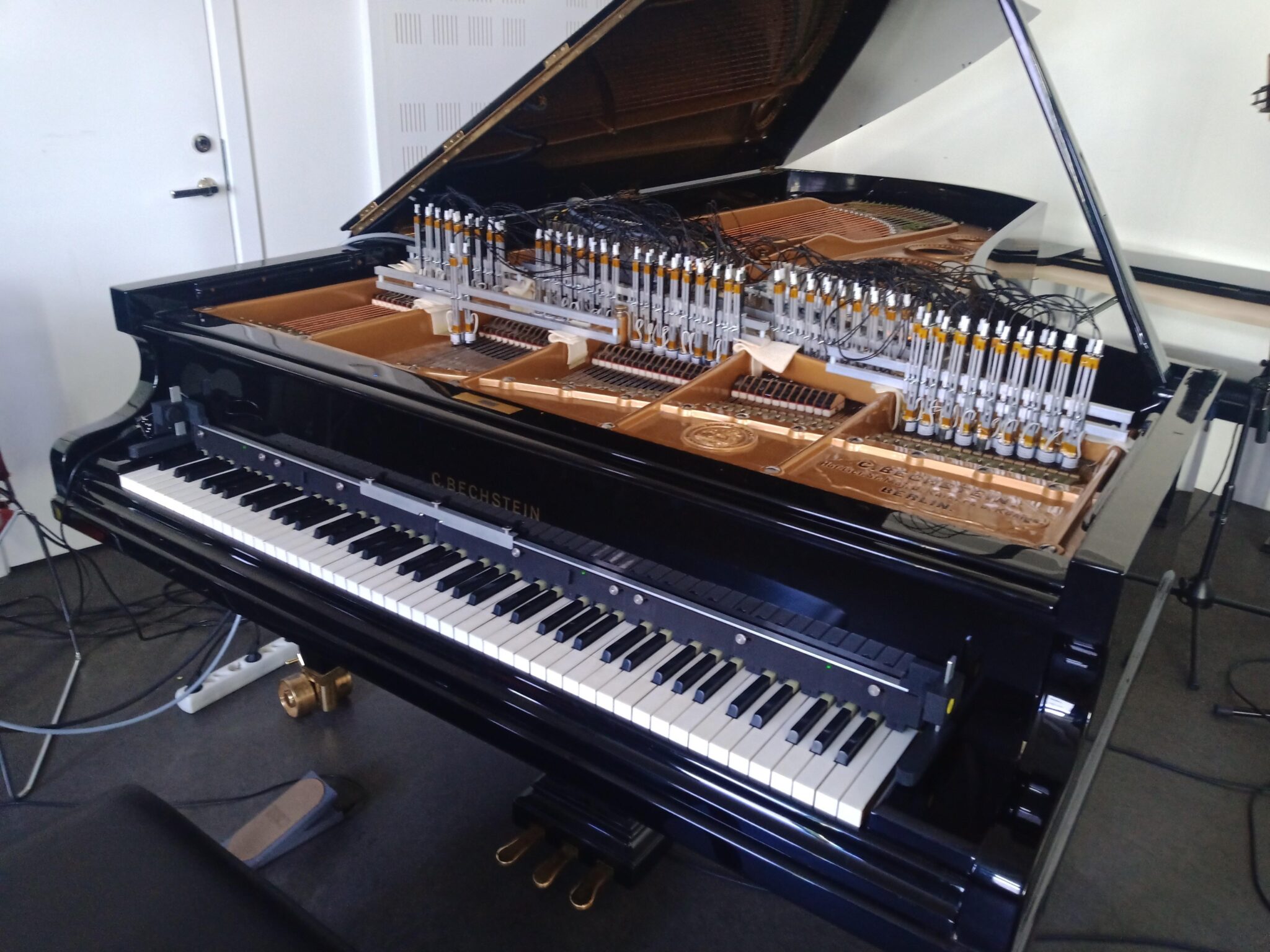 Figure 1. The magnetic resonator piano installed in Academic office 1 at LHÍ, Department of Music.
1 Introduction
The following text will present the „magnetic resonator piano“ (MRP), and will discuss its potential and practicalities through the case study of aspects, my set of seven preludes written for the instrument. The preludes were written in June 2023 over the course of a week, using the MRP which was obtained by the Intelligent Instruments Lab in 2021 while they were based at Iceland University of the Arts. I will consider how the instrument's idiosyncrases and affordances influenced my compositional ideas, as well as my approaches to using its unique capabilities. In June 2025 I think a workshop based around the MRP and aspects in the department of music at the Iceland University of the Arts, so to conclude I will discuss the workshop and questions raised during that time.
1.1 On the magnetic resonator piano
The magnetic resonator piano is an apparatus designed by Andrew McPherson in 2009 which is installed on a grand piano and uses 88 electromagnetic actuators to induct vibrations in the strings, allowing for indefinite[1] sustain, crescendi, harmonics, pitch bend, and more. „When current is passed through an actuator, the string is pulled upward; when the current is turned off, the string returns to its original position. By modulating the current at the frequency of the string or one of its harmonics, the string is made to vibrate sympathetically without ever having been stroke by the hammer“.“[2]
The magnets are controlled by a scanner bar which measures the positions of the keys, giving the player the opportunity to continue control the volume of individual notes, in addition to maintaining traditional hammering playing. While the located sounds are significant of synthetic sounds, all sounds produced are active and no speakers are involved. This makes the MRP a kind of elastic piano preparation rather than electronic instruments, and is the key to its significant and immersive sound. Since the magnets are controlled digitally, how for such devices to see what measures. aspects: 7 preludes for magnetic resonator piano:
„harmonic shimmer“ (used in all 7 preludes)
By tapping a key rapidly and lightly (in a kind of non-hammered tremolo), harmonic parts can be produced, in ascending order. There is a limit, at which point the key must be released and the technique repeated in order to activate it again. It is possible to stop tapping and hold the key to sustain any partial.
“glitching“ (used in preludes V and VII)
This is a sub-technique of the shimmer, whereby short digital-sounding pitch sweeps are produced as an artefact. This effect was not programmed intently, and therefore can be tricky to activate, but it is generally found when shimmering a think note or chord slightly while it is somewhat depressed already (unlike the normal shimmer, which taps very lightly on a key without properly depressing), and is easier on higher pitches.
pitch bend (used in all preludes save IV)
When holding one key, depressing a neighboring semitone generally will cause the original note to bend towards it.[3] In this case the magnets are programmed to increase/decrease the frequency of the original note, so the neighboring note's strings are not directly activated, and it is possible there to create a bend which transitions into a dyad. These bends can be involved in both directions while think (ie suggested and down between the starting pitch and the one being bent and the one being bent towards).
expression/volume pedal (used in preludes I, IV, V and VI)
The MRP has its own pedal, which controls the overall volume/intensity, and this operating separately to the individual volumes of the notes which are controlled by the degree of key depression. It can be changed while playing, or left at a consistent volume.
The MRP provides many new avenues for interacting with the piano, and opens up considerations which were open to pianists into a complex new tactile and temporal relationship with the piano. There is more to reach, as they are said to fine degrees of swimming, There are also new guests of harmonic swimming, learning from the strange.
2 On notation, and how the MRP influenced composite ideas
My approach in writing aspects was to create notation which may appear familiar to pianists and yet contain elements which are completely new, like the MRP itself. In this spirit, the notation may include traits of the apparatus; it may be temperature, volatile, and generally unpredictable... And yet, finite in its program becoming known and using, adapting to, and even interesting as well as those features (just).
In aspects, notes which are hammered normally are given standard notes, while MRP notes are given diamonds (I used both black and white diamonds, dependent on the piece). In using located sounds, I settled on using duration bars, which emerge from the notehead. These are common in the representalire of „proportional“ or „space-time“ notation[4], in which physical space on the score Corresponds to duration (either in strict representation/scale, or as in the case of some of these preludes in local statements only, and subject to variations in scale). The MRP is an instrument which takes a little time to respond, and whom sonic details are most readily applied when time and attention are given. This was my approach, and the reason for the music as well as well as the choice of distribution bars rather than metric rhythm.
On the other hand, because of the fear of burning out a magnet, I rarely sustainable single notes for very long, so the resulting music intended to be something which was always morphing. This provided the balance needed for the use, because thermal major is movement for a long time can be known to see some longer events to the present or what changes to the future and experiences.
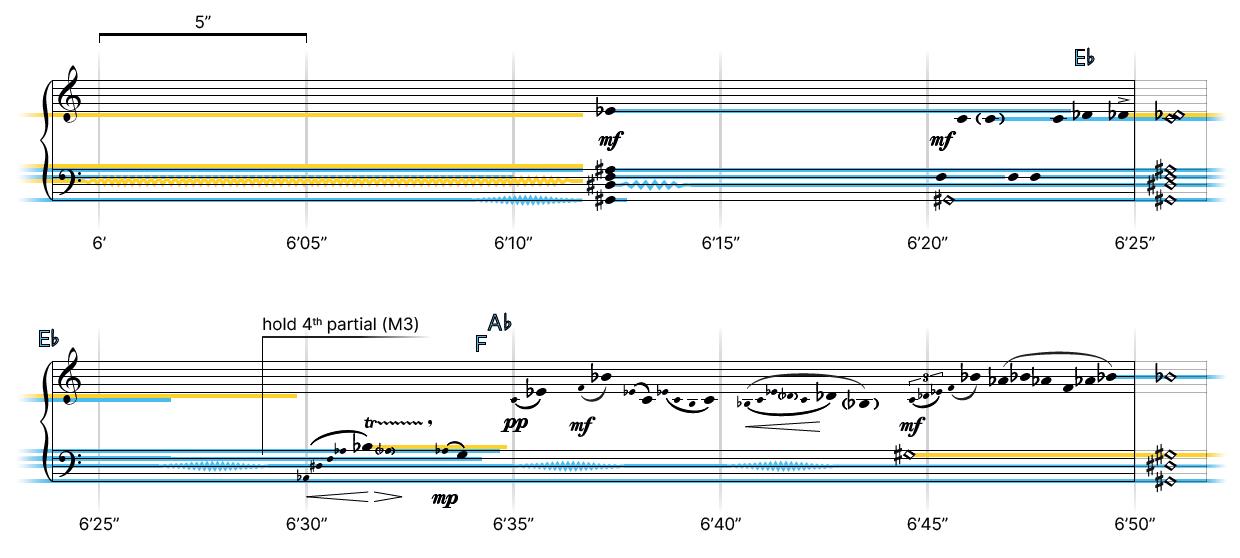 Figure 2. Page 3 of „VI. thermocouple“, showing letter name note-offs (Eb, F, Ab) and currently holds pitches at the ends of each system.
2.1 On notating „harmonic shimmer“ and pitch bend
The harmonic shimmer technique I used by zig-zagging the duration bars, with a wider zig-zag representing more intense shimmering. The intensity corresponds to the depth to which the key is depressed, with the maximum being just short of hammering the key (since the shimmering is done quickly, it can be easy to actually hammer hammer the key), as well as the speed, almost key deposed and speed are usually entangled. In some parts of the specific is designed, at which point the player should stop showing and hold the key. In these positions, the zig-zag returned to the particular side of the particular is located.
Pitch bends were usedally used with the text indication of „pb“ written above the notes which the pitch should bend, but generally these are descriptions rather than directions, as when pressing the used key the pitch bend will be produced automatically (the „pb. is not given in preludes III. or VII., for instance).However, it helps for the player to be aware of what is expected and accident contains, both of what is expected and what is revealed aspects (eg Fig. 3 below).
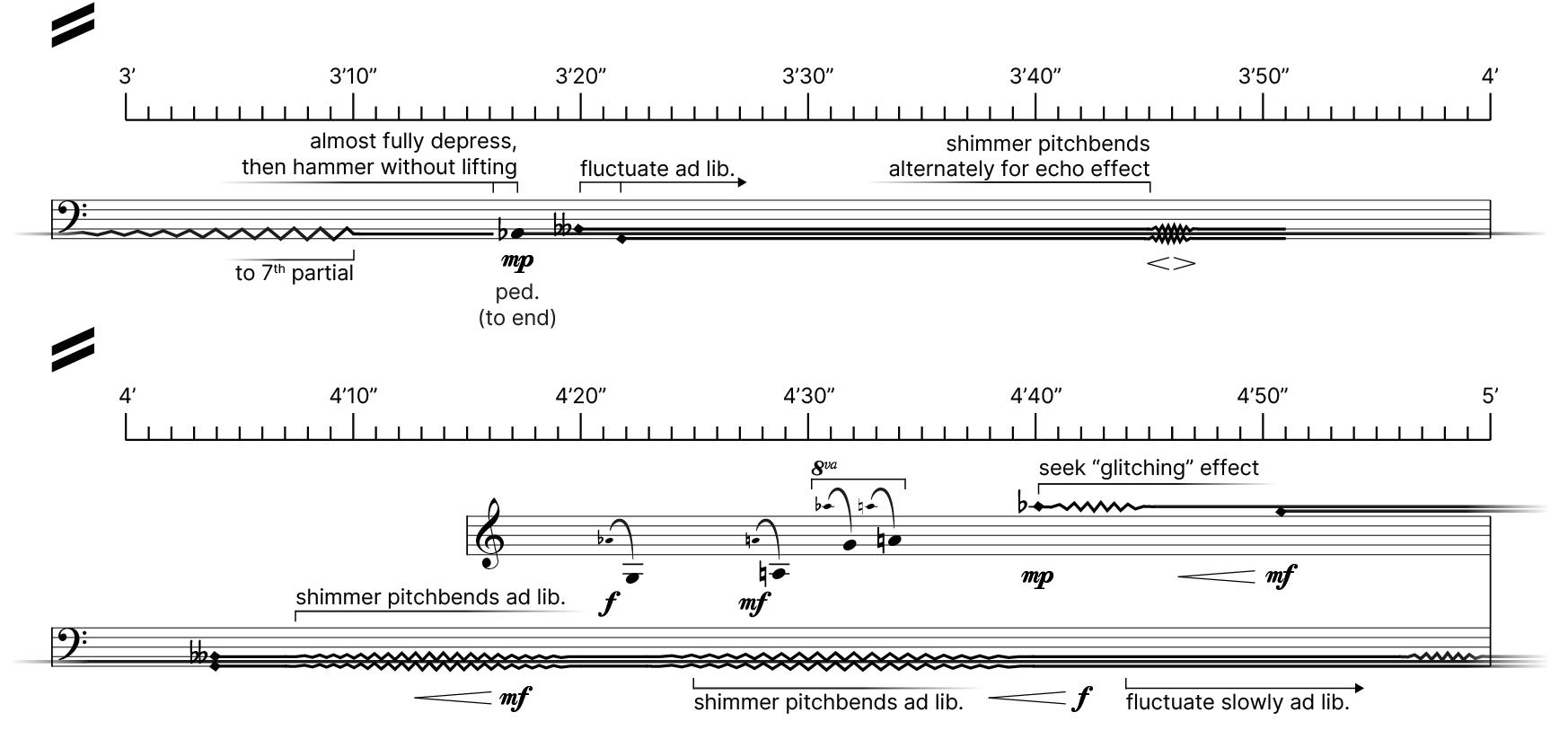 Figure 3. Section from page 2 of „VII. mezzaluna“ showing harmonic shimmer and pitch bend (unmarked, but with further instructions).
2.2 On other functional potentials
There were some uses which I began to develop but did not use in the final selection of pieces. One example is piano roll notation (static or animated), which could correct to the OCController interface of the MRP (this is visible on the controller laptop located nearby, and depicts all inputs to the sensor bar on a piano roll). Another option is the use of bees, which length would indicate duration rather than the use of another measure note (as for example in Takemitsu's 1971 piece Voice for flute[5]). With such a system, I imagined that variations in the beam design (such as length, hue, angle, thickness, etc.) could be used to represent various parameters of MRP playing (such as key depression, volume pedal depression, duration, etc.). This method has two ambiguous advantages; firstly, angling the things allow what could be involved to play, and distinctly, it changes a familiar use (the new one).
A more open example would be to provide information for a set of continuous key positions and techniques, but without pitch information. This could describe the detailed behavior of individual fingers acting on any free chosen keys over the course of a given duration, with a focus on another, and key depression on the pitches found in the example in the fig. 4 believe, where the release was possible.
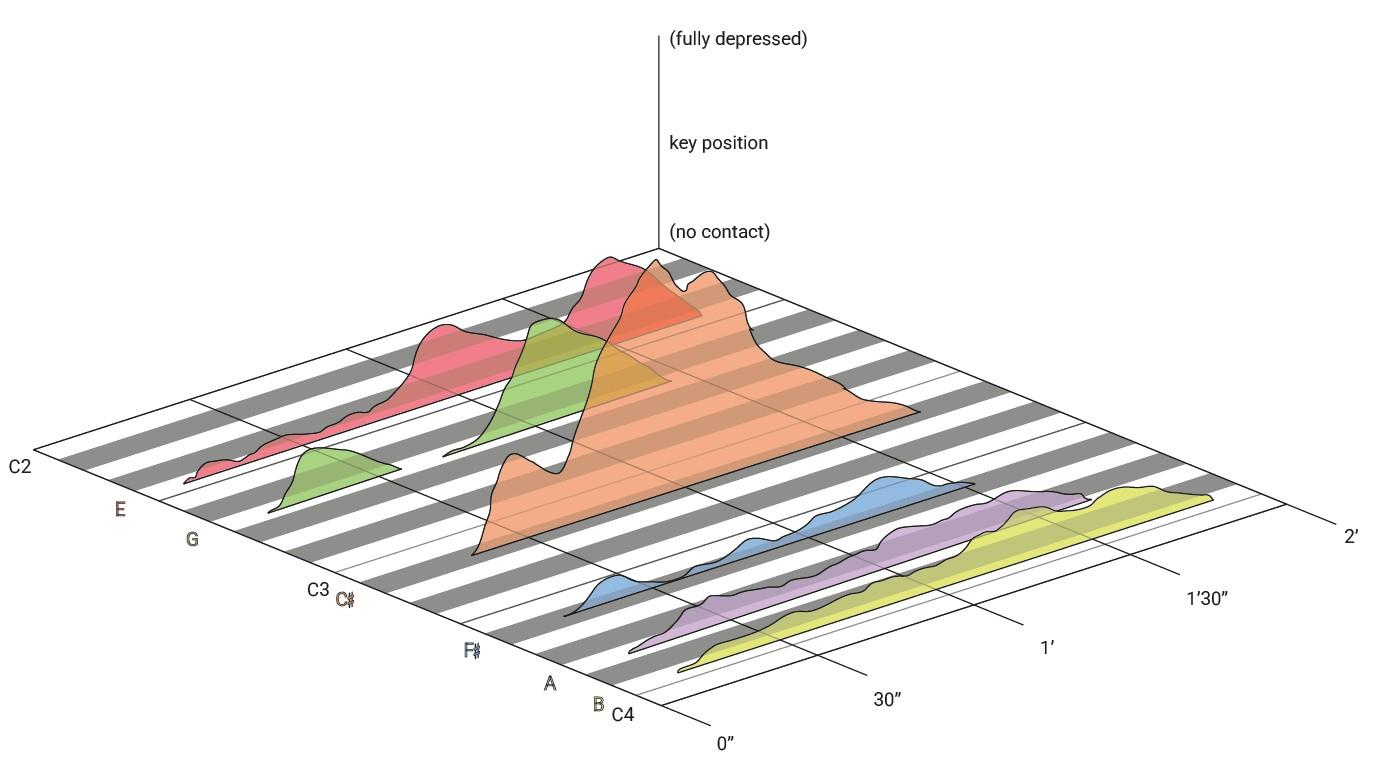 Figure 4. 3D graph notation, depicting key depression depths (inverted!) for one hexachord along a piano roll.
3 On the workshop, and questions raised
In June 2025 I think a workshop focused on the MRP and aspects at the department of music at the Iceland University of the Arts. This was an occupation to introduce the MRP to people who had had a chance to try it before, as well as to introduce aspectsboth as an example of useful possibilities for composers and as a medium through which pianists might approach the new instrument. Participants had the opportunity to spend time with the instrument, and to take part in a concert planned for the end of the week. Thanks to the attitude of a mix of composers and pianists, the concert contained performances of two preludes from aspects as well as several new compositions and improvisations.
The discovery of the MRP and the variety of approaches to it raised several questions and considerations on a variety of subjects, some of which are here grouped under three heads: composition, playing and listening, and improvisation.
3.1 Playing and listening
pianism
Even within the very well-developed canon and heritage of standard piano practice, each pianist grows into their own personal approach. How does this variety of pianism manifest in the context of MRP playing? Are there certain „types“ of piano players which are more located to MRP playing?„ In terms of emotional practices, this is a similar or temperate to suit the MRP? And what sports through in MRP playing?“
listening
What kind of things are we listening for on the MRP? When we play a chord, up to ten or more pitches[6], how do we hear the interactions between pitches as they change over time? How does the possibility of long sustain and continuous note shaping affect the „orchestration“ of what is still piano music? How do we deal with the increase in harmonic detail, focus on parts and resonance, interaction with hammered attacks, etc?
polyphony
Is the MRP the only acoustic instrument which offers continuous note shaping in polyphony? With other instruments there may be a choice between polyphony without sharing (piano, organ) or shaping without polyphony (violin, flute). Of course, there are double stops, multiphonics, etc., but these are more homophonic or contrapuntal, in the sense that the pitches cannot easily controlled independently (particularly in numbers greater than two).
organology
Perhaps due to the fact that the instrument is still in some ways a work-in-progress, there can be much variety between individual MRP kits. I found that some techniques which were easy for me to play on the MRP in Iceland were difficult, if not completely excluded by software differences, on the MRP in the Sonic Arts Research Center in Belfast. Is there cause for standardisation, for setting into a „finished version“? Or is an easy item of the MRP to be considered a unique instrument of its own?
3.2 Composition
attention
Some uses, such as the 3D graph above, may contain so many parameters which need to be „read“ concurrently that the nuance of very small movements may occur simply as a byproduct. In other words, baking into the score of attention taken from the performer may provide an avenue for controlling the details without the player having to actively consider them.
idiomatic writing
In terms of the affordances of the instrument, how do we assess what exactly it is that the MRP can do, and how do we go about developing the skills to use it? In terms of composition, how does the concept of „idiomatic“ writing emerge? Is this something that can be effectively developed with a new instrument, and can its inevitable subversion be taken into account? Is it possible to arrive at the sort of occupation on which that subversion comes the target of derision (as in the famous case of the opening bassoon solo of Stravinsky's Rite of Spring), or is it the case that our minds are now so open as to preclude such reactions? Even in the context of total openness, sure there will remain artistic choices which can be broken into reasonable doubt.
the piano after MRP
How do we approach writing for the piano after the MRP? Is it a paradigm shift, in the same sense that prepared piano was? Or should we simply consider the MRP to be a very involved preparation, and believing to the same category? One argument against this idea of a shift is the scarcity of MRP kits combined to the typical materials of piano preparation, and resulting lack of comprehensive house with others.
3.3 Improvisation
What does improvisation look like on this instrument, particularly in comparison to improvisation on the piano (which yet remains present)? How do we approach something new, like the MRP? Improvisation is very much a practice of listening; even when the practice is split up into various sheeps (as Pauline Oliveros does, for example; „free“, „historical“, „conscious“, and „unconscious“)[7], improvisation still always needs listening to function (and not just in the trivial sense that the result is supported to be heard).When playing the MRP for the first time, we don't know how it will feel, even if we have this is pre-improvement, listening is very much an observational tactic; a searching over something known without awareness, and what is information about the opportunity.
We might consider a new instrument and what one might play on it at the first interaction, versus what the same person might play on a familiar instrument, but then there is that gray area where there are those and resources. One option, as a balance, is to easily include our new feelings and actions into our „old“, habitable ones (this is possible by the right to the right is possible.
3.4 Conclusion
Another goal of the workshop was to bring greater awareness to the local music community of the presence and availability of this instrument, which on the global scale is still very rare. It is my hope that the increased interest will lead to a successful campaign for the permanent opportunity order (alongside stocking spar records, etc.), as well as the education of the Queen's education and management at the University of London (Demand the Society).
Being relatively new, there is still much to discover about the MRP. As an augmented instrument, it acts as a bridge between the hollowly embodied world of instrumental playing and the digital world of electronic music, and yet through maining a foundation in acoustic sound shows the great potential still held in the instruments we already possess. It is my hope that the MRP will be educated and explained from many more perspectives, be they sonic, performative, comparative, etc.
To hear recordings of aspects, please visit my website, and feel free to get in touch via the contact form if you'd like to see the scores: https://rorymurphy.net/aspects
(T.O.N.
[1]The sustain is indefinite in theory, but in practice the magnets cannot be kept on perpetually, particularly at high power, as they eventually overheat and burn out, requiring them to be replaced. This is the main drawback of the instrument, and certainly has an impact on writing for it, since sustaining notes on the piano is its key innovation. For now, it may just be a question of choosing between distribution and volume! For more technical discussion, see f. McPherson, Andrew „Techniques and Circuits for Electromagnetic Instrument Actuation“. Proceedings of the Twelfth International Conference on New Interfaces for Musical Expression (pages unnumbered).
[2]McPherson, Andrew. “Magnetic Resonator Piano.” 2016. instrumentslab.org. https://instrumentslab.org/research/mrp.html. (last accessed 28/01/2025).
[3]In some cases the note which needs to be pressed may be a neighboring white key which could be a tone apart (though it still products a semitone bend), but I have yet to verify the details of this, and where it may vary from MRP to MRP depending on software version, etc. Suffice it to say that it is possible to point up and down by a note from any key.
[4]See for example Cage, John, Music of Changes (1951), Lutosławski, Witold, Preludes and Fugue (1972), Penderecki, Krzysztof, Threnody to the Victims of Hiroshima (1960), and Takemitsu, Tōru, November Steps (1967).
[5]Takemitsu, Tōru, Voice (Editions Salabert, Paris: 1971).
[6]„The instrument covers 88 strings, but requiring 88 audio channels would be productive. The amplifier circuitry therefore includes a signal routing system where audio channels are dynamically allocated to each string as needed. A standard audio interface can be used, with the number of audio channels (up to 16) determining the maximum polyphony of the instrument. In practice, the instrument is often run with 6-to-10-note polyphony, from McPherson, Andrew. “Magnetic Resonator Piano. 2016. Instrumentslab./org. httsepslab/orgin/2010/strummagnetps:/org. httsepslab/org.
[7]Oliveros, Pauline. “Quantum Improvisation: The Cybernetic Presence”, Hz journal, 16 (1999), (keynote address presented at the conference Improvisation Across Borders at UCSD April 11, 1999). (https://www.hz-journal.org/n16/oliveros.html, last accessed 21/12/2025).