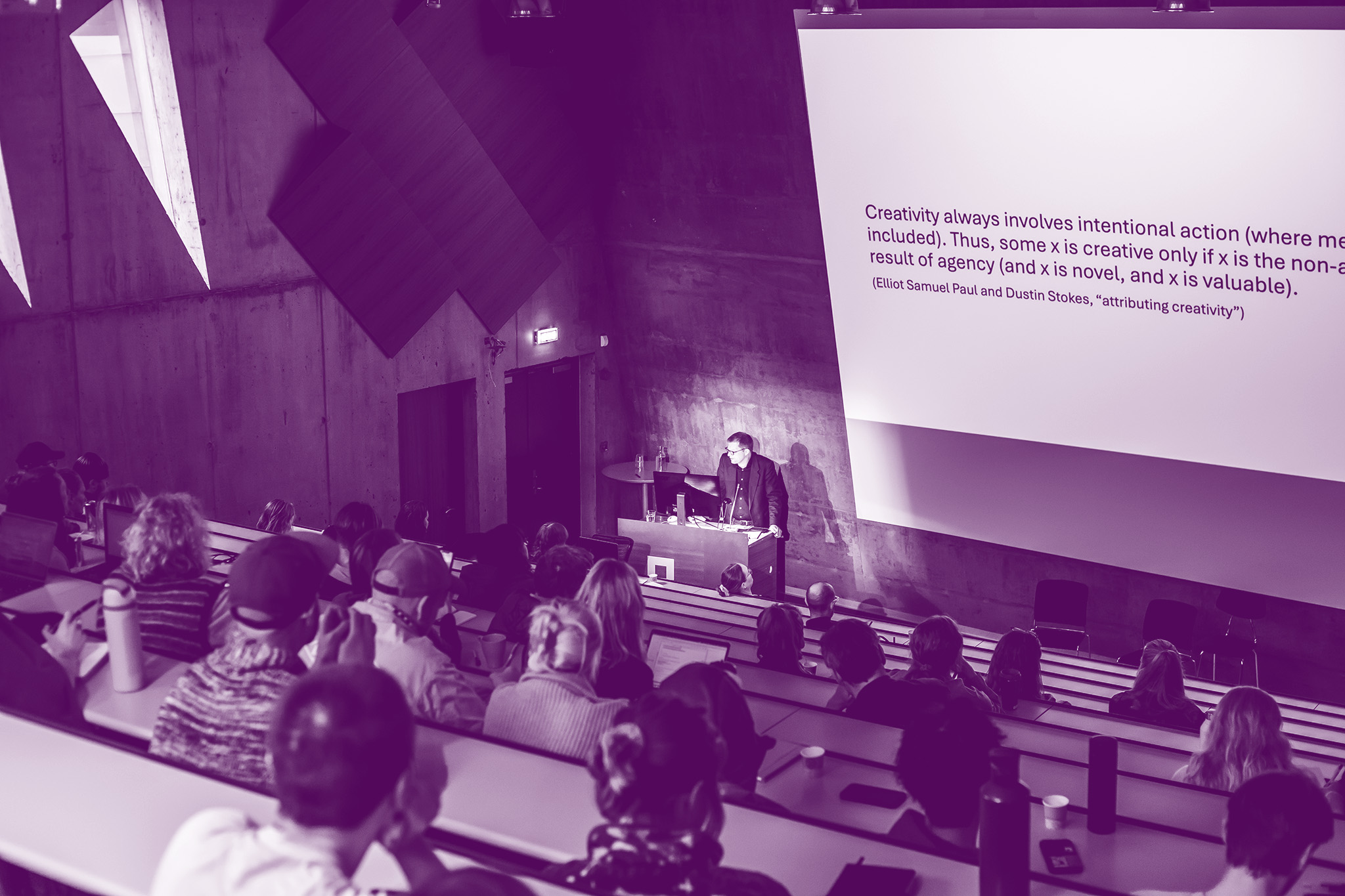
2026 Hugarflug
9- 11 September 2026
Sensing the world
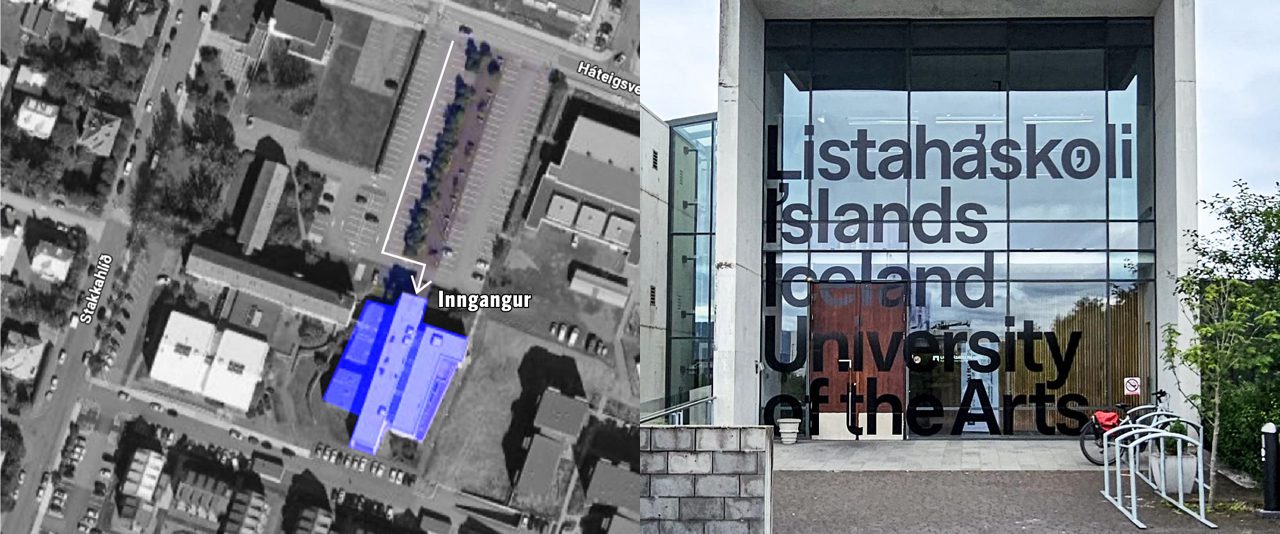
Hugarflug, the annual conference of the Iceland Academy of the Arts will be held for the fifteenth time on September 9 - 11 next year in the school's premises at Stakkahlíð 1. The conference is a forum for open, professional and critical discussion about arts, design, architecture and art education, and their relationship with other fields and professions.
This time we focus on the world of perception How do we relate to our own perceptions and the world around us? Today, it is easy to become disconnected not only from the environment but also from people who experience the world in a different way than ourselves By paying attention to our perceptions, slowing down and creating spaces for diverse experiences, opening up new ways of knowledge creation and deeper connections to the world Research in the arts is a platform to explore this diversity, ask critical questions, and develop strategies that lead to new knowledge and perspectives.
Perception is never uniform; it is complex, shaped by context and affects our communication.
Key speakers at Hugarflugi 2026 are Mette Edvardsen, stage artist, choreographer, and doctoral candidate in arts at the University of the Arts in Oslo, and Hildur Hákonardóttir, visual artist and writer, who has taken on contemporary issues for a long career at any given time, not least environmental and equality issues.
Sensing the world
Sensing the World at Hugarflug 2026. The 15th annual conference of the Iceland University of the Arts will take place on September 9th - 11th at the University's premisses in Stakkahlíð 1 in Reykjavík.
Hugarflug is a forum for open, professional and critical dialogue on art, design, architecture and arts education, and their interaction with related (and unrelated) fields. This year's theme invites reflection on perception as a dynamic and multifaceted experience.
In an era where disconnection from our own senses, and from those who perform the world differently, is increasingly common, how can we re-engage with perception? By slowing down, paying attention, and creating space for diverse sensory experiences, we open new pathways for knowledge creation and deeper connections with the world. Artistic research offers a unique platform to explore this diversity, pose critical questions, and develop methods that lead to news and perspectives.
Art, design, and architecture remind us that perception is never uniform; it is shaped by context, diversity, and interaction.
Hugarflug 2026 is proud to present keynote speakers Mette Edvardsen, performer, choreographer, and PhD candidate at the Oslo National Academy of the Arts, and Hildur Hákonardóttir, visual artist and writer whom pioneering engagement with contemporary issues and gender politics has produced works that stand as significant landmark in Icelandic cultural history and have contributed to broad social change..
Program / Program →
Here is information about Hugarflug's previous conferences.
2025 brainstorming
Brainstorming annual conference on artistic research
September 11th - 12th 2025
2024 brainstorming
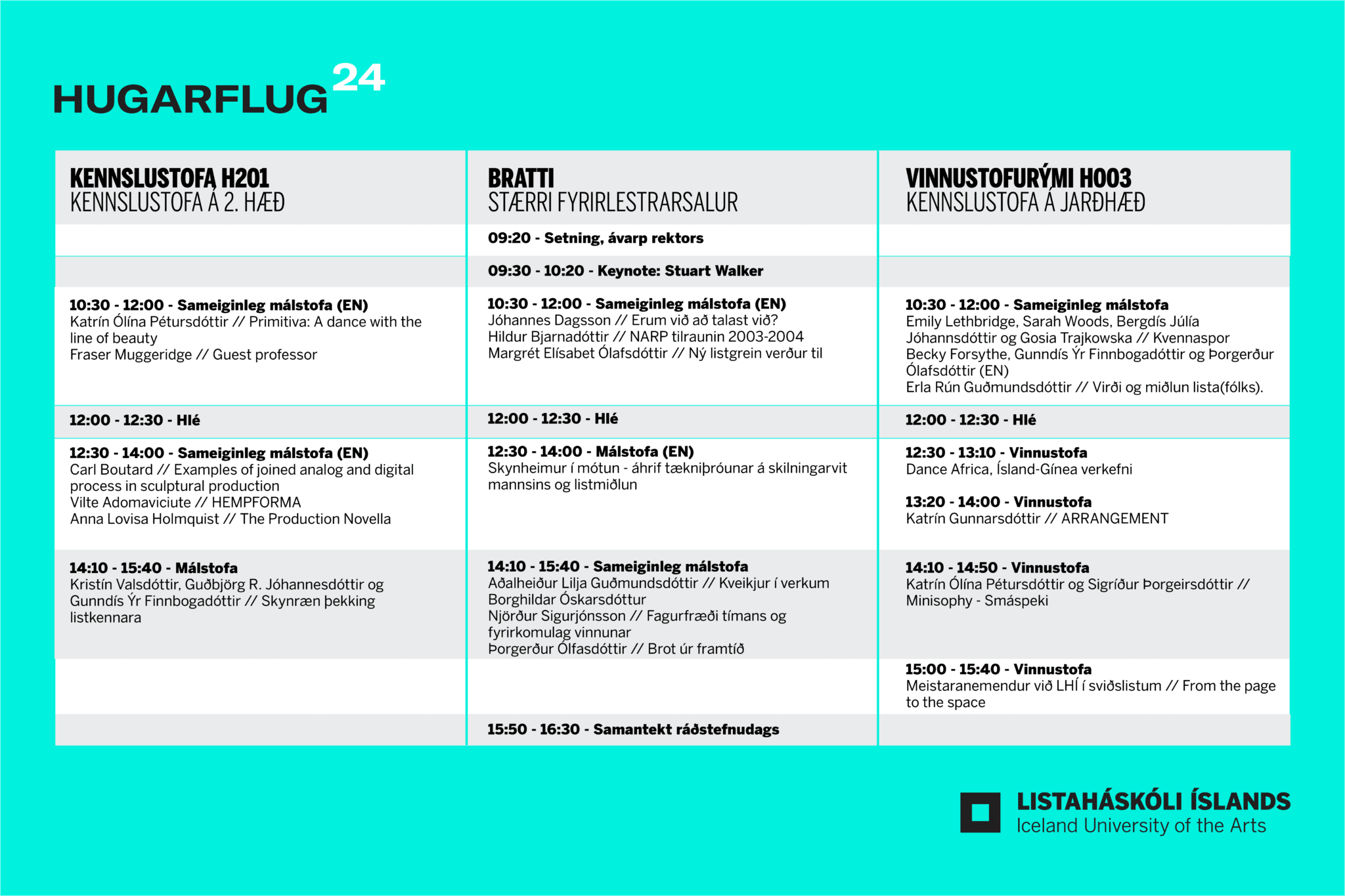
Art Research: The Sensory Knowledge
See English below
The researchers are increasingly focusing their attention on artists and how they approach their subjectsThe insight and the creative thinking that artistic creation requires has proven to be an effective addition to the standard methods of physical science Artists are curious individuals who apply critical and interdisciplinary thinking to solutions to complex problems Often, that skill has evolved from an early age Art research therefore has value far beyond the obvious aesthetic elements.
Despite this, there seems to be a lack of understanding and dialogue with the research environment The purpose of Hugarflugi 2024 is to find out what lies behind it. Is there a lack of common language? Are artists' research methods too different from the traditional ways to be taken seriously? Could the results of art research be communicated in a different way than is done, or is quality at times simply lacking?
We open the discussion with the aim of answering the above questions. The Iceland Academy of the Arts is calling here for proposals of any kind, presentations of research that are ongoing or have been carried out by our staff, students and/or partners. In this way, we hope to produce a “ screen shot of our research culture that can be discussed between us, but no less with representatives of today's broad research environment. The clear visitor's eye is, as it is a valuable contribution to the development of research within the Iceland Academy of the Arts for the future.
Hugarflug 2024 will be held in Hamri, Stakkahlíð 1, the premises of LHÍ on September 13.
2024 Brainstorming Committee
Ása Helga Hjörleifsdóttir
Carl Boutard
Ingimar Ólafsson Waage
Katrín Ólína Pétursdóttir
Peter Jónasson
Sahar Ghaderi
Elín Þórhallsdóttir
Artistic Research: The Tacit Knowledge
The creative insight of artists is increasingly engaging the attention of the well-being research arena. Artists’ divergent thinking (ie imaginative, open ended) has been showing to add a new, beneficial dimension to problem solving which has mostly been done in the hands of conversent thinkers (ie logical, analytical). But the artist is also important to see that there is definitely important, almost really important, especially important and important.
Still, there seems to be a lack of understanding between these different research communities. The overarching question Brainstorming 2024 sees to answer is: why? Is it a lack of common terminology? Are the methods of investigation used by artists too different from the more traditional ways of performing research to be taken seriously? Are artists' means of dissemination not clear enough, or is it even a simple question of quality?
In order to answer the above questions, we want to open the field to wide discussion. The Iceland University of the Arts calls for research topics of any kind being performed3⁄4or having been performed3⁄4by our staff, students and collaborators. The aim is to provide a snapshot of our research output and to sit down and talk, not only between our products but not least with results of the result with experience of the well-reported community who will be informed to the discussion, providing a valid „guest's eye“ It is such a truly open call.
2023 brainstorming
Hugarflug
The brainstorming research conference of the Iceland Academy of the Arts will be held on February 9 and 10.
The theme of this year's conference is: Multiple futures, where the challenges we face and will shape the future will be considered.
Contributors include key speaker philosopher Philip Kitcher who discusses the role of art in enriching human experience and making it easier for us to throw anger at ourselves, our world and life.
Other participants come from across and represent diverse arts and disciplines that offer interdisciplinary seminars, workshops, lectures and video installations Papers deal with artificial intelligence in artistic creation, diverse communication methods in art education, the home office based on architecture, a staff study in music and interesting roundtable discussions where we can dream together about the future, but discussions are moderated by people aged 13-18.
The conference is held on Friday, February 10 at LHÍ, Laugarnesvegi 91, 105 Reykjavík. Starts the program at 9:00 and lasts until 17:00, admission is open and free to everyone.
Hugarflug's opening ceremony will be at 17:00-18:00 on Thursday, February 9 at Y Gallerí in Hamraborg 12, 200 Kópavogur, where a group of contemporary dancers shake us up with Februar Idea Dump and we listen to a talk about Hamraborg Deammachine, which explores the future and past of this urban landscape in a dreamy way. The event is open and free to everyone.
2022 brainstorming
We stand at the turning point of various challenges of climate change, pandemic, rights struggle and also war disaster in Europe with Russia's invasion of Ukraine These are truly open-minded times but we seek to analyze the situation and what the future holds. What we face is the urgent need to nurture our communities, nourish the core values that matter most in the lives of the whole and of each individual How do we best ensure solidarity against tyranny and for peace and justice? What are those values, how do we continue, together, into the future we don't know who we are; the nature and species that together create the ecosystem we live in? How do we co-create, a world that keeps track of everyone?
At the Iceland Academy of the Arts' 2022 Brainstorming session, we want to discuss how each person is part of a whole, sometimes many wholes. How each experience and action is tied to a larger context. How we flow, instead of standing firm; how we connect as a whole, rather than standing alone; how we face the possibility that none of us can come up with a solution, but rather it lies in the collective power, now and for the future.
Collective Care is the theme of Hugarflug 2022.
The key speaker of the council is Sonya Lindfors
Black Hall: 2pm-3pm,
The title of her talk is: Attempting the impossible - decolonial dreaming practices
How to dream of futures that we don't know yet how to dream of? Well, as Afrofuturist Sun Ra once said: „The possible has been tried and failed. Now it is time to try the impossible.“
Radical dreaming can be a powerful tool to reimagine intersectional feminist and decolonial futures - as well as presents. In her mini talk choreographer Sonya Lindfors talks about the power of speculation, dreams, responsibilities and the decolonial dreaming project We Should All Be Dreaming.
Sonya Lindfors is a choreographer from Cameroon and Finland and has made a name for herself both in the Nordic countries and elsewhere for her choreography and writing, but also as the artistic director of UrbanApa, an anti-racist and intertwined feminist art institution in Helsinki Her work centers questions about the politics of the black body, manifestations and power structures, possible futures and deconstructive decolonial dreams practices/creating a space that allows people to dream new ways of living.
2021 brainstorming
THE THEME IS: TURNING POINT - TURNING POINT
Hugarflug is a platform for open, professional and critical discussion about arts, design, and architecture; about knowledge creation in the wide field of art and their overlap with other fields of study, with an emphasis on the diversity that characterizes the approaches, methods, topics, communication and research that are applied there.
We stand at a turning point in history that requires us to reflect on the role and importance of the arts in the re-creation of societies following major world events such as those we live in now There are challenging challenges ahead in climate and environmental issues, the circular economy, democratic empowerment and social structure How can we respond to these challenges and challenges in the field of art? How do we begin to understand and respond to the profound changes in our environment that we face? How do we use the ideological renewal that is an important part of artistic creation, our environment and society for the good of our arts? How have the arts responded to such challenges in history?
One of the main goals of the conference is to offer a safe space for peers where it is safe to ask open questions, conduct experiments and present projects in progress Staff, students and part-time teachers of the University of the Arts, and other working artists, designers, architects and academics are encouraged to submit proposals.
As the conference becomes electronic, we encourage participants to take advantage of diverse methods, media and approaches to digitally find their contribution the appropriate framework and form Contributions could, for example, take on a material or visual form (exhibition, installation, graphic communication), be staged (performance, performance, intervention) or presented in theory (lecture, Pecha Kucha, self-interview/conversation form, round table discussion, seminar, workshop) Apart from papers and seminars that will be broadcast by LHÍ, only finished proposals such as videos, audio, photographs, text and/or other presentations of art research, art creation, design and architecture will be received.
Conference Committee:
Hanna Styrmisdóttir (chairman)
Atli Ingólfsson
Ásgerður Roberts Gunnarsdóttir
Gunndís Yr Finnbogadóttir
Hildigunn Sverrisdóttir
Magnea Einarsdóttir
Karólína Stefánsdóttir (project manager)
The conference will take place electronically on the 8th-14th. February 2021
//
2021 brainstorming:
The theme is: Turning point - Turning Point
The conference is a platform for an open, informed and critical dialogue on the arts, architecture and design; on knowledge production in the expanded field of the arts as well as their intersections with other fields. Emphasis is placed on the diversity of the approaches, methods, discussion, and research that characteristics the field.
We stand at a turning point in history which requirements that we critically reflect on the role and value of the arts in building societies and communities in the wake of current major world events. Head of us are challenging challenges in relation to the climate and environment? How can we make use of ideological renewal, what is meeting in the environment?
One of the main objects of the conference is to offer a safe space for people to ask open questions, performance experiments and present works in progress. Staff, students, and part-time lecturers at the Iceland University of the Arts (IUA), as well as other practicing artists, designers, architects and scholars are engaged to respond to the call.
As the conference will take place as an online event, we encourage participants to use diverse methods, media, and approaches to find the appropriate form for their digital contributions. As an example, a contribution could take on a material or visual form (exhibition, graphic dissemination), a staged form (performance, intervention), or a verbal form (paper presentation, Pecha Kucha, auto-interview, panel discussion, seminar, workshop, Apart from paper presentations and seminars, which will be streamed by the IUA, we will only developed control, communication and photography, text.
The conference will take place online 8.-14. February, 2021.
Conference Committee:
Hanna Styrmisdóttir (chair)
Atli Ingólfsson
Ásgerður Roberts Gunnarsdóttir
Gunndís Yr Finnbogadóttir
Hildigunn Sverrisdóttir
Magnea Einarsdóttir
Karólína Stefánsdóttir (project manager)
2020 brainstorming
Brainstorming on February 13 and 14, 2020
Hugarflug, the annual conference of the University of the Arts, is now taking place for the ninth time, and this time there was a call for talks regarding the subject narratives.
The conference is a forum for staff, students and others who engage in creativity and research in the academic fields of art or in their close proximity to meet and ask questions, experiment and present their projects The intention is to facilitate the possibility of collaboration across different fields and plough the field for new connections and dialogue.
Numerous good proposals were received by the conference committee, and we were particularly pleased to receive many good proposals from the arts and academics working outside the University of the Arts, as dialogue outside the university is an essential part of the work that takes place here.
As you can see in the program of the conference, the seminars are characterized by diverse perspectives on the nature and mission of stories in history and contemporary times. Among the topics discussed are the arrival of polar bears in the country and the history of Icelandic jazz music, the support system of the market, equality and diversity at the level of university work, to name just a few.
The key speakers at the conference are Hildur Guðnadóttir and Egill Sæbjörnsson, who have each attracted a lot of attention for their use of the narrative possibilities of art. The special guest of the conference is Goddur, Guðmundur Oddur Magnússon, a research professor at the Iceland Academy of the Arts who is currently putting the finishing touches on an extensive study of the visual narrative heritage of the Icelandic people.
There is obviously a lot to take in and we encourage guests to familiarize themselves with the program while we warmly welcome you to Hugarflug 2020.
Sincerely, the conference committee,
Martin Sindri Jónsson
Chairman of committee and adjunct professor in the Department of Design and Architecture
Ásgerður G. Gunnarsdóttir
Lecturer and professional director in the Faculty of Performing Arts
Ingimar Ólafsson Waage
Lecturer and professional director in the art education department
Jesper Pedersen
Adjunct professor in the music department
Páll Haukur Björnsson
Adjunct professor in the Faculty of Fine Arts
Ólöf Hugrún Valdimarsdóttir
Hugarflug's project manager
The conference will take place in the premises of the University of the Arts at Laugarnesvegi 91 on Thursday, February 13 and Friday, 14, 2020.
Registration is unnecessary and everyone is welcome.
KEYNOTE SPEAKERS
Hildur Guðnadóttir
Egill Sæbjörnsson
SPECIAL GUEST
Guðmundur Oddur Magnússon-Goddur
2019 brainstorming
Brainstorming 15 - 16 February 2019
Hugarflug is an annual conference of the University of the Arts held for the eighth time in 2019. the conference is a forum for staff, students and others who conduct research in the academic field of art or related fields to meet and ask questions, experiment and present their projects. The intention is thus to create conditions for new connections and conversations to take place, and new possibilities for collaboration between different fields to open up.
In 2019, the conference was larger than in previous years and covered two days, but there were special calls for content related to the theme of body/physicality.
A large number of good proposals were received and it was especially gratifying how many proposals were received from working art and academics working in different arenas outside the Academy of Arts, but conversation outside the school is a very important part of the work that takes place there.
The theme of Hugarflug in 2019, body/physicality provided an opportunity to examine and reflect on many different threads that call for increased space in the present.
Questions like what is the relationship between animals, plants and humans? What is the relationship between the body and technology? What is the relationship between the inner and outer perception of the body? become more and more urgent and call for attention.
Research in the field of art has focused its attention on these threads to an increasing extent, and it can be said that such research is precisely often characterized by working with the body, physicality and the knowledge that resides in the body in a direct way than other fields of study. The body places us in the world and gives us access to understanding and perceiving the situations we are in at any given time. It can be said that it is precisely this understanding and perception that the arts focus their attention most on, thus creating an opportunity to create a conversation, both inwardly within each observer/hearer and outwardly into society as a whole.
It was precisely this special status of art research that the participants in Hugarflugi had the opportunity to get to know in the diverse forms of dialogue that the program offered.
The conference took place in the premises of the University of the Arts at Laugarnesvegi on the 91st. Registration was unnecessary and the conference was open to everyone.
Key speakers
Sigríður Þorgeirsdóttir
Rebecca Hilton
Conference Committee:
Guðbjörg R. Jóhannesdóttir
Ásgerður Gunnarsdóttir
Berglind María Tómasdóttir
Garðar Eyjólfsson
Hildur Bjarnadóttir
Páll Haukur Björnsson
Project manager: Ólöf Hugrún Valdimarsdóttir
Supervision of artistic installation: Ástríður Jónsdóttir
2018 brainstorming
Brainstorming 8 - 9 February 2018
Hugarflug is the annual conference of the University of the Arts on research in the field of art and was held for the seventh time in 2018. the conference creates a platform for professional and critical discussion about knowledge creation in the arts and culture, with an emphasis on the diversity that characterizes approach, methods, content and communication in the field. One of the main goals of the conference is to offer a safe space for peers where it is safe to ask open questions, conduct experiments and present unfinished research results.
The 2018 brainstorming was primarily about how to create a platform that truly reflects the subjects of the school's staff and students, but no less those working in the field of art and design Thus, the conference had no theme this time and no title Instead, efforts were made to make the conference a multidisciplinary platform for art and design, encouraging teachers, students and working artists and designers to share their questions, knowledge and practice, and interweaving them with each other.
The conference took place in the premises of the school's art education and art departments, Laugarnesvegi 91, Reykjavík.
Conference Committee
Alexander Roberts, Chair, Department of Performing Arts
Bjarki Bragason, Faculty of Fine Arts
Gunndís Ýr Finnbogadóttir, art education department
Thomas Pausz, Department of Design and Architecture
Þorbjörg Daphne Hall, music department
Hugarflug's project manager is Ólöf Hugrún Valdimarsdóttir
2017 brainstorming
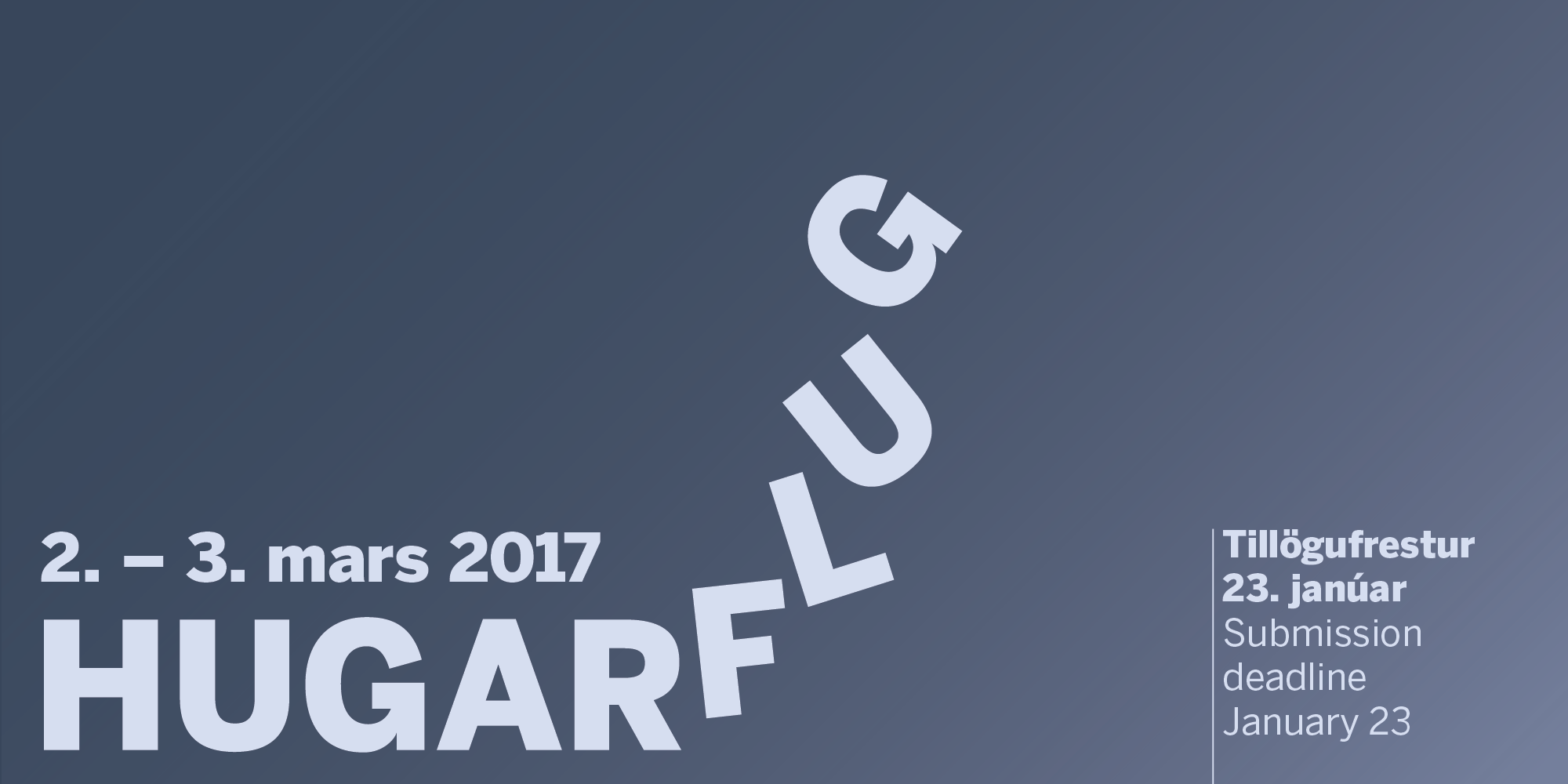
Hugarflug is the annual conference of the University of the Arts on research in the field of art and was held for the sixth time in 2017. Hugarflug's theme in 2017 was „minor“" Over 50 artists, designers and academics discussed memory from diverse perspectives in 16 seminars, as well as the artistic program made a strong impression on the conference.
The conference creates a platform for professional and critical discussion of knowledge creation in the arts and culture, focusing on the diversity that characterizes approach, methods, content and communication in the field One of the main goals of the conference is to offer a safe space for peers where it is safe to ask open questions, conduct experiments and present unfinished research results.
Conference Committee /Conference Committee:
Alexander G. Roberts, Assistant Professor of the Department of Performing Arts
Berglind María Tómasdóttir, associate professor of music department
Bjarki Bragason, lecturer in the art department
Gunndís Ýr Finnbogadóttir, assistant art education department
Ólöf Gerður Sigfúsdóttir, stage manager
Ragnheiður Sigurðard Bjarnarson, MA student
Thomas Pausz, Adjunct Faculty of Design and Architecture
Hugarflug's project manager: Ólöf Hugrún Valdimarsdóttir
The conference took place in the premises of the school's art education and art departments, Laugarnesvegi 91, Reykjavík.
2016 brainstorming
(English below)
Hugarflug is the annual conference of the University of the Arts and will now be held for the fifth time. The aim of the conference is to create a platform for professional and critical discussion about knowledge creation with an emphasis on art research and the diversity that characterizes approach, methods, content and communication in the field.
Hugarflug offers opportunities for networking in the academic context of the creative industries and brings together the school's employees, students, part-time teachers and working artists, designers, curators, artistic directors and academics in the fields of culture, art and education.
This year, the program is particularly auspicious, but 18 seminars, performances, workshops and joint discussions will take place on Friday, February 19. On Thursday, February 18, we invite Rolf Hughes, professor at the University of the Arts in Stockholm, together with a panel discussion with Friða Björk Ingvarsdóttir, rector of the University of the Arts.
The conference will take place in the premises of the art education department and the art department, Laugarnesvegi 91.
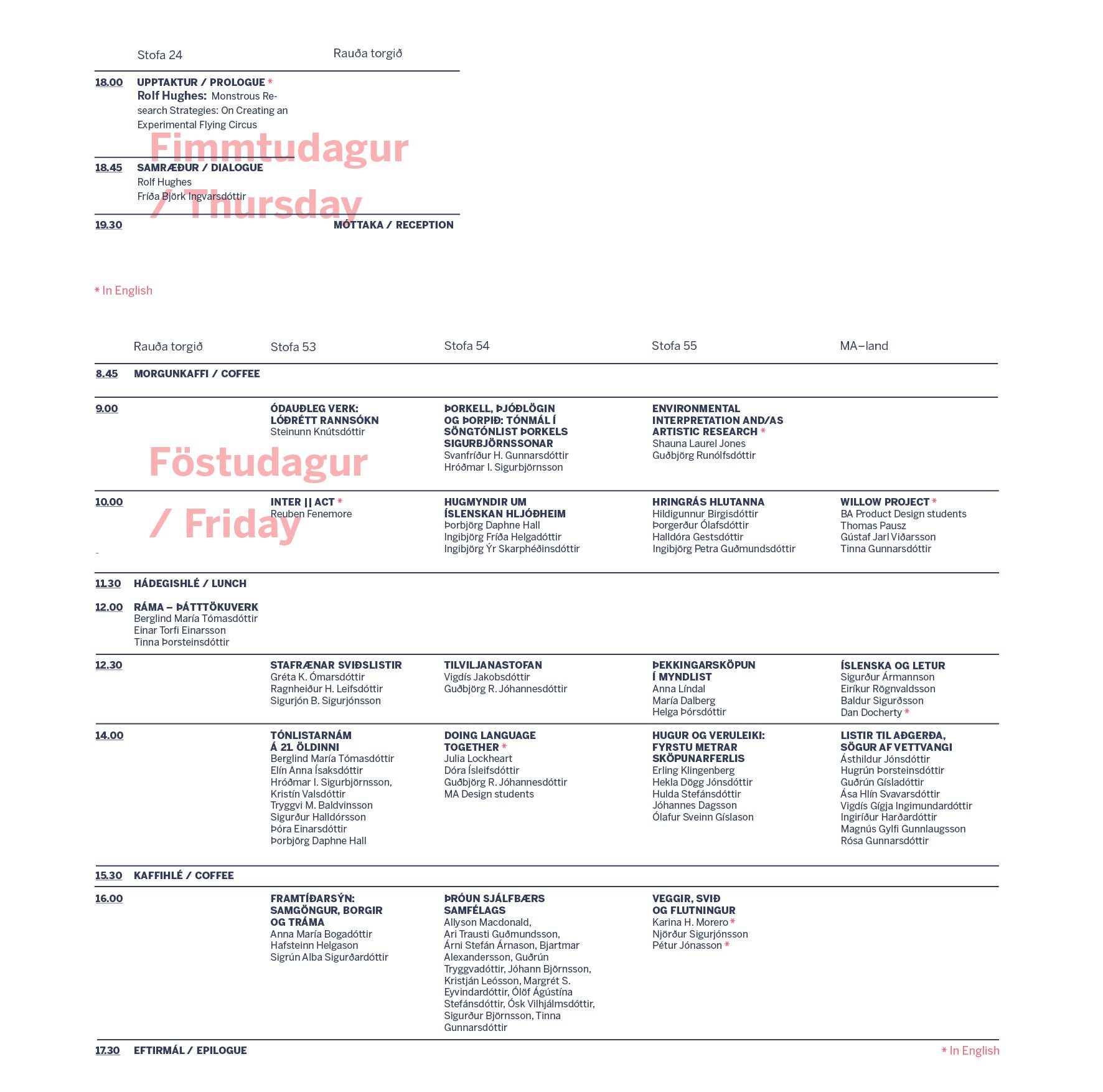
KEYNOTE:
ROLF HUGHES: MONSTROUS RESEARCH STRATEGIES: ON CREATING AN EXPERIMENTAL FLYING CIRCUS
This presentation yes together different research traditions to explore monstrousness as a research strategy that spans conferences of scientific and artistic research traditions to create a hybrid research. They are also most appropriate through my own artistic practice with the potential and responsible within the collective.
Monsters residence identity, genre, discipline - i.e. categories that make claims on authority. Monstrousness is the site of experimentation, where certainties are torn apart and stitched together in new forms. One such site of experimentation is my current endeavor to bring together the nascent field of circus arts research with the established field of space research.
Circus arts research is a space of radical transformation, a theater of becoming, full of magic and organization. It subverts the tools of assessment applied to other research and demands new applications. The scientific spaces such as tent, big top or street are now joined by other spaces that foreign sheep of but is responsible, and responsible for animals, and events to meet such animals, and events to meet such animals, and events to meet such animals, and events to meet such animals.
One such site of monster experimentation is starship Persephone. It takes the form of an experimental environment in which the nature of life itself is being choreographed into existence through the interactions of its bodies, spaces and the many potential relationships between them. Persephone's laboratory is a living body produced by countless prototypes and relationships between human beings and claims that research or research institutions. It is an instrument of radical research. These conditions and research.
Persephone's principal investigator, Rachel Armstrong, Professor of Experimental Architecture at Newcastle University School of Architecture, and Rolf Hughes, Head of Research at the newly created Stockholm University of the Arts, are working together to explore monstrous methods and materials, and how these might contract to the creation of a third millennium experimental research laboratory. My
presentation will outline work so far and how a paradigm of monstrousness is at the core of the project's design-led research.
Rolf Hughes Bio (2015)
A prose poet and disciplinary nomad, Hughes has been actively promoting innovative forms of artistic and transdisciplinary research over the past twenty years.
Hughes is Head of Research and Professor of Artistic Research at Stockholm University of the Arts (inaugurated 2014).He has been expert advisor for artistic research at the Swedish Research Council, the Norwegian Artistic Research Programme, and the Austrian Programme for Arts-based Research (PEEK); Guest Professor in Design Theory and Practice-Based Research at Konstfack University College of Arts, Crafts and Design (2006-2014); Senior Professor in Research Design at Sint-Lucas School of Architecture (KU-Leuven, Belgium), where helped create and develop an international, design-led PhD. program (2007-2013). He has also presented by the Sector-2013, (2007-2013). He has also presented as an international research society for the S.
Hughes holds a First Class degree in English and Related Literature (University of York), an MA (with Distribution) in Creative Writing and the first ever PhD. in Creative and Critical Writing found by the British Academy from the University of East Anglia, UK. He is currently exploring the potential contribution of magic and the circus arts to the conception and design of a third millennium experimental research laboratory Writing and theatre remain central to his endeavour to link diverse forms of experience, expert, and knowledge.
Conference Committee
Dr. Berglind María Tómasdóttir, assistant professor and professional director at the music department
Dr. Einar Torfi Einarsson, assistant professor at the music department
Dr. Guðbjörg R. Jóhannesdóttir, assistant professor at the design and architecture department and the art education department
María Dalberg, MA student in art
Ólöf Gerður Sigfúsdóttir, director of research services
Tinna Gunnarsdóttir, assistant professor at the Department of Design and Architecture
2015 brainstorming
2014 brainstorming
2013 brainstorming
2012 brainstorming
Conference on the relationship between artistic creation and research
Questions on this topic?
Contact the school office and we will send the inquiry to the correct department or department.