Decor overlay

Praxis, the performing arts congress of the Iceland Academy of the Arts, will be held for the second time on Saturday, March 29, 2025. the Congress is a forum for artistic experimentation, knowledge creation and conversation between the professional forum and the university community Thus, the Congress is a place for the performing arts scene to come together and share methods, research, and think together for the future. 

PRAXIS 2025

//English below.

Praxis, the performing arts congress of the Iceland Academy of the Arts, will be held for the second time on Saturday, March 29, 2025. The Congress is a platform for artistic experimentation, knowledge creation, and conversation between the professional forum and the university community Thus, the Congress is a place for the performing arts scene to come together and share methods, research, and think together for the future.

The theme of Praxis 2025 is Directors on Direction - What/How/Why. The main speaker of the parliament is Saana Lavaste, professor of directing at Uniarts Helsinki, the title of her talk Creating three-level situations: The stage, the show and the training process.

The session begins with the opening and presentation of the Red Square on the first floor of LHÍ Laugarnes, and the program begins as a result. Each event lasts 45 minutes and short breaks are expected in between. Coffee and light refreshments will be served.

Praxis is held in the premises of the Iceland Academy of the Arts at Laugarnesvegi 91, 105 Reykjavík. Free admission and all welcome. REGISTRATION HERE.
——-

Program:

11:30-12:00 - Opening and coffee/chat

Lecture hall L193:
12:00-13:00 - Saana Lavaste - Creating the three-level situation: The scene, the performance and the production process
13:00-13:45 - Hallveig Kristín Eiríksdóttir - How Can We Play Together?
14:00-14:45 - Steinunn Knúts-Önnudóttir - The sustainable director - consider the existential sustainability of performing artists
15:00-15:45 - Kevin Kuhlke - When the How is the What in service of the Why
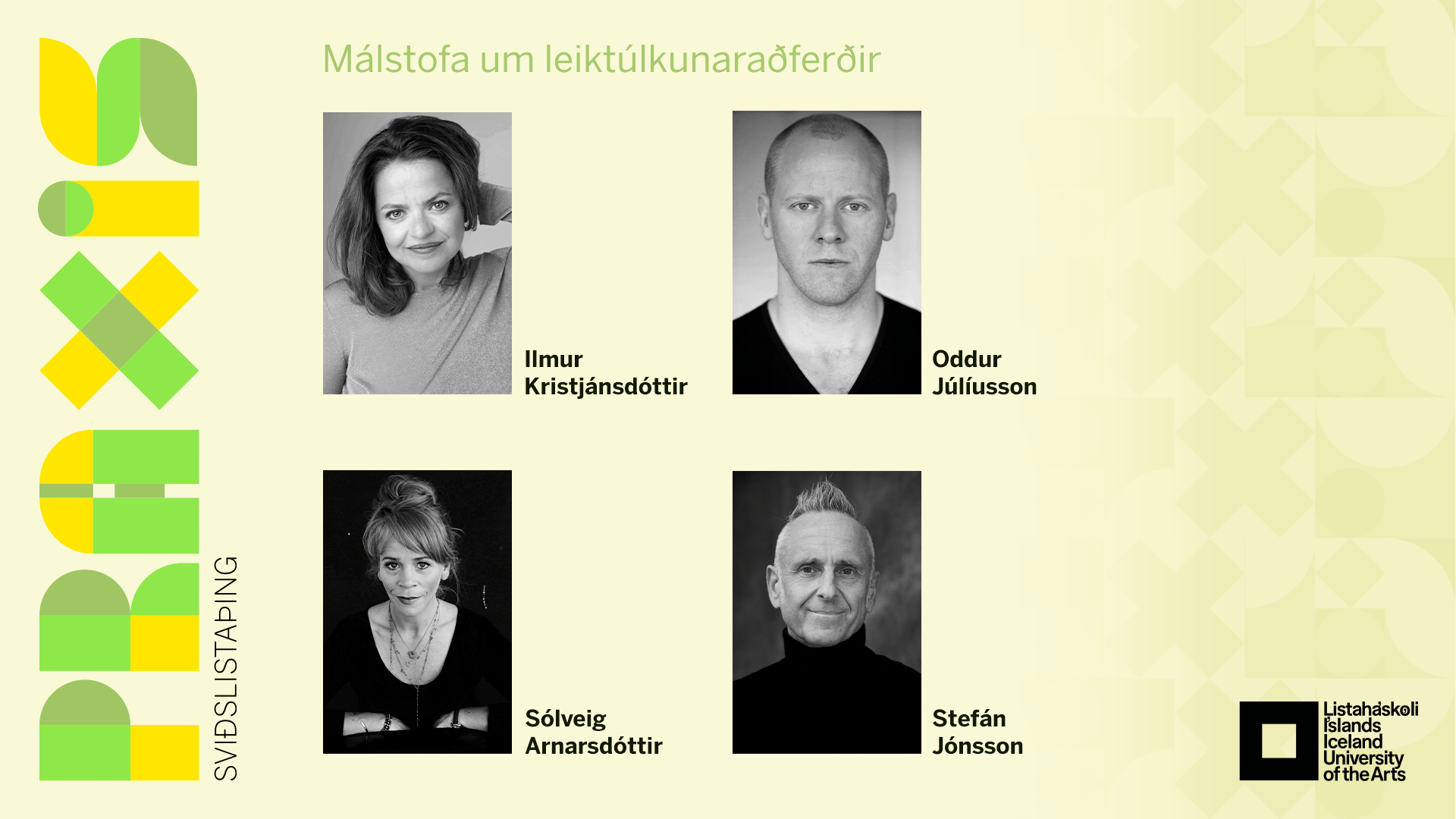
16:00-17:00 - Panel: Do I need to prepare? - Adolf Smári Unnarsson, Egill Pálsson, Gréta Kristín Ómarsdóttir, Saana Lavaste & Una Þorleifsdóttir.

17:00-17:30 - Closure and coffee/talk


Praxis, Iceland University of the Arts’ Performing Arts Symposium, will be held for the second time Saturday March 29th, 2025. The symposium is a platform for artistic experiments, knowledge creation and dialogue between the performing arts scene and the academia. Thus, the symposium becomes a place for the Icelandic performing arts scene to come together, share methods and/or research, and look towards the future.

The theme of Praxis 2025 is Directors on Directing - What / How / Why. The keynote speaker of the symposium is Saana Lavaste, Professor of Directing at Uniarts Helsinki, whose talk is titled Creating the three-level situation: The scene, the performance and the production process.

The program begins with an opening on the Red Square on the first floor at IUA Laugarnes, after which the program begins. Each lecture is approximately 45 minutes, followed by a short break where coffee and light snacks will be served.

Praxis will take place at Iceland University of the Arts, Laugarnesvegur 91, 105 Reykjavík. Free admission and everyone is welcome. REGISTER HERE.

Schedule:

11:30-12:00 - Opening & coffee/talk

Lecture hall L193:
12:00-13:00 - Saana Lavaste - Creating the three-level situation: The scene, the performance and the production process
13:00-13:45 - Hallveig Kristín Eiríksdóttir - How Can We Play Together?
14:00-14:45 - Steinunn Knúts-Önnudóttir - The Sustainable Director - Considering Existential Sustainability in the Performing Arts
15:00-15:45 - Kevin Kuhlke - When the How is the What in service of the Why
16:00-17:00 - Panel: Do I need to be prepared? - Adolf Smári Unnarsson, Egill Pálsson, Gréta Kristín Ómarsdóttir, Saana Lavaste & Una Þorleifsdóttir.

17:00-17:30 - Closing & coffee/talk

  • Creating the three-level situation: The scene, the performance and the production process

    Saana Lavaste

    Saana Lavaste, professor of directing at Uniarts, Helsinki, is Praxis's 2025 keynote speaker Her talk, entitled Creating three-level conditions: The stage, the show and the training process, assumes the idea that the director's job is to define the situation as a starting point for the artistic process of a working group. 

    If dramatic situations are defined based on the six questions (Who, What, Where, When, How and Why), how does the director answer these questions at three different stages of the work? 

    How could the same artistic vision be interpreted at all three levels, as well as in the production process? 

    How does the director's job change if you shift the main focus of the work from one level (eg the stage) to another (eg the production process)? 

    How do questions about themes and topics become reality at these different levels? 

    And finally, how does the director's leadership appear at these different levels? 

    (T.O.N. 

    Saana Lavaste, professor of directing at Uniarts, Helsinki, is the keynote speaker of Praxis 2025. Her talk, titled Creating the three-level situation: The scene, the performance and the production process, starts from the idea that the work of the director is to define a situation as a starting point for the artistic process of the working group.   

    If a dramatic situation is defined by the six questions (Who, What, Where, When, How and Why), how does the director answer these questions in three different levels of the work? 

    How could the same artistic vision be expressed on all three levels, as well as on the level of the production process? 

    How does the work of the director change if one shifts the main focus of the work from one level (fx the scene) to another (fx the production process)?    

    How do questions of theme and subject matter actualize in these different levels?   

    And finally, how does the director's leadership manifest in these different levels? 

  • How Can We Play Together?

    Hallveig Kristín Eiríksdóttir

    Director and stage writer Hallveig Kristín Eiríksdóttir delivers a talk based on her master's thesis directed by Uniarts, Helsinki, which discusses how to start staging collaborative plays within theater institutions so that they succeed. 

    The essay is an attempt to define what can be nurtured when co-creation works are staged, focusing on the responsibility of directors, actors and theater directors, and finding where these three parties can meet despite different needs. Hallveig explores what steps each party can take towards the center, hoping to better define who the center is and who the center can be; with a special emphasis on the director's responsibility in the process. In light of the experience gained from her own co-creation work at the Åbo Svenska Teater in the fall of 2024 and mixed with interviews with various artists, Hallveig tries to take one step closer to normalizing creative processes that do not rely on texts within institutional theaters, and create more space for the unconventional, unknown and non-linear in our best-funded areas. 

    (T.O.N. 

    Director and performance maker Hallveig Kristín Eiríksdóttir will do a presentation based on her MA thesis in Directing from Uniarts, Helsinki, which discusses how to successfully stage devised performances within theatre institutions. 

    The theme is an attempt to define what can be fostered when aiming to stage devised performances, with a focus on the responsibilities of the director, actors and theater manager, and to find where these three parties can meet different needs. Hallveig exhibiting on lessons from her own devised performance at Åbo Svenska Teater in the case of infection with information, was included in the case of information and information, and what it can be; with a special exposure on the report. 

  • When the How is the What in service of the Why

    Kevin Kuhlke

    The popularity of post-dramatic theatre may have reached its peak towards the end of the 20th century, but it has had a lasting impact on modern acting methods For the last 25 years, countless productions have been made of traditional theatre directed using post-dramatic methods These are performances in which the dramatic narrative of a play is visible but belongs to an artistic framework that has its own non-linear rules of play that are also visible In the talk, director and professor Kevin Kuhlke uses his own adaptation of Helene Cixous' play, Drums on the Dam, to explore how a creative approach between traditional and post-dramatic theatre could make updating relevant to modern audiences Text analysis, conceptual preparation, dramatic research and cultural perspectives will be discussed The talk will also discuss the relationship between post-dramatic theatre and postmodernism in general In addition, examples of an integrated practice process that supports script analysis and staging will be taken through the use of various psychological techniques that help actors fully participate in a postmodern version of Knebel and Stanislavski's active analysis. 

    (T.O.N. 

    The popularity of post-dramatic theater may have learned its peaks the end of the 20th century, but it has had a reading effect on contemporary theater practice. The last 25 years have seen uncontless productions of dramatic theatre directed with a post-dramatic sense. These are productions in which a play's dramatic narrative is present and comprehensive but results inside an artistic frame that has its own and alternative rules that is also present and comprehensive Drums on the Dam to example how a creative rapprochement between dramatic and post-dramatic theater might enhance the attitude to make a production relevant for a contemporary audience. Topics covered will include text analysis, conceptual preparation, dramatic research and cultural considerations. The presentation will touch on the link between post-dramatic theatre and postmodernism in general. It will also give examples of an integrated hearing process that augments detail analysis and stage composition with the use of various physical technologies to help actors fully engineering in a post-modern version of Kneelys' Activity. 

  • The sustainable director - consider the existential sustainability of performing artists

    Steinunn Knúts-Önudóttir

    In this talk, the role of the „Director“ is examined from a new perspective, emphasizing existential sustainability in the creative process of performing arts The concept of the director within different types of performing arts is scrutinized; on stage, offstage, with and without the participation of actors, with the participation of the audience trying to redefine the role of the director in a context that calls for increased awareness of the balance between artistic, social and personal aspects. 

    Existentially sustainable performing arts are not only about maintaining the energy and creativity of artists and other participants, but also about scrutinizing power structures and collaborative forms of the performing artsWhat does the director direct? What is the director's moral responsibility? How can artistic creation be thought of as a process that nourishes artists and other participants while also being dynamic and rewarding for visitors? 

    The talk is based on the art study „How Little Is Enough?“ which was conducted at the Academy of Dramatic Arts in Malmö and highlights possible ways to develop strategies that reinforce existential sustainability in the role of the director The aim is to create a discussion about how new approaches can increase awareness of moral responsibility and support the existentially sustainable working environment of performing artists. 

    (T.O.N. 

    The Sustainable Director - Considering Existential Sustainability in the Performing Arts 

    This talk explores the role of the director from a new perspective, off stage, with and without actors, and with audibility participation sustainability in the creative process of performing arts. It examples the concept of the director across different forms of performance Byron stage, off stage, with and without actors, and personal dimensions. 

    Existently sustainable performance-making is not only about maining the energy and creative drive of artists and participants but also about critically examining power structures and collaborative models in the performing arts. What does the director control? What is their ethical responsibility? How can artistic creation be understood as a process that resources artists and collaborators while also being engaging and impressive for resources? 

    The talk is based on the artistic research projectHow Little Is Enough? conduct at Malmö Theater Academy and presents possible approaches for developing methods that support existential sustainability in directing. The aim is to foster discussion on how new perspectives can enhance awareness of ethical responsibility and contribution to a more sustainable working environment for performing artists. 

  • Panel: Do I need to prepare? // Do I need to be prepared?

    Directors Una Þorleifsdóttir and Gréta Kristín Ómarsdóttir hold a panel on directing under the title Do I need to prepare? Different methods of the director's preliminary work and preparation and the interaction between flow and organization will be examined. 

    Guests: Adolf Smári Unnarsson, Egill Pálsson & Saana Lavaste.

    (T.O.N. 

    Directors Una Þorleifsdóttir and Gréta Kristín Ómarsdóttir will host a panel discussion on directing titled Do I need to prepare? They will explore different methods of pre-production and directorial preparation, and the dialogue between the performing arts scene and the academy.

    Guests: Adolf Smári Unnarsson, Egill Pálsson & Saana Lavaste.

PREVIOUS PRAXIS

  • Praxis 2023

    Praxis is the annual performing arts convention of the Iceland Academy of the Arts The congress is a forum for artistic experimentation, knowledge creation, and conversation between the professional arena and the university community Thus, the congress is a place for the performing arts scene to come together and share methods and/or research, and think together for the future.
    The first session will be held on Saturday, September 16, 2023 in the premises of the Iceland Academy of the Arts at Laugarnesveg 91, 105 Reykjavík.
    The session begins with the opening and presentation of the Red Square on the first floor, and as a result, the program starts Each event lasts 45 minutes and short breaks are expected in between Coffee and light refreshments will be served.
    praxis_dagskra_ig.png


    90 (ID) IS THE SUBJECT OF THE SUBJECT OF THE SUBJECT.

    SWIMMING - insight into process

    - Birnir Jón Sigurðsson
    - 13:00-13:45 I Space L142
    bears.jpg
    In his lecture, Birnir Jón Sigurðsson reviews the creative process of the exhibition SUND, which is currently being shown in Tjarnarbíó. He tells how the idea of a work where a set is in the main role was born and the organization of exercises aimed at creating into the world of the swimming pool. He breaks the pros and cons of the co-creation process, theories about the importance of exercises in space and magic and the challenges of doing everything in a pod and waiting instead of linear creativity.
    *The event takes place in Icelandic.
    Birnir Jón Sigurðsson is a stage writer, playwright and director. Since he graduated from LHÍ's stage writer's course in 2019, he has focused on original creation on stage, process and experimentalism. He is part of the co-creation theater groups CGFC and Ást og karaoke that staged the works Kartöflur (nominated as play of the year at Grímunn 2020) and Skattsvik Development Group. He wrote and produced the children's opera Fuglabjargið 2021 and has written shorter works for radio and stage. He is the working playwright of the City Theater and the founder of Tóma space, which is a platform for rehearsals and experiments in the performing arts.
    İTRÁSTOVÍT.

    The Art of Social Practice: Skills for Making Multi-Disciplinary Work in Community

    - Mary Bitel
    - 13:00-13:45 I Space L193
    mary_bitel.jpg
    My lecture will focus on concepts and skills that are fundamental to entering into and enabling communities in a creative process of individual and collective meaning: identifying a composition/community with which to build a project; identifying the system of mutual aid and the role that experience plays in the building of collective projects; balancing the need for inclusive group process with the need for meaningful development and production of development.
    *The lecture will be held in English.
    Dr. Bitel is an Associate Arts Professor at New York University's Tisch School of the Arts where she created and launched the Collaborative Arts BFA, a multi- and interdisciplinary program for undergraduate arts students. She is Associate Director of NYU's International Theater Workshop, Amsterdam, a Co-Director of Arts & Health @ NYU, and Director of the Tisch Arts & Health Project. Dr. Bitel theories courses in advanced acting, Shakespeare, and the integration of multi-disciplinary art forms with community-based arts practice. She productions and facilitates community organizations between Tisch arts students and local public schools organizations and is a public school organization for the social work of the social organization of the social workers’ organization and is a collective organization for the social workers' organization.
    İTRÁSTOVÍT.

    National Theater - Take off, baby!

    - Kolbrún Dögg Kristjánsdóttir and Ilmur Stefánsdóttir
    - 2pm-2.45pm I Black Box L223
    kolbrun_and_silmur.jpg
    Kolbrún Dögg performs selected passages from the work Take the Flight Beibí, which deals with Kolbrún's life course. The work will be staged in the fall of 2024 at the National Theater and she will play in the show. A girl with big future dreams realizes that something is happening to her, her body gradually loses its power and she has to face great challenges to make her dreams come true. Kolbrún and Ilmur briefly tell about the planned production of the work at the National Theater and answer questions.
    *The event takes place in Icelandic.
    Kolbrún Dögg is a graduate of LHí's Stage Writers' Program and is currently studying writing at the University of Iceland, which she intends to complete in the spring of 2024. She has participated in a number of performances and stand-up events. Take Flight Beibí is Kolbrún's first work that the National Theater buys from her and will be staged in the fall of 2024. Ilmur graduated as an artist from MHÍ and completed a Masters in Art from Goldsmiths College. She has shown her art and made a number of performances in Iceland and abroad. She has worked in theater for decades and is now a working Set Designer and Artistic Director at the National Theater.
    İTRÁSTOVÍT.

    Embodiment Toolbox

    - Felix Urbina Alejandre
    - 2 PM-2:45 PM I Space L220
    felix.jpg


    „Embodiment toolbox“ is a workshop aimed to share different creative approaches towards the exploration of movement and performance.
    In the workshop we will explore Imagery, free association and somatic exploration focusing on the activation of your personal physical imaginary archive.
    The main goal is to invite the participants to find useful techniques to tap on their free flow of imagination, ground it in the body and find ways to bring it into movement/performativity.
    The strategies explained in this workshop in are part of an ongoing choreographic/performative practice focused on images, and „sensorial intuition“ as a creative generator.
    *Please bring comfortable/training clothes, a notebook and writing material.
    *Max 15 participants.
    *The workshop will be held in English.
    Felix Urbina Alejandre is a Mexican dancer and performer.
    He completed his dance education at SEAD (Salzburg Experimental Academy of Dance), and has been a member of Iceland Dance Company since 2018.
    From 2017 to 2018 he was also part of SEAD Bodhi Project, performing in different venues and festivals worldwide.
    Felix actively collaborates in different artistic projects in Iceland and abroad, and has facilitated different workshops all through his career.
    As an artist he grounds his practice within a decolonial, queer and emancipatory perspective; his wish is to offer reflections regarding imaging, embodiment, and the radical political implications of the performing body.
    İTRÁSTOVÍT.

    Art + Rural: an introduction to artist-led rural rejuvenation

    - Greta Clough
    - 2pm-2.45pmI Space Finland
    greta_clough.jpg
    Rural arts are a major area of interest to the European Union, which policymakers understand that if art does indeed matter, it matters everywhere. Incorporating professional arts into rural rejuvenation strategies leads to sustainable growth, fostering a symbiotic relationship between culture and economics. Rural areas can understand that environmental vision, but a comprehensive reality waiting to be fully recognized, this opportunity, this changes.
    *The lecture will be held in English.
    Greta Clough is the artistic director of Handbendi Puppet Theater and the Hvammstangi International Puppetry Festival in Iceland. Greta is an award-winning international performer, director, and playwright. She is the former Associate Artist of Little Angel Theater, and has over a decade of experience creating and touring original theater productions around the world. She trained
    as an actor and theater creator in London where she worked in theatre, radio, and recorded media for many years before moving to Iceland. She is the president of UNIMA Iceland, the national center for the international network of puppeteers.

    İTRÁSTOVÍT.

    Sentience, Sentences, & Sentiment: Sensing Deep-Ocean Sediment through Artistic Practice

    - Dr. Angela Rawlings and José Luis Anderson
    - 15:00-15:45 I Space L193
    angela.jpg
    Sentience, Sentences, & Sentiment: Sensing Deep-Ocean Sediment through Artistic Practice examination and the role of language in perceiving the more-than-human species specificly the deep-ocean sedimentation core extended between Greenland and Iceland during 2021 science research crisis. In Icelandic, chorus means for chorus; it is promoted together the experience, and research, and research.
    *The lecture will be held in English.
    Dr. Angela Rawlings is a Canadian-Icelandic interdisciplinary artist-researcher who works with languages as dominant exploratory material. rawlings’ books include Wide slumber for lepidopterists (Coach House Books, 2006), Gibber (online, 2012), o n (CUE BOOKS, 2015), si tu (MaMa Multimedijalni Institut, 2017), and Sound of Mull (Laboratory for Aesthetics and Ecology, 2022, rawlings co-curated SPHERE Festival for the Canadian National Arts Center's Orchestra in the Library with the Canadian Museum of Nature, Royal Danish University and the Iceland at the University of Iceland.
    Andervel is the music project of singer-songwriter, composer and multi-instrumentalist musician José Luis Anderson. Born and raised in Mexico, Anderson currently lives in Iceland. Anderson graduated with a bachelor's degree in classical singing in his native Mexico and later relocated to Iceland, where he completed a master's degree in Music and a second degree in New Media composition at the Icelandic University of the Arts. In recent years, Andervel has moved into fields such as musical composition, sound organization design, poetry for art exhibitions, poetry, songwriting and visual media design, and visual media design, and visual media design, songwriting and visual media design.
    İTRÁSTOVÍT.

    Why we bow: self-awareness for social justice

    - Gréta Kristín Ómarsdóttir
    - 15:00-15:45 I Space L142
    greta_kristin.jpg


    Excerpts from a master thesis: Gréta's thesis buildings on the premiere that performing arts are ideological representations of democracy that continuous part-take in creating our social structures, it examples how critical self-awareness is key to leading artistic processes and institutions. How can theater create a more just society? The thesis is in social background and responsible information.
    *The lecture will be held in English.
    Gréta Kristín Ómarsdóttir graduated with a BA degree in Theater and performance making from IUA in 2016 and an MA degree in Directing from the Uniarts Helsinki in 2023. Her prior studies include Comparative Literature and Gender studies at the University of Iceland. Gréta has worked professionally in the performing arts field since 2016 and directed works in most performing arts institutions in Iceland and independently. 2020-2023 Gréta was artistic director of the National Theater of Iceland, where she inspired projective programming for action and inclusive society and leading society in 2000 and leading women's activities and activities for working and leading women's activities and activities and activities in 200000 and leading society.
    İTRÁSTOVÍT.

    Bodies without Borders: Queerly Performing Israeli Citizenship

    - Dr. Yarden Stern
    - 4pm-4.45pm I Black Box L223
    dr._yarden.jpg
    „Bodies without Borders: Queerly Performing Israeli Citizenship“ is a multimedia exploration of various queer, Israeli artists and their relationship of borders and citizenship? Using the framework of queer and secondary theories, this lecture aims to reflect the ongoing Israeli occupation in terms of a spatial, corporal, and affective assumption of the border with the Bodies (Borean).
    *The lecture will be held in English.
    Dr. Yarden Stern is an independent curator and post-doctoral fellow at the Gender Studies Department at the University of Tel Aviv. He received his Doctoral degree from the department of Performance Studies at New York University. His work revolves around the politics of gender non-conformity as they intersection with discoveries of nationalism, borders and their manifestation and contemporary queer performance. He has been published in academic journals such as The Drama Review, women & performance, Spectator & PRTCLS.
    İTRÁSTOVÍT.