An internship provides students with the opportunity to gain training in the professional field and it must be related to the subject a student is pursuing at LHÍ and contribute to the student developing their skills in the subject. This is a residence grant, a shorter internship is 5-14 days, while the minimum length of stay for a general internship, including an internship after graduation, is two months.
Application process
1. Finding a receiver: Student finds a receiving party It is desirable that the receiving party be available when students apply for a grant, but this is not necessary.
2. Erasmus+ grant application: A student who aims for vocational training after graduation fills out an application for an Erasmus grant through OWL. The application deadline is May 1 each year.
A student who is aiming for an internship in the summer must apply by April 1 and be in the conversation with a professional director as well as the International Office. Agreements cannot be finalized after the internship begins.
3. Vattachment with Owl application: Note that students must submit the following attachments with the application:
- Curriculum summary (download here)
- „Description and benefits of internships“ (300-500 words with respect to length of internship, at least 500 words for scheduled stays of 6 months or longer).A internship contract does not need to be submitted at this point, unless it is available (last step in application).
When can I go?
Students have the opportunity to apply for a grant internships in the summer. This is an internship outside the normal study period and in some cases it is evaluated for credits (2 ECTS), but the approval of the subject manager must be available. The application deadline is April 1 each year.
Stage writers track and dance track offer internship during study time. 15 weeks of internship is equivalent to one semester or a total of 30 ECTS credits Internships are specified during the academic process and on the certificate supplement that comes with a diploma upon graduation.
Graduates can apply for an ERASMUS+ grant to internships that take place after graduation. The grant must be applied for by May 1st and the grant must be used within twelve months from the date of graduation. The grant is not calculated for credits, but students receive an internship certificate after that.
What kind of internship can I do?
Internships provide students with the opportunity to gain training in the professional field The training shall be related to the subject the student is pursuing at LHÍ and contribute to the student developing their skills in the subject Students use the knowledge and methods they have learned in the course of the internship shall aim to:
- Strengthen network
- Build a resume
- Lead to increased career opportunities
- Provide international experience
In an internship, a student performs the tasks assigned to him at the receiving party, and receives training from his or her mentor In that way, internships involve benefits for both parties The position of interns may be paid or unpaid, but there is always a temporary position at the University of the Arts is responsible for grant-making and provides assistance in the event of a dispute between the parties.
Who can be the receiving party?
The recipient must have extensive experience in the professional field and it is preferable that the instructor has completed studies in the subject. The recipient can be:
- Company
- Establishment
- Organisations
- Self-employed person
The supervisor must have knowledge and skills that enable him to guide the intern so that he receives targeted training in the areas described in the internship contract. In this respect, it is not assumed that it is peer education. More about the recipient:
- It is not possible to grant a grant for an internship conducted in Iceland, whether it is remote work or due to the tasks of the receiving party in Iceland. If part of the internship takes place in Iceland, the days in question must be deducted from the grant period.
- The receiving party shall define the intern's task with the intention that the student is in training and that he should acquire certain skills in the internship. An intern can never replace an employee/employee.
- The receiver guarantees that the student's training is carried out in a professional manner. It is important that the receiving party understands its role as a mentor and not only uses the intern's workforce for its own benefit.
- The receiving party must provide the intern with adequate working conditions that are in accordance with the tasks assigned to him.
- It is assumed that the recipient can accept a maximum of 1-2 students from the University of the Arts per year.
How do I find a receptionist?
Students are responsible for finding a receiving body that can meet the goals of the internship The LHÍ International Office does not undertake to find a receiving body for students However, here are some tips that can direct students in the right direction:
- Student subject managers and teachers can provide advice and can use their own network to point students to people in the field.
- If a student is interested in being an intern at a specific artist, studio, salon, organization or other, it doesn't hurt to find an email address from the person, drop them a line and see if they are looking for an intern.
- On the website erasmusintern.org you can find information about people who advertise for interns.
- Many job search sites such as Welcome to the Jungle have a search category for internships.
- Some countries in Europe maintain websites with search engines for internships For example, the French government operates this page, the Danish state this one here and the German state this one here.
I have a concierge. What are the next steps?
If you applied for an internship at Uglu, had the application approved and have found a recipient, the next step is to fill out internship contract with a receiving party An internship contract specifies the objectives of the internship, the student's mission, learning criteria, along with the period and arrangement of the internship With the contract, the receiving party undertakes to provide training to the students, and the student undertakes to work for the receiving party as described.
The contract is in three parts:
-
- Before the mobility
- During the mobility
- After the mobility
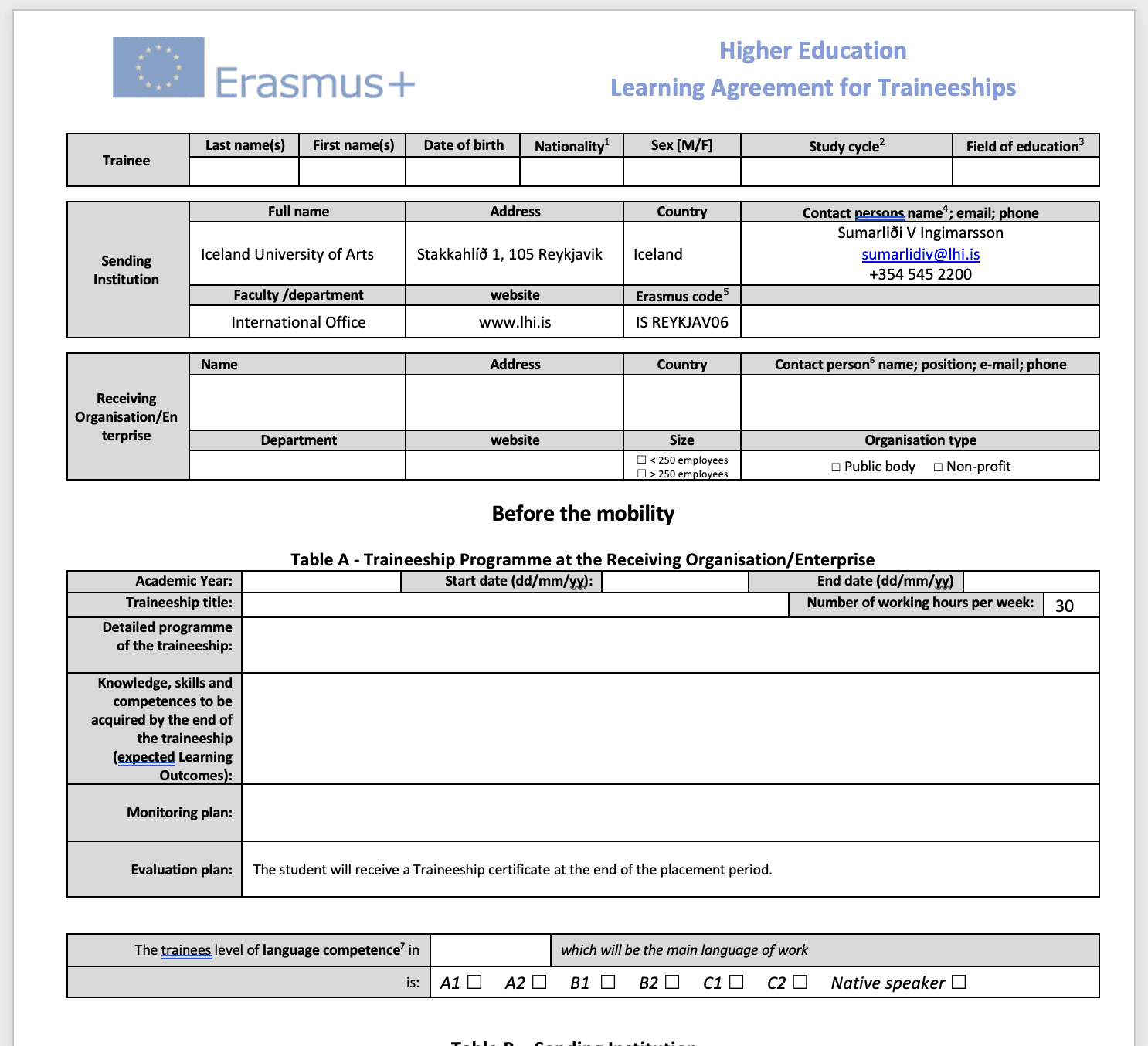
Only the basic information at the top as well as the first part (before the mobility) should be filled in with the receiving party, signed and sent to the email address of the international office. Here are some points in the agreement that the international office often gets questions about:
- Study cycle: Here, the level of study is specified (BA/MA)
- Field of education: Here is a subject specified according to the ISCED codes of the European Union:
- 0114: Art lessons
- 0211: Graphic Design & Cinematic Art
- 0212: Clothing and Product Design, MA Design
- 0213: Art
- 0215: Music & Performing Arts
- 0731: Architecture
- Number of working hours per week: Internships must be at least 30 hours per week Anything beyond that is an agreement between interns and the receiving party Interns are not required to work beyond the agreed hours.
- Detailed program of the traineeship: Here it is important that the intern and the receiving party clearly report which tasks will be submitted to the intern.
- Monitoring plan: Here, the arrangements for follow-up are explained These can be, for example, weekly morning meetings with the intern on Mondays or position meetings at lunch every other Friday.
- Financial support: The recipient is free to pay the interns a salary for their work, in which case it is important that it is stated in the internship contract. If the reward for the work done is in the form of benefits, such as a transport card, weekday lunches, accommodation facilities, tickets for cultural events, use of a bicycle, etc. they must be listed under contribution in kind.
- Accident & stability insurance: An intern is not insured by the Iceland Academy of the Arts while he is in an internship. Therefore, it is important that interns check if they are insured if they have an accident during the internship, they take with them The European Health Insurance Card and that they will be in charge of additional insurance if they deem it necessary. The receiving party can also state in the contract whether the intern is offered insurance on their behalf or not.
Download internship contract →
How does the internship grant work?
Grant amounts vary from year to year, as do countries Rannís maintains this website but there you can find more information about internship grants and there is a link to a page with grant amounts. The grant consists of:
- Travel allowance
- Residence grant
- Vocational training supplement (€150 per month)
In some cases, a student can also apply for a validation grant, in which case €250 per month is added to the grant amount. More information about validation grants may be available find here.
Once a student has submitted all the necessary data to an international office, he will receive the 70% grant transferred, but never until at least 2 weeks until the internship begins. NOTE! Contracts cannot be concluded after the internship begins. The second payment, 30%, is then transferred to the student after the internship has been completed and the student has submitted confirmation of the internship as well as the final Erasmus+ report. Confirmation of the internship is the last part of the internship contract (e. After the mobility/TRAINEESHIP CERTIFICATE) and it is filled out by the recipient after the internship and the student returns it to the international office. Erasmus+'s final report is automatically sent to the student's email address at the end of the internship.
Ethics and important issues
It is good to keep in mind the following points:
- Students are not expected to go on internships with their current partners or partners.
- It is not expected to support collaborative projects or independent work of students under the guidance of an instructor.
- Internship grant is based on residence period with the receiving party, outside of Iceland, in Europe.
- An intern is not obliged to do projects other than those stated in the internship contract, especially if they are not related to training in the subject.
- Internships must be at least 30 hours per week Anything beyond that is an agreement between interns and the receiving party Interns are not required to work beyond the agreed hours.
If a dispute arises with the receiving party, including due to the above-mentioned issues or due to bullying or harassment, the student must contact an international office and/or LHÍ's study advisor immediately.
Nordplus
Students can also apply for a Nordplus grant for a shorter stay of one to eight weeks in the North and Baltic countries For more information on Nordplus grants, the International Office provides.
Contact/Book an appointment
If you do not find the information you are looking for on this page, you can contact an international office by sending a mail to exchange@lhi.is or booking an appointment with an international office project manager by clicking the button below.
Questions on this topic?
Contact the school office and we will send the inquiry to the correct department or department.