Phi spiral, resolutions and uneven intervals in the Fells of Time

Irrational settings beyond the octave: Phi spiral, resolutions and unequal intervals in Fells of Time
Einar Torfi Einarsson
This article discusses the settings used in the work Felling of Time. The work is done by the signatories in collaboration with the musical group Þelgap and is based, among other things, on time expansion, layering, mixing of electronic and acoustic sounds and processing of acoustic and klid colors. Under these different layers lies, however, a certain tonal thinking: a search for a tonal space that is not closed in regular octave division but opens up as a changing, asymmetric distribution Instead of proceeding from isostatic and periodic repetitions, work is done with irrational proportions, uneven intervals and what could be called a phi-formed (φ) spiral in frequency space This article deals with this aspect of the work.
This puts the work in conversation with a longer history of tunings From Pythagoras to equal tuning, the history of music theory has to a considerable extent been about how to divide a frequency domain in a usable, convincing and culturally sustainable way In Fells of Time settings, however, are not intended as a technical problem, but a formal and philosophical subject: how can a musical space be formed that reflects a world that is not closed, not completely captureable, but constantly in folds and winds.
Why settings?
All modes are actually based on choice They not only state where tones land, but about which relationships are considered valid between them In Pythagorean thought, intervals were ordered by simple integer ratios, notably 2:1 for octave and 3:2 for fifth, etc. This approach is based on a strong connection between numbers, chord, and the cosmic rule of vibrating strings The musical space is read as a series of simple and stable mathematical relationships.
Just intonation continues this thinking, but seeks to organize more intervals with pure proportions, such as 5:4 for a triconch. There, harmonies become clear and “ pure”, but the problem is that such a system is unmanageable between keys; what sounds good in one place breaks easily elsewhere. Meantones were an attempt to soften this problem by spreading deviations, especially in fifths, so that certain areas of keys would be more usable. The equal adjustment (e. equal temperament) then marks a decisive change: it gives up the requirement that key intervals are perfectly clean and instead chooses an equal division of the octave into twelve equal steps. The benefit is enormous flexibility, but the cost is that all intervals become compromises in a certain sense.
This trend shows that settings are never neutral. [1] They are always the result of prioritization: should purity, transmissibility, phonological simplicity or cultural use be maximized? In Fells of Time another question arises: what happens if the order of priority moves from stability to difference? What happens if the musical space is not to balance out irregularity, but make it an active morphism?
Why 12 tones?
The twelfth division of the octave is not a law of nature but a historical result It became dominant because it solved certain practical and aesthetic problems in Western music It became a common measure that made tonal performance possible, opened writing to keyboards, movements between keys, and allowed composers to build large compositions on a stable substrate But like many systems that reach wide spread, it becomes over time not only a tool but a default horizon (sometimes uncritical).
Therein lies the reason why experiments with other modes matter They not only assume more or fewer tones, but expose the very assumption that tonal spaces need to be equal and closed When composers and scholars explore systems beyond the octave, irrational tunings or so-called EDN systems[2], where another „repetition scale“ is chosen instead of 2:1, the musicology is being reopened as a field of research rather than accepted as a closed standard.[3]
Why octaves?
The octave, of course, has enormous uniqueness because it is both sensory and morphological tones separated by a ratio of 2:1 are not identical, but they still perceive as related in such a decisive way that they form a unit This has made the octave the main frame of the tonal space She closes the system She says: here the same category repeats itself, at a new height level.
But what happens if one departs from this cycle? What happens if the tonal space does not close at 1200 centum[4], or if it is not usually organized as a system of recursion? Such questions have underpinned many „non-octave“ experiments in the 20th and 21st centuries, including the Bohlen -Pierce system which has 3:1 as a cycle (e. period) and various phi-related scales in which the golden ratio (φ) or other irrational ratios replace or interfere with the traditional octave.[5]
Here it is useful to pause at the concept of incompatibility. When numbers or ratios are non-measurable, they cannot be submitted to one simple common measure. This led to irrational numbers, i.e. no general fractions manage to capture them (eg π and e). In a tonological context, this means that the intervals do not work in a neat, regular network. The gold profile is particularly interesting in this respect, both because it is unspoken and because it is more difficult to approximate it with simple integer fractions than most other ratios (and therefore φ is often said to be the most irrational number[6]). Therefore, it can act as a tonological “interfer”: it draws the tonal space from simple recursion to a more open, twisted and ever-changing process.[7]
The electronic composition Stria by John Chowning is a good example The work shows how the world of the octave can be left without falling into an unplanned vacuum. In Stria is the gold-based format used as a fixed organizational force in both frequency space and sound design Chowning based the work on eight „pseudo-octaves“, each divided into nine tones, and used φ as well as a ratio in FM sound synthesis, so that tonal space and phonetic spectrum became parts of one and the same arrangement. The result is not a traditional „tonal“ space, but a complete phoneme as a “ around φ.[8]
There opens one possible way from the world of the octave to other settings and other approaches. Stria is not a model in the sense that Felling of Time repeating Chowning's method but shows us that when the octave is no longer the default endpoint, the tonal space becomes a field of research In that context, the question no longer becomes „how to divide the octave?“ but „how to formulate a distribution?“
Search for uneven intervals: φ-spiral as a method
The simplest way to use the golden format for modes would be to have frequencies follow a pure power series, for example:

Such a method is interesting, but it does not lead to the type of distribution that was searched for Fells of Time. The reason is that when such an exponential sequence is projected into cent space, the intervals between adjacent tones become in practice equal or almost equal The distribution seems uneven in frequency space, because the intervals in Hz expand with each step but when the same sequence is projected to cent space, which is a logarithmic space, it becomes linear: all steps are equal. Therefore, a simple phi-exponential sequence was not alone sufficient to produce the unequal intervals sought in the work A simple picture of this could be presented like this:
Hz:
| -| SOLE|SIGNS|SOLDER-|SOLVENT-|
cent:
| ID| ID| PHON| PHON| PHONEME|
The cent space consists of looking at exponential growth in logarithmic form A sequence exponentially in frequencies (hz) becomes linear in the centum, because cent measures the relative distance between frequencies rather than simple differences in Hz. This is consistent with the perception of intervals, where the ear responds primarily to ratios (cf. 220 -440 Hz and 440 -880 Hz as identical intervals, although the difference in Hz is very different).
For that reason, a simple phi-power series was not sufficient to produce the unequal pitch structure sought in the work Therefore, a method had to be developed that shaped the distribution itself differently.
What was sought after was a different kind of behavior: not simply a new „generator“ or a new batch size, but an uneven nonuniform interval arrangement where some tones contract into dense clusters, while others are more distributed. In other words: the goal was not only to go beyond the octave, but to form a musical space where differences in density would become morphology.
For that reason, trials were conducted using various methods Instead of directly defining the tones, a step sequence was started which was then shaped and deformed (or interrupted) After several failed attempts, a formula actually proposing from equal steps came into the search, but they are distorted by φ and sinus function:

Here 1200/N is some initial equal division, but it is not left to stand immobile. It is replaced by log2( φ) into as a measure of the effect of the golden profile in logarithmic frequency space, while α is a factor that controls the intensity of the error The sine term then ensures that the inflection does not become fragmentary but smooth and continuous across the sequence (still asymmetric due to the φ effect).
The steps (tone intervals) Sn are therefore not equal, but variable They are then summed up in cumulative order C (for cent):
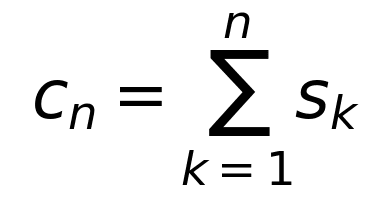
This creates a series of cent positions or points that describes the initial journey through the frequency space The next operation consisted of incorporating this sequence into a single field by a modulo operation:

Finally, the dots are arranged in ascending order or we can say that they are folded (e. folded) which resembles „spectral“ methods when overtones are projected down to one octave except here we are talking about the order of intervals in the centum This step is decisive, because there the production sequence changes to a new distribution The tones then appear as a set of dots within a pseudo-octave (which is of varying size), and the intervals between the next notes become the result of a three-movement interaction:
- initial basic step,
- φ-warped sine-turn,
- and the rankings by modulo projection.
Thus, a tonal space is created that is neither uniform nor random. It is not a simple φ power series, but also not a traditional isosceles. It is rather a model of φ spiral, where diffusion, density, and clustering appear as active curves. What is heard as condensation or gliding in the tonal space is therefore a direct result of a φ-warped step sequence, modulo projection, and alignment In other words: the tuning is not a partition but a topology of diffusion, namely the shape and topography of diffusion.
With this method, it became possible to model the three dissolving families used in the work.[9] Low-resolution shows clear and coarse asymmetry, mid-resolution multilayer density, and high-resolution leads to textures approaching continuity In any case, the same fundamental thought that dictates the move is: to not only let φ define a ratio, but to shape the behavior of the tonal space itself.
Settings will be resolutions (setting spirals)
The overall system consists of thirteen modes that are classified as being said to be in three families: low-resolution, mid-resolution, and high-resolution Although the term „resolution“ is borrowed from digital image processing, this here simply applies to the density of tonal space: how many tones fall within a certain range, and how fine or rough the distribution will be.
Low-resolution gives few positions within pseudo-octave (1200/N where N is a low number 7<N<13).There, each interval becomes quite prominent, and clustering appears in a simple and clear manner. Central-resolution increases the number of points, so that the space becomes multilayer; it forms areas with condensation and others with greater opening. High-resolution then narrows the distribution so much that individual intervals gradually cease to be the main point and give way to texture.
Now let's move away from a mathematical perspective and look, graphically and acoustically, three examples from these families.
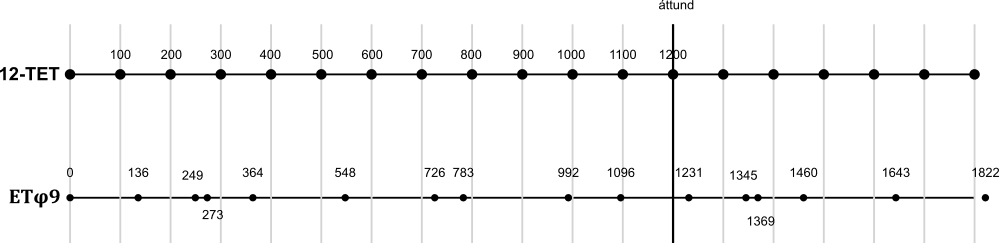
Example 1: Low-resolution-A (ETφ9) next to 12-TET settings based on central c with cent values from 0-point (rounded values).
In example 1, few points are seen within the pseudo-octave, and the inequality therefore becomes very visible and audible Some tones fall close to each other, other intervals open up dramatically This version shows what happens when the φ spiral is cut to a rough resolution.
Sound example 1: scale motion of low-resolution-A (ETφ9).
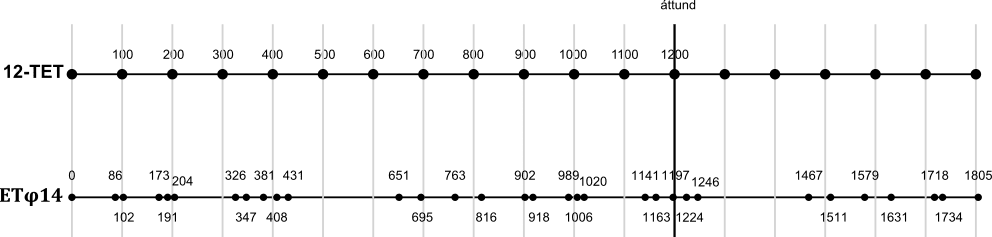
Example 2: Central-resolution-A (ETφ14) next to 12-TET settings based on central c with cent values from 0-point (rounded values).
Here in example 2, the same idea has become more compact The distribution becomes multi-layered and the spaces smaller, yet not regular The proportions continue to be asymmetric and non-measurable, but now the image becomes more complex.
Sound example 2: Scale motion at mid-resolution-A (ETφ22).
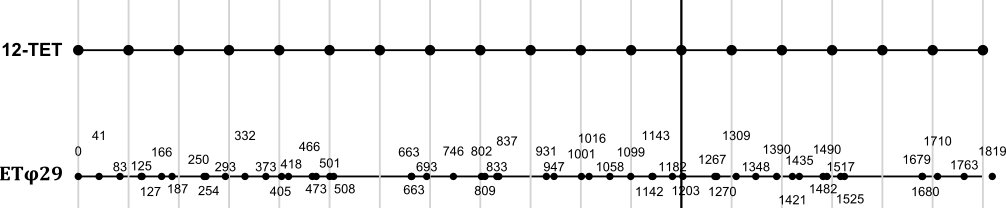 Example 3: High-resolution-B (ETφ29) next to 12-TET settings based on central c with cent values from 0-point (rounded values).
In example 3, the system approaches continuity (some points simply overlap almost completely). The points become so many that the setting works less as a scale in the traditional sense, but rather as a distorted sound spectrum, but is also very interesting for acoustic material.
Sound example 3: Scale motion of high-resolution-B (ETφ34).
From settings to terminals (resolution to resolution)
An important aspect of the work is involved in the processing of a clause (e. noise). But in the work, a piece is not a secondary material, a residual material or a side effect of the settings, but a continuation of them. When the same sets of tones are not played in series but activated simultaneously, they become discolored slips. There, the resolution is of primary importance: low-resolution can produce a coarser and more granular sliver, middle-resolution multilayer and vibrating texture, but high-resolution leads to a denser and more continuous mass We can think of this as different 128-tone chords, which become discrete depending on the resolution of the settings and cause varying degrees of resolution of other kinds. The same building principle therefore appears in two stages: as a tonal distribution when the dots are all sounded at once. The result is in the form of different chords, each with its distorted properties.
Therefore, three corresponding examples can be added here, where different resolutions lead to dissolution, in the older sense of the word (cf. chaos).
Sound example 4: Low-resolution A as a claw.
Sound example 5: Central resolution A as a clade.
Sound example 6: High-resolution B as a claw.
These examples show that the resolution is not only a tonological or tuning variable, but also a phonological variable that shapes the color of the joints.
Scala and Implementation
Here I want to touch a little on the practical side Once these settings have been formulated as point libraries, they are projected across the entire range of tone in the Scala application[10], which creates tuning files that are then utilized to run MIDI files (where the basic layout of tones lies along with chord progression) The Scala program is particularly important in this context as it supports both the construction and execution of specific microtonal configurations, including „non-octave“ systems and custom scala files for electronic instruments in the MIDI material Fells of Time these settings are therefore shaped and distorted, but they are further transformed in the next processing operations where they are made to sound through sound-designed VST instruments (which also take on dynamic movements as well as movements in space through a multi-molecular speaker system). However, that processing is not the subject of this article, but this process all ends in computer playback that the performers rely on in their performance, as the settings act as a kind of reference and routing network. This setting world is of course difficult to deal with when it comes to the performance of music, but if you rely on a combination of computer playback and live performance (as is done in Fells of Time) it turns out that you can adopt the most amazing settings.
The philosophy of the work: difference and intangible whole
But how does this set theory relate to the work's philosophy? Felling of Time not based on an idea of a closed whole that a listener can occupy as a whole and then “ass” or capture as an overview On the contrary, the whole is organized as something that undermines, is always budding, infinite even Here we can talk about the ontology of the difference (e. differential ontology): the whole is not a primary premise that the parts refer to, but only appears through different folds, spatial perspectives and temporal approaches. You never reach the whole (there is always a new perspective around the corner).
And the world isn't locked in itself: The world is an infinity of curvatures and inflections...„ [11] and is always folding (and hiding) folds together, folded headwinds that are also inside other folds:
„Unfolding is such not the contrary of folding, but follows the fold up to the following fold... the whole world is only a virtue that currently exists only in the folds of the soul which convey it...”.[12]
In this poststructuralist thought, the whole is not a closed object but something that appears only in motion, in fragments, in local revelations What could be called an intangible or non-captivable whole is not a lack, but a principle of the work As is treated with time itself, it is not smooth with equal division as the clock would mean (and even two clocks do not reach a harmony if relativity is taken into account) but all in folds, wrinkles and creases.
This thought appears in Fells of Time at many levels: in the multi-part presentation of the work and its length (the work is 25 hours in its entirety, 5×5 hours episodes), in its spatialization, in the fact that no listener gets the same experience as another, and also in the tonal space itself the settings mirror this because they do not close themselves in simple repetition They present not a single clear framework, but a frame structure that transforms, a distribution that will only be numin in sections, in local clusters, in concrete but asymmetric relationships Thus the music theory is not just a technical substrate but a direct metaphor of the ideology: the whole is only in the fold, and the tonal space is only given as a temporary view of a larger, incompleable process.
The search for irrational settings beyond the octave is in this work not an idiosyncratic attempt to “complicate a pitch, but a way to open the tonal space as a living, changing, and asymmetric form By moving from isosynchrony to uneven intervals (where the inequality is alive), from closed octave to φ-formed distribution, and from scale to resolution, the music theory becomes an active morphological force It organizes not only what tones are used, but how the work thinks time, space, listening, and whole.
Stria shows that the octave can be left and another world built. Felling of Time proceeds somewhat in the same direction, but chooses not to make φ become a fixed organizational law but rather to the power of the difference Thereby, the configuration becomes not a pure sequence but a fold within folds; not a closed system but an irrational and intangible whole in constant distribution The whole becomes the process that continues to expose itself without closing, such as an irrational number that has an internal rule but no final closure.
Sources
Bohlen, Heinz. “The 833 Cents Scale: An Experiment on Harmony” (Huygens-Fokker Foundation, 2012).
Deleuze, Gilles. The Fold: Leibniz and the Baroque (University of Minnesota Press, 1993).
Dettmann, Carl P., and L. Taylor-West. “Algebraic Tunings” (Journal of Mathematics and Music 18, no. 2, 2024).
Meneghini, Marco, et al. “Stria, by John Chowning: Analysis of the Compositional Process” (Proceedings of CIM 2003).
O'Connell, William. “The Tonality of the Golden Section” (Xenharmonikôn 15, 1993).
Rasch, Rudolf. “Tuning and Temperament” in The Cambridge History of Western Music Theory (Cambridge University Press, 2002).
Scala. “Scala: A Powerful Software Tool for Experimentation with Musical Tunings” (Huygens-Fokker Foundation).
Sethares, William A. Tuning, Timbre, Spectrum, Scale, 2nd ed. (Springer, 2005).
Smethurst, Graham. “Two Non-Octave Tunings by Heinz Bohlen: A Practical Proposal” (Bridges Conference Proceedings, 2016).
(T.O.N.
[1] A fine overview of this can be found in: Rasch R. Tuning and temperament. In: Christensen T, ed. The Cambridge History of Western Music Theory. The Cambridge History of Music. (Cambridge University Press; 2002:193-222).
[2] EDN stands for “Equal Divisions of the N-th” (equal division of Part N), and is an extension of the classic 12-tone isosynchronous system (TET).
[3] Dettmann & Taylor-West (2024); O'Connell (1993); Smethurst (2016).
[4] An octave is defined as a pitch with a frequency ratio of 2:1, which corresponds exactly to 1200 centum in a logarithmic measurement system.
[5] Smethurst (2016); Dettmann & Taylor-West (2024).
[6] Weisstein, Eric W. „Golden Ratio.“ MathWorld, Wolfram Research" Accessed April 17, 2026. https://mathworld.wolfram.com/GoldenRatio.html
[7] Dettmann & Taylor-West (2024); Bohlen (2012/1999)
[8] Meneghini et al. (2003); Laura Zattra (2016)
[9] This is still not the only method that could work, and so there are obviously more possibilities to study uneven pitch structure, since the intervals do not repeat as in isosynchrony The non-uniform distributions will be continued and settings will be treated as different scales to travel between.
[10] See the application's website here: https://www.huygens-fokker.org/scala/
[11] Deleuze, G. The Fold: Leibniz and the Baroque (University of Minnesota Press, 1993).
[12] Deleuze, G. The Fold: Leibniz and the Baroque (University of Minnesota Press, 1993).