On the origin and arrangement of the composition method called Khallam's Notes

Condition: about the origin and arrangement of the composition method called Khallam's Notes
Atli Ingólfsson
Sign
It is probably hopeless to sum up in one word what music is about. Nevertheless, I once made it a game to try it; it was such an oversimplification that can be useful to project in a lecture, reasonably wrong to provoke discussion, reasonably right to inspire listeners.
This is how it sounded: I shot that around 1913 it happened expression - as Expressionism defined the concept of - being the essence, around 1953 perhaps morphology, around 1983 this no longer applied and happened sound be closer and the music has been more than anything else diving into the sound.
Then I tried to look within myself and consider whether this still applied to my compositional work, that it was primarily a journey into the wonderworld of sound Then it dawned on me that, although I often directed there the microscope, it was not the essence of fictionI am often more preoccupied with what can produce the sound and with its context, as I feel that the listener's experience and understanding must depend on the two.
So I explain this as soon as possible: You can certainly put it on stage and dissect, for example, a beautiful deep tone in the violin that sound and its behaviour but I am fond of taking into account the intervals from the next notes, the expression of the violin voice and its attitude towards other incidents in the workI consider these situations to be an integral part of the experience of the sound, and the experience of the composition This idea could easily be applied to the penultimate period above, the modernist belief in morphology, if it weren't for a certain difference that I hopefully manage to describe in what follows.[1]
It is the case that in later years I have not been enough of the consistency that the material of the composition forms but have felt the need to loosen, deconstruct or even alienate the music There are many ways to do that, but they probably all have something to do with the conditions in which the composition is set, or some internal conditions of the work In short, it may be said that I do not seek morphology or sound, either condition. It is specific condition which makes morphology or sound can begin to a new fictional level. Here the influence of the theatre speaks to itself There, the play text alone is never enough, the work is created when the text is given context, forming condition or is part of it.
Condition. I pitched this at a lecture and it fell into good soil It was actually not only about my own creations but was supposed to describe the ways of many composers in later years. And just like the words morphology or sound the meaning here is wide and this sign is a great simplification. Among the composers who could wear it, perhaps such different artists as Alvin Lucier and Georges Aperghis from the past days or Cassandra Miller, Laurence Crane and Jennifer Walshe could be mentioned by slightly younger authors, but of the people of Iceland, audiologists, there is no doubt that Guðmundur Steinn Gunnarsson, Einar Torfi Einarsson, Thráinn Hjálmarsson or Bergrún Snæbjörnsdóttir could be considered in the vicinity of such a label.
The production line
Some such tendency was to fall around in me and had its effect on various works, but of course mostly in the concert hall works[2]. At the same time, my various reflections on the staging of music and roles intensified or indeed errand performers, and the audience's experience of it There was this feeling that the production line of the music needed to be refreshed, from idea, out of composer, through performer and to delivery in listener's ears This has actually been a number of musicians struggling with in recent decades.
On top of that, I was not against the mood to shake up my own methods - it is healthy for every artist to try such things from time to time so that one continues to be born.
I was suspected of that condition was there a definite beacon in many of my newer works, feeling that now I needed to challenge myself and confess it categorically I decided to overturn my methods of composition, even if only for a moment, began experiments, sketches and notes, traveled into the roadless and have not bitten the needle with it yet But here follows a description of the project that arose from this.
Khallam's notes: A fictional prequel
In order to try to step out of my own history, culture and education and see it all from a distance, I imagined a particular antecedentThe various thoughts of philosophy begin with exactly such „what if“ experimentsI imagined that a well-informed Moroccan musicologist, Azbet Khallam, had encountered Central European music around 1934, when the key system has somewhat become weak or disappeared altogether He would have been free of reactionary and would have been impressed by many things he heard He would have spotted a particular problem that arose when the music said he understood the clear division of the material into melody, accompaniment and bass He decides to invite some musicians, his associates, to meet regularly and experiment with his own version of new music that was not key-bound.
In 1936, an Italian envoy arrives to him, curious about his ideas, and notes their long conversation These are Khallam's notes which contain loose explanations of the musicologist's position and a description of the method of composition he promotes.
Hopefully the reader is not losing this fictional thread, because he continues: I myself travel to Morocco a few years ago and at an inn in Marrakech I come across some snowy typed sheets in a folder of these notes in Italian The truth is that there was certainly one morning in Marrakech that I fully formed this idea and wrote down the notes, imitating the best of my ability the Italian writing style from the first half of the 20th century.
A bit of a writing in Italian called Glósur Khallam exists, but I'm not quite smart enough to make gold plates out of it in the style of Joseph Smith.[3]
It is enough for me that this account became a method for me to get rid of compromises When doubts arose, I could always say to myself „this problem does not leave Khallam, away with it“ It is difficult and in fact unnecessary to answer the extent to which I agree with Khallam's words below; they at least describe a position that can be substantiated and taken seriously.
So it can be added that when a composer composes a work, it is actually always creating a character, we call it „the Creator“ who then creates the work It is created from the poses in which the composer sets himself at any given time A clear example of this is that Beethoven must have composed such a gerolike composition as the 5th and 6th symphonies around the same time The author is Beethoven, but they are clearly an offshoot of two different creators The idea of Azbet Khallam is therefore not so far removed from the usual compositional work The only thing added here is that this character receives special attention and name[4].
Khallam's notes: Three roles
Now we go straight to describing the method that Khallam suggests.
When performing a piece of music, the performers are divided into three categories Every category has one defined role and therefore holds it for a while, or until the chapter break. At the turn of the chapter, the group is then usually reshuffled and the division of the performers into categories changes.
The music is formed by the conversation of these different roles According to Khallam's definition, there are only three of them Each of them sets special conditions on how to put it together, how it should be interpreted, and what its attitude is towards the other two The work must therefore be composed in consideration of the three roles.
The roles each received their own name in Arabic They are as follows: 1) Tadaris, or the landscape, 2) lahen, or the voice and 3) hayat, or the bran.
To describe them a little in more detail: Tadaris is what gives the chapter stability It needs to be reasonably predictable and give performers something to stand on It focuses primarily on itself and lahen, to support it. Lahen, is like the voice directed at listeners This roll is much more erratic than tadaris and the listener needs to be directly convinced of his independence and freedom, even if she uses the foundation as tadaris gives. The third role is then hayat, the bran. This is a role that opens the work outward. It is completely independent of the other two, playing ym or klið, or even acquired material. Hayat focusing on itself and the world around It likes to pretend that the foundation doesn't affect it, but is actually creating a kind of sound shading that sharpens the contours of the others.
So we summarize the positions of these three departments, one looks primarily at the other two, one looks at the first and at the listener, while the third is preoccupied with itself and the world around It's a bit like when writing a play and the positions of three characters defined in advance, a position that the actor has to interpret.
This arrangement is supposed to ensure that every performer's mission is clear to him and always to the audience as well, the relationship between the performers alive and the participation of the performers active and creative.[5]
The idea then is that the division of roles remains unchanged for a good while, or for a whole section of the composition Each section, however, is like a bit of a game where there is no aim to build or develop a form There just to immerse itself in the dominant state I estimated that it would produce passages that were three to five minutes long, The overall form would then be a series of such passages, which I began to mention early on beat.
Khallam's notes: The tone material itself
It is not surprising, although it seems to some that the description above reminds of the old idea of bass and rhythm base, accompaniment or chord progressions and then melody Something is related by this and the roles described here and certainly not undesirable if Khallam's method manages to draw up a counter-simple interface However, the difference is clearly expressed when the tonal material itself is examined.
From the beginning it was clear to me that the type of ensemble I was looking for was unrelated to the super-precise specification of various late modernist works - works in which the performer's speech is largely delegated to the author - but it would be equally unrelated to music of the most liberal kind - where the author's speech is largely delegated to performers - let alone the various forms of improvisation on top of the given basis.
To distinguish itself from this and speak for itself, it seemed to me that the music needed to be based on tones that were not reminiscent of known modes of music It could be very simple, but would have to draw a soundscape beyond equal tuning, or at least an unspeakable version of uniform tonal material (for example, so that not all tones have exact frequencies) In a conversation with a Marrakech outfielder over the year, I had my suspicion confirmed that the tuning and performance of the performer were connected to fairly strong bands. Certain themes can have a special tuning, not the same small-tone intervals played on the way up and down in the musical range, etc. We also know singing styles in many countries where small-tone intervals are not steps in the scale but a kind of theatrical addition.[6]
Just as the tuning of the pieces does not obey the accepted Western lattice, I felt it was important that the rhythm similarly breaks out of a predictable rhythmic beatI widely use a departmental rhythm (irregular rhythm or so-called straps) on top of a variable base where it makes the rhythm track reasonably alive In addition, what I call an experimental wedge is widely applicablehryn, but there is a truncated divisional rhythm, for example, such that the game is played at the rate of a penta-pole but then starting at the second stroke in a different substitution after only three notes of the pentamole, thus different truncated straps can be arranged and a somewhat volatile but precise collapse can be tailored (see Figure 1).[7]
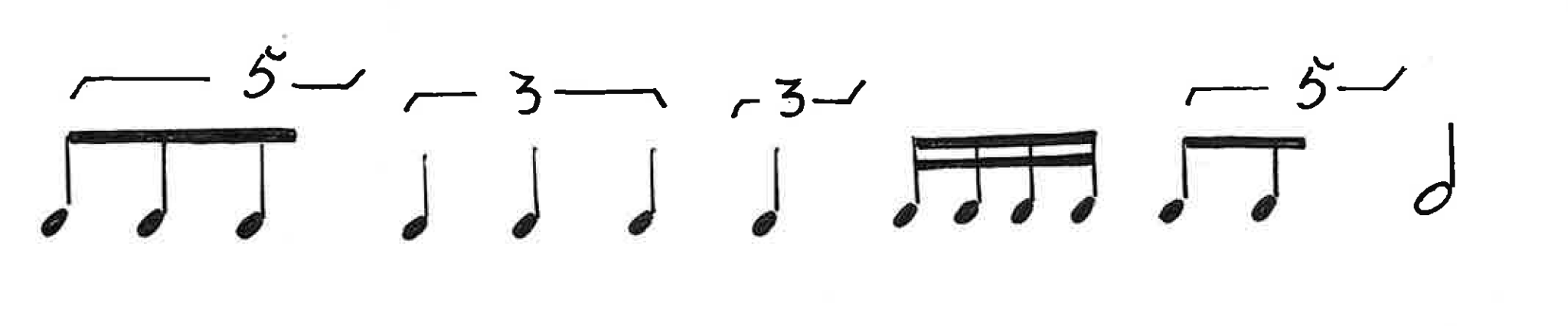
Figure 1
Neither the timbre nor the rhythm thus contended is intended to become particularly complex On the contrary, attempts are made to tailor from them the repeated patterns that become tame to the performers after a bit of rehearsal The reason for the slight distortion described here is on the one hand, as mentioned above, to distinguish the music from known models - simplicity tends to search for a predictable course and it had to be avoided - but on the other hand, the distortion serves a very important theatrical purpose: the performers in tadaris the group must have reasonably unpredictable content to deal with together. Neither small intonation nor key rhythm can be transferred to a group unless the group listens well together, is synchronized and safe. It is a symptom tadaris the group, that he has a particularly high level of confidence precisely because he has mastered a bit of twisted material in sync.
There is no reason to go into more detailed descriptions of the tonal material, but here are some small samples of the notes of the first work that were put together according to this method.
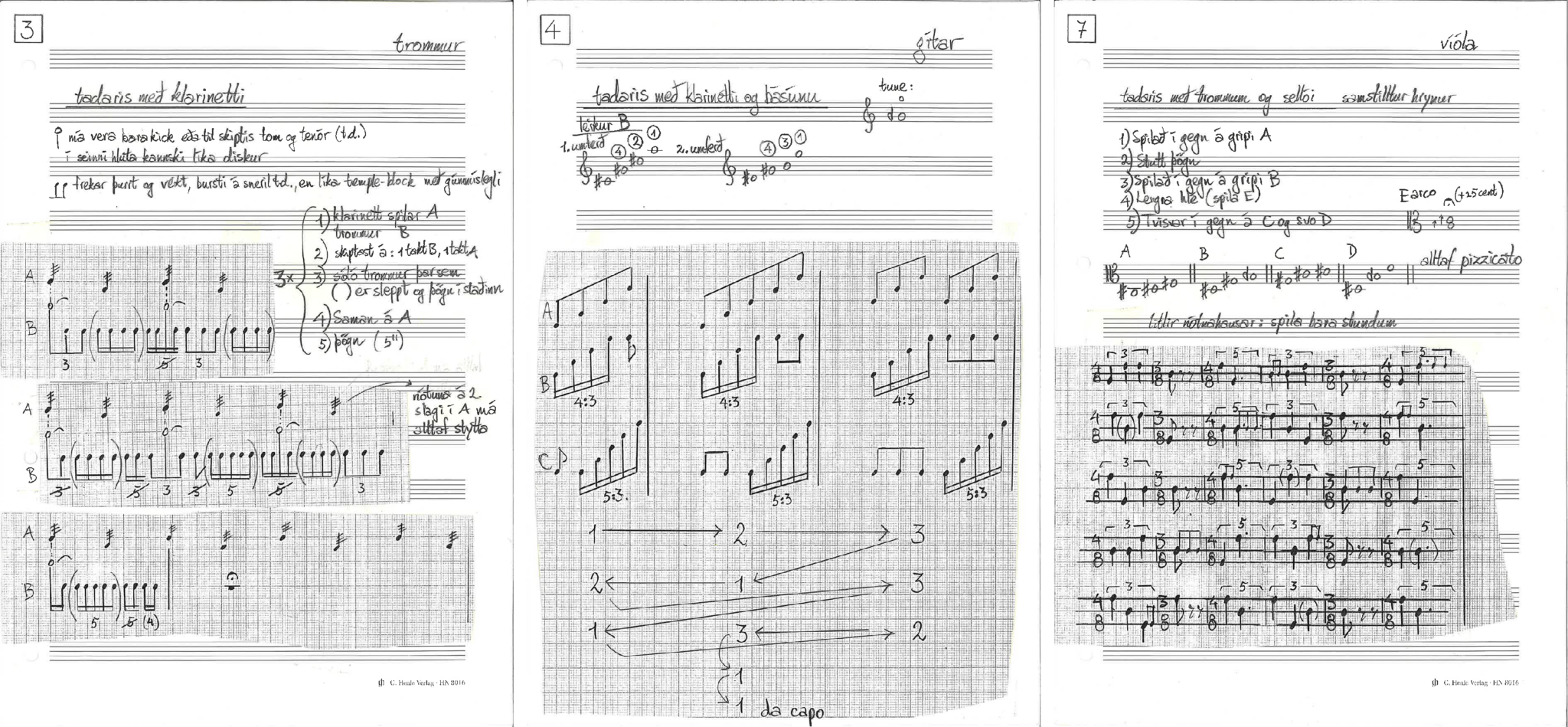
Figure 2
Khallam's notes: How the construction is done
In order to thoroughly distinguish this method from my usual procedure, I decided that the work should not be written in its entirety from beginning to endI was probably influenced by electronic dance music when, on the contrary, I decided that it should start with a kind of foundation - tadaris the role - and finish giving him a convincing picture to the end before thinking about the other roles This is related to what is said before about the unmistakable and confident appearance that this role was thriving It was one of the characteristics of the method.
About a decade ago, I would have found this change in the order of the work elements utterly idiotic It knocks out of my hands a number of good methods but instead I stood in an uncertain area It was, however, extremely restorative It goes without saying that this refreshing transition is a sufficient justification for me throughout the process „What if this fails?“ could be asked, but the answer to that was simple: „What about that?“
One of the things I discovered and resulted from this procedure was that the composition begins to be divided into many sections that are between three and five minutes long Namely, it seemed inadvisable to stretch the foundation too much He ends his stanza when the expression is mostly revealed, which takes about this time. There are certain reasons for this that could be explained to some extent, but it would be long-winded and unnecessary at the time.
These short parts of the work do not correspond explicitly to the usual sections: the section of a composition traditionally has a particular architectural purpose and form characteristic That is not the case here The only thing that delineates the section is the division of roles, although it is of course accompanied by a particular expression and a rhythmic and sonic main idea And the section does not end when a particular form is perfected but simply when the performers feel they have already published its theatrical content clearly enough so that it can be switched to the next pattern I mention these parts of the composition beat.
But this is an area of uncertainty, here it was necessary to learn so well to re-learn to compose music Here it was the circumstances that shaped the work, set conditions, rules and purposes I repeatedly did my best to organize the material in some logical ways that did not respect the circumstances Then a step had to be taken backwards, composed less and created more, so to speak.
Exactly to what extent the work needed to be a uniform building was a constant concern Although I greatly reduced the traditional requirements for this, I decided that a single sonorous frame could be a kind of backbone throughout the work It is based on a particular spectrum of sound that is variously frequency distorted and shuffled along beats.
It was important to me that all performers tried all roles so that, for example, bass instruments do not automatically enter tadaris the role. I began to look at how many possibilities there are for dividing a group into three parts This problem proved solvable with so-called other types Stirling formula and the result is that compared to a group of seven, like the one I thought I would invite to play, there were 301 possibilities for a tripartite[8]. This was considerably more than I had imagined and put me in trouble determining which divisions would be chosen The first answer to that was to let economics rule.
Khallam's notes: Training process
It was a kind of vision at the beginning of this study that the first attempt with the material would be for a group of seven performers and would be in seven acts. Through Guðna Franzson and the Caput group, these attacked the work: Hilmar Jensson, guitar, Bryndís Halla Gylfadóttir, cello, Guðbjartur Hákonarson, viola, Matthías Hemstock, percussion, Magnús Jóhann Ragnarsson, Ondes Martenot, Jón Arnar Jónsson, trombone, as well as Guðna who played clarinet. The group shows the intention that this set of performers cannot be assigned to any specific category according to age, instrument or type of music.
Now exercises had to be planned where the method was put to the test. The condition that tadaris should they always be worn before the other roles came into play resulted in an engineering subject Rehearsals had to be planned so that all performers had something to deal with and no one was idle, even if only one role was being rehearsed first I meant this by mentioning the economy above.
This was resolved so that the group recommended a tournament in a place where there were three halls.[9] An exact rehearsal structure was created, in which each performer was given a table of which hall to stay in at any one time and for how long Before, of course, I had already covered this, creating seven different ones tadaris groups that could, however, be put together in such an exercise plan with as close as possible to the full utilization of the group (see figure 3).
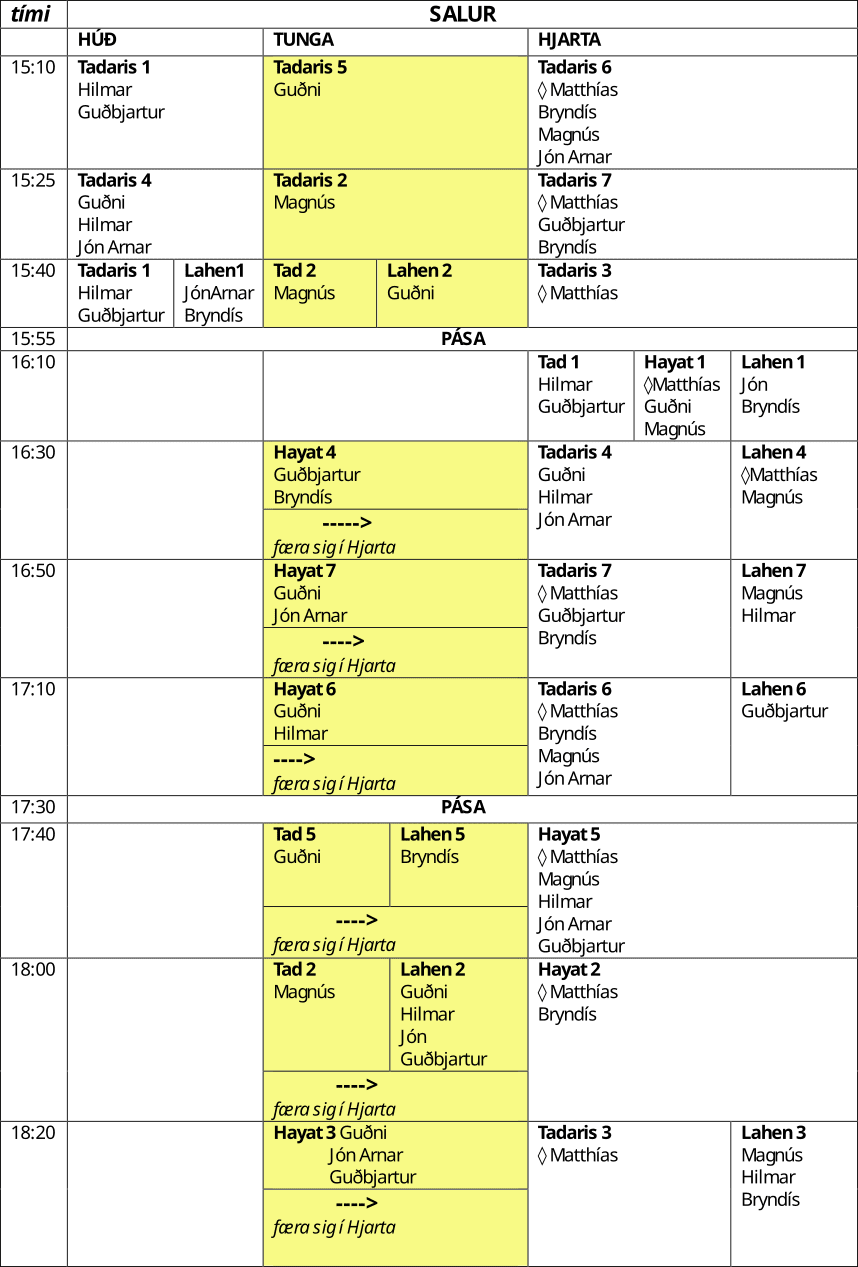
Figure 3
Apart from the space puzzle, there were several other conditions that affected the group division Tadar groups were supposed to be diverse in size, the same performers were not allowed to be together often in this group, no performer was allowed to be in the group more than three times, and all performers had to be at least once in it It can be said that I thought these conditions that contribute to the variety of the groups were ideal for the research value of the project Some beauty also seemed to lie in the unpredictability, but who knows that unless an old modernist ghost has awakened in me. The idea of diversity is actually much older than modernism and affects music far back centuries.
Workshop with Caput
It is safe to admit that the selection of the participants was not determined only by this sexual instrumental mix. Here, of course, it was necessary to call in curious, positive and versatile musicians and try from the beginning to open up the mind of this project.
Work actually began with a dinner party soon after the group's appointment There I tried to explain as best as possible what was at the door and to have performers one thing or another to consider until the studio There I was not ready with notes and written instructions Although it had been, I probably would not have delivered them immediately; it would have indicated that in the end the subject was quite traditional and was about reading from notes Instead, I chose to try to sow some seeds, create anticipation or curiosity I then asked the group to keep all my descriptions within and not comment on them to others. There was actually no military secret on the move, but it was a working method.
On the afternoon of January 19, 2025, the group met and the first edition of Khallam's Notes was test-driven: Time and Space Deployment, Group Splitting, the Seven Beats, the Writing of Tone Content and General Communication It was important to me to get through all the material and in just about four hours we put together seven beats, something that could be about half an hour long piece.
I thought of this in many ways as the first data collection of the project and placed more emphasis on quantity than the quality of the resultsWe therefore usually did not take the time to refine or revise the outcome I am including here some gags from video documentation provided by Adam Buffington that there is a chance to hear a work in its infancy but nothing resembling a finished film because it will require more togetherness and better directing work on my part.
Figure 4: Glefsur from the studio on January 19, 2025. At the end you can hear how hayat can let fully exotic but well-known material into the work.
After the workshop, I made a lot of notes about the further development of the work. I was very happy about it condition which I felt on the horizon but in many places I obviously had to simplify, clarify and revise, and probably some beats will fall out and others will replace them It does not diminish the value of the whole.
In any case, my main conclusion was that the experiment had been successful: There was a desire to move on and take the next steps that would result in the public publication of the work That step is now being prepared and aimed at the togetherness of the musicians in a public space where the audience can observe without being bound over the work There, even the overall form could be performed more often, repeated sporadic beats, spoken and altered or at all not consider the performance as a normal concert.
After that, it is important that the method is tried with more musicians, for example so that the same material is transferred to other instruments, but also experiments are carried out with smaller or larger groups. Then it can be said that the method is not fully tested until other composers try it and gradually accumulate more experience, vocabulary and technique in relation to it. Furthermore, it would be interesting in the future to experiment with amateur participation in collaboration with experienced musicians. For example, it would be easy to find a place in them hayat the role.
All that should reduce our accepted expectations of what a composition is, what a performer, what an author, what a concert and preferably also what a concert venue. And after that there is only some feeling condition, as if we were inside a cell and could not help but participate in its biochemical processes, ever-changing but necessary.
Appendix: survey of participants
As mentioned earlier, communication with performers was very important to the project After the workshop, I shared with them some of my conclusions so that they could be discussed in a group At the same time, I did a little exploration of their attitude towards several things She was anonymous, sent through about Forms the program and all seven responded There were four answer options to each question, from decisive negative to very positive answers. Below are the results of this survey. To save space, I do not specify answers that no one checked.
- The general introduction of the method could have been better.
- Yes, it was too vague: 14%
- No, she was pretty light: 43%
- No, it was absolutely clear: 43%
- The written instructions of each part could have been clearer.
- Yes, in some parts instructions could have been clearer: 14%
- No, they were usually quite light: 86%
- The fights were reasonably long.
- Yes, they were mostly of reasonable length: 100%
- It was difficult to constantly change roles in the work.
- No, it was usually normal: 29%
- No, not at all, and was just a pleasure: 71%
- It was uncomfortable to have new actors in the roles all the time.
- No, it was always fun: 100%
- It would have taken a manager to achieve better results.
- Yes, the whole work would have gone better with the manager: 14%
- Yes, sometimes the work would have gotten better with the manager: 29%
- No, usually it was better to work without a manager: 29%
- No, it should not have been controlled at all: 29%
- I had enough creative scope in the work.
- Yes, I usually had reasonable scope: 86%
- Yes, scope could not have been more: 14%
- The music was reasonably simple for everyone to connect.
- Yes, it was usually moderately simple: 100%
- My instrument enjoyed itself quite a bit in this context.
- Yes, it usually enjoyed itself appropriately: 100%
- Is there anything you want to add from your heart about this project?
- „Would be nice to meet again and dive deeper.“
- „The response options in No.8 do not cover the situation in that they address the unnecessarily/moderately simple/complex" I do not consider these scales to apply but rather whether the topic was interesting, which it certainly was.
- „A fun project and great pre-work.“
(T.O.N.
[1] I have tried before to put my creative work in a historical context Then I examined my work from the beginning of the compositional career and discussed their position on modernism See ATÓNAL 3.1 in Threads, 1st tbl., 2016.
[2] Here is a reference to the concert hall works Suzannah, Play Alter Native, Njáls saga - burnt opera and Ísl#nsk Þjóðlö g, but probably on the choral composition My dear Borga also at home on this list.
[3] Here is a reference to the originator of Mormonism and its cartoon.
[4] It is a sign that this study of mine is far from finished that the name of this fine musicologist has been somewhat erratic In a dream, the name Azbet Jervi Khallam first appeared to me During a bit of superficial exploration of that name, it seemed to me something doubtful about it and began to use for a while Khashif, and under that title, I have presented the project on some occasions Most recently, I dropped this shyness and returned to my original name, as I think it sounds better.
[5] Here, of course, the old-fashioned problem in the world of written music is dealt with that at some point the performer's mandate to participate in the creation of the work seems to have diminished In other words, authors and interpreters were diagnosed; authors became more and less often interpreters of their own works, and interpreters were simultaneously evicted from the author's class.
[6] Hopefully it will be enough to refer to meend the singing technique in Hindustani music as an example.
[7] This is what is mentioned in English incomplete tuplets.
[8] I thank mathematician and accordionist Matthias Kormáksson for solving this puzzle for me For those interested, the formula looks like this: where n=7 and k=3.
[9] Guðni Franzson was still a key player in the work and therefore gave facilities at Tóneyjar's headquarters in Skipholt.