Hróðmar I. Sigurbjörnsson
Entrance
Prokofiev's music is often described as being in a neoclassical style. His melodies are either soft and lyrical or crude and resonant with strong contrasts in range and feeling. The classical theme models are never far behind but it is often difficult to fully define them. The acoustics are based on traditional triads, but the sudden transition to distant chords and keys weave for us, even to talk about „wrong note theory„ The same applies to the characteristics of the phoneme, strong contrasts; either “motorized devil's demonic movement, light-hearted dance or wonderfully slow process„ According to Taruskin, Prokofjev was no revolutionary in his composition, but he was well trained in classical studies and proud of his music, such as Stravinsky's and Scriabin's, was not primarily developed by the standards of the highest standards of the romantic and traditional music.[1]
In recent seasons I have sought to analyze the Piano Concerto No. 1 of 1912 by Sergej Prokofjev with Hjalta Þór Davíðsson, a master's student in composition It has been an interesting and fun journey I, raised in the „Second Viennese School“ and then following up on the 20th century's progress on all kinds of compositional methods, had not studied the composers in any way that followed the legacy of the late romantic trend, such as Shostakovich and Prokofjev. What immediately caught my attention were the theme models that appeared in the Piano Concerto and indeed other works that I had encountered as a mentor in the writing of BA theses.
First of all, we can talk about diversity in the form and size of the themes, although eight-bar themes based on classic models (sentences, cycles, hybrids) are indeed the most common. Then we can mention compound sentences according to 16-bar models and then their doubling into 32-bar integrals. All this made me want to analyze the themes and their closer construction according to William E. Caplin's definitions of classic theme forms as they appear in Classical Form (1998) and Analyzing Classical Form (2013).
Classic eight-bar theme format
According to Caplin, the eight-bar theme forms of the classical period are divided into sentences, periods and hybrid themes of sentence and cycle. The key is to know the role of individual units of cycle and sentence well, which is then useful in defining the hybrids.[2]
An eight-bar theme form is composed of two four-bar hands The first hand is composed of two-bar units, 2+2. The second hand can take a wider variety of forms, indeed 2+2 but also 1+1+2 and 1+2+1 among others.
Basic idea (gh) is a two-bar unit presented at the beginning of a hand.
Opposite idea (ah) is likewise a two-bar unit that leads to the conclusion of a hand.
New idea (nh) a two-bar unit that can appear in the second hand of a theme.
Original is a one-bar unit that can be a part gh, ah or nh.
Decomposition (nbr) are repeated one-bar primals, often in sekvens.
Conclusion (nlg), two (sometimes four) beats that complete a hand.
A basic concept is composed of:
- a) two different cells, a and b, respectively one beat or (see examples 1 and 3)
- b) one cell presented in bar 1 and repeated in bar 2 (see example 2).
An opposing idea is usually composed of two cells, where the latter plays an ek attrition role. In any case, it can be a new cell or a repetition of either primary basic idea with a subduction cell.
Conclusions are basically the following: perfect primary endings [F], imperfect primary endings [Oh], they can be completed [FF] or [FO], then there are half ends [HE] and hoax endings [GE].
Not the end [EE] is an important concept because we consider that a four-bar hand does not have to end with a decisive conclusion such as a main end or a half end. A main end is not present unless V and I (i) are in a basic position otherwise we talk about [EE]. According to classical definitions, [HE] is only on V in a basic position and without a seventh.[3]
An eight-bar theme form is composed of two four-bar hands, „"triggers“ (e. initiating phrase) or previous hand of a theme are presentation phase[4] (e. presentation phrase), antecedent and composite basic idea[5] (e. compound basic idea) (see Table 1).
The second hand of a theme can be continuation phase (e. continuation phrase) or consequence (e. consequence) which can each be defined in three ways (see Table 1).In consequence, the basic idea of the „trigger“ is repeated but the opposite idea can be new A new idea can appear at the beginning of the continuation phase.[6]
Deviations from the eight-bar model are relatively common, a follow-up phase can be, for example, repetitive, often altered, or otherwise lengthened As a result, the conclusion can be lengthened by two bars or repeated in order to achieve a stronger closure Individual themes are irregular, composed of five or six-bar hands, so to mention real (R) rhythm opposite notated (N) beat (e. real vs. notated measures)[7] where a theme is half as short in slow tempo or twice as long in very fast tempo.
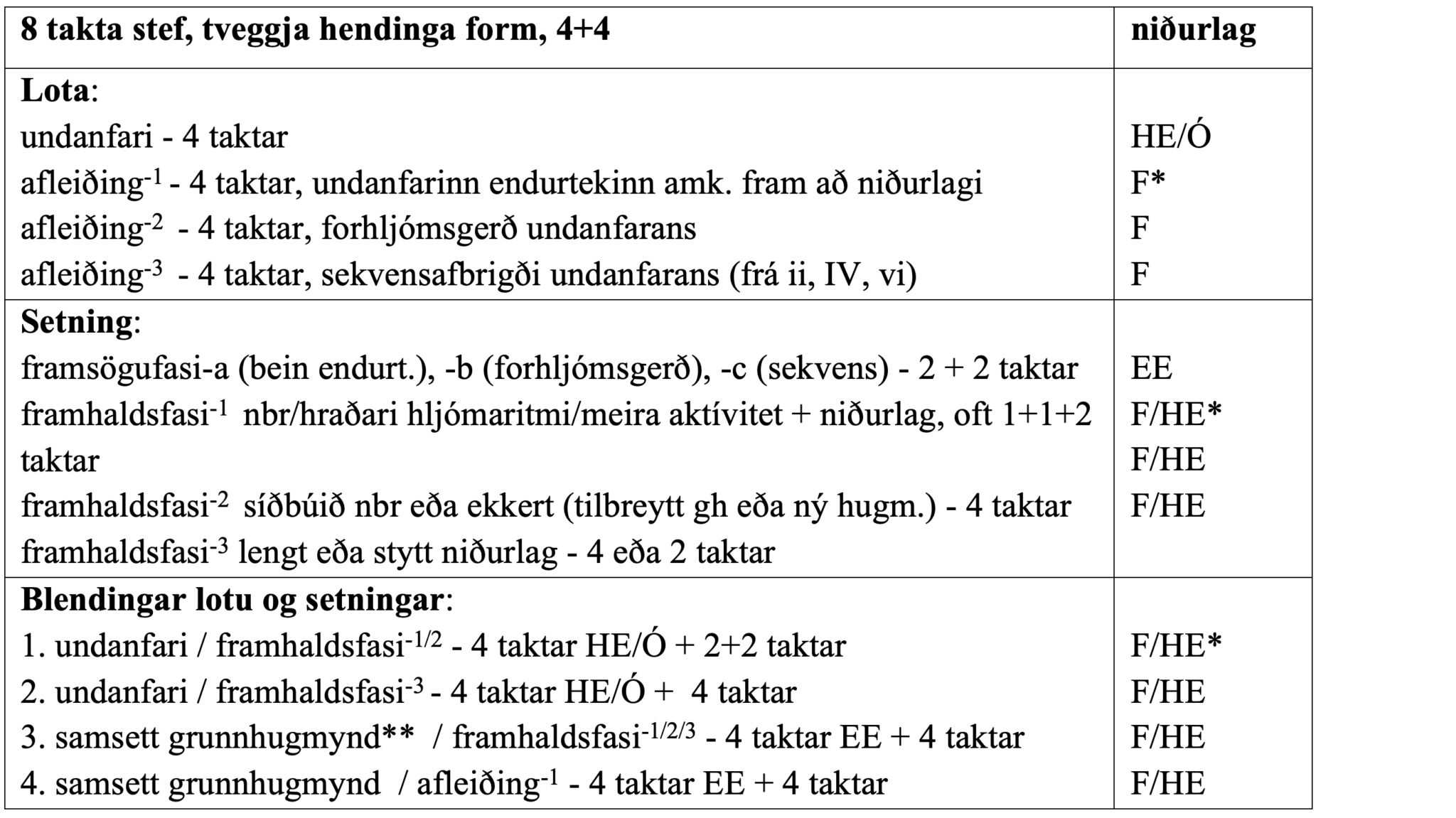
Table 1: 8-bar theme, two-hand form, 4+4. [*In the case of key changes, the downs are the same (F or HE) in the new key. **The term samsett basic concept (sgh) is twice the size of a basic concept and composed of two two-bar units, gh and ah, sgh resembles the precursor but is without a decisive conclusion.]
To better understand the foregoing, let us look at example 1. In the predicate phase of Beethoven's theorem, the basic idea is composed of two one-bar cells, a and b, which are then repeated from the antecedent phase In the follow-up phase, the b-cell is used as a material for decomposition, and in the conclusion come two new cells, c and d. All in all, are the one-bar four cells.
Sound example 1: Lv Beethoven, Piano Sonata in F minor, Op. 2, no. 2, chapter 1, t.1-8.[8]
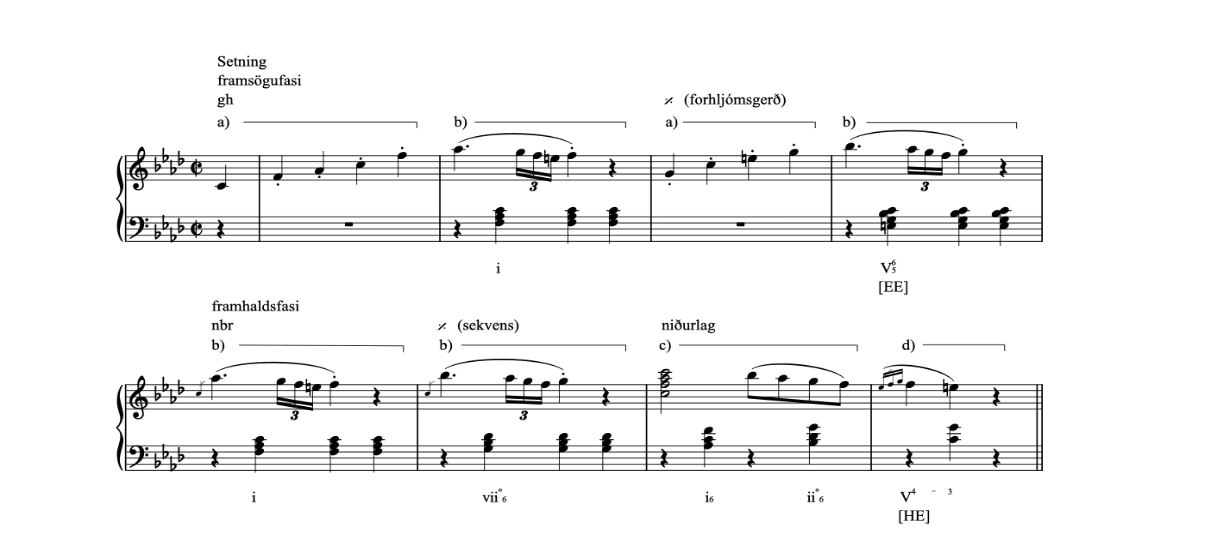
Example 1: L. v. Beethoven, Piano Sonata in F minor, Op. 2, No. 2, Chapter 1, t.1-8.
In Mozart's cycle (example 2) is gbushhthe idea composed of repeat one beat cell, a, but andvanta hthe idea contains two prim, b and c. In the result are a-the cells repeated directly but andvanta hthe idea is new. Here are the same beats the cells also four.
In Mozart's cycle (example 2) is gbushhthe idea composed of repeat one beat cell, a, but andvanta hthe idea contains two prim, b and c. In the result are a-the cells repeated directly but andvanta hthe idea is new. Here are the same beats the cells also four.
Sound example 2: WA Mozart, Sonata for piano in F major, K. 332, Chapter 1, 13-20
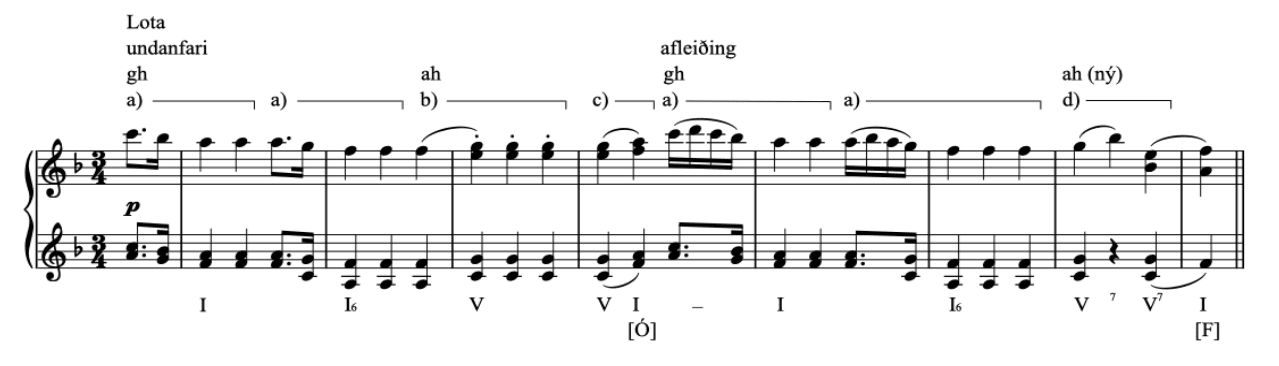
Example 2: WA Mozart, Sonata for piano in F major, K. 332, Chapter 1, t. 13-20
Í a hybrid Haydn's (example 3) contains gbushhthe idea prim a and b, and andvanta hthe idea prim c and d. In the continuation phase, a new idea comes in nthe breakdown, prim e, and then new prim í nlg. This is therefore six identical beats prim.
Sound example 3: J. Haydn, Partita no. 16 in D major, Hob. XVI:14, Chapter 2, t. 15-22.
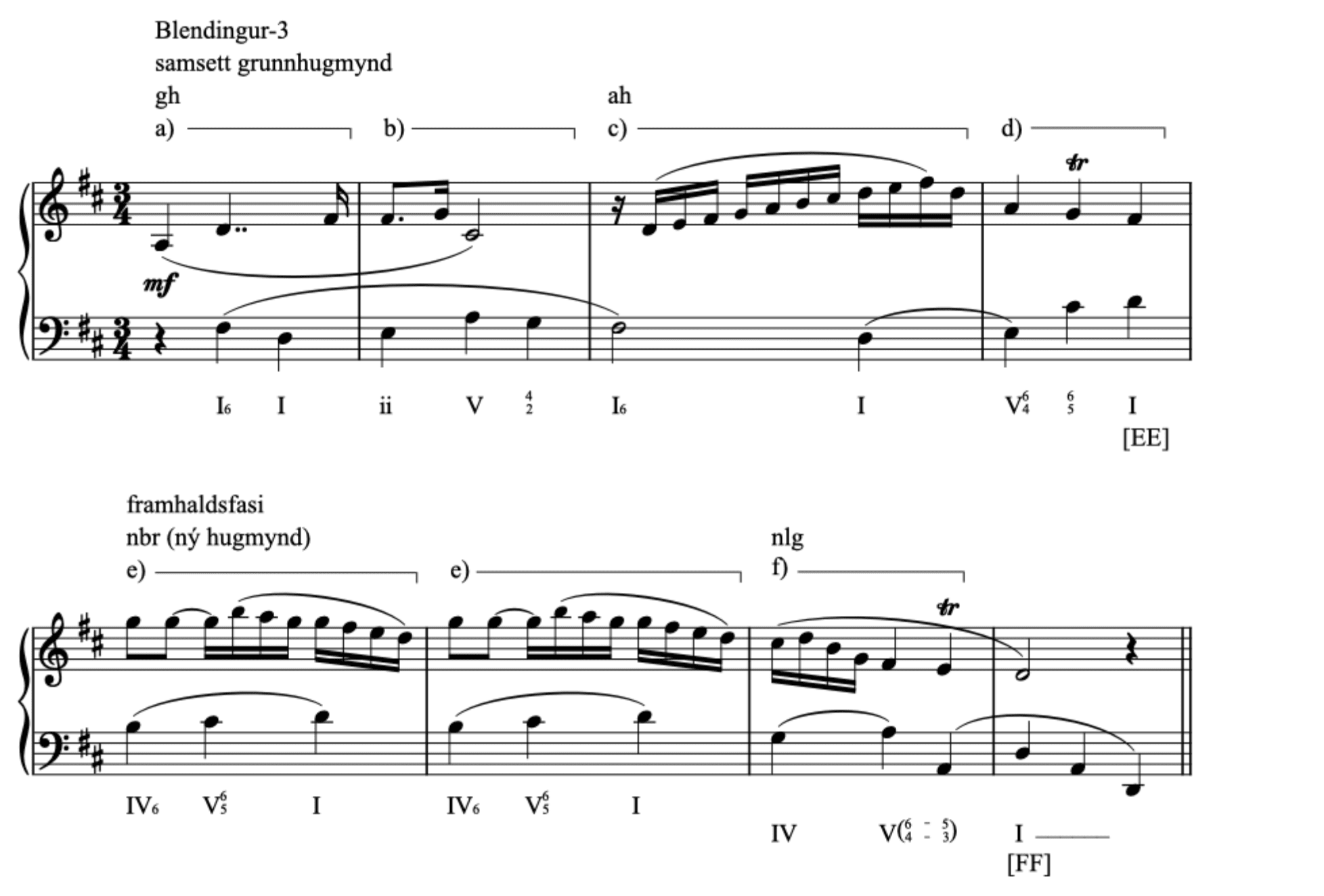
Example 3: J. Haydn, Partita no. 16 in D major, Hob. XVI:14, Chapter 2, t. 15-22
Prokofjev, some things about acoustics and songs
In a doctoral thesis by Konrad Harley from 2014, Harmonic Function in the Music of Sergei Prokofiev, he mentions the Russian musicologists, Viktor Berkov (1958) and Natalia Zaporozhets (1962) who put forward theories about Prokofiev's acoustics.
Berkov noted the „traditional“ prelude on a V-seat that could contain a seventh, raised seventh, and expanded fifth (C: gh-dis-f-f-fis) and resolves with four tones minifigitously on I
(hc/dís-e/fe/fís-g). Furthermore, Prokofjev could use VII-seats (h-dís-fís) as a substitute for V-seats in CD and #vii (gís-h-dís) as substitute V in am where all tones are solved with a small binary.[9]
Zaporozhets expands on Berkov's theories and explores how Prokofjev competes with „enhancing beauty and excitement“ (e. strips to maximize beauty and tension), with what she calls the „guide-precordion“ and the „guide-subprecordion“ that lead a little bit to the basic triad (H)D and DesD in CD). The prechord receives the same kind of minute-step encapsulation with a „guide-secondary prechord“ (FísD - GD) and „guide-sub-prelude“ (AsD - GD).[10]
With these definitions as a guide, we can approach Prokofiev's theme model and propose ideas for abrogations. Guide (pre)chords can appear in important destinations and have a mild characteristic of half-ends, as the solution of the chord in the opening chord of the next hand is based on small solutions.
The introductory theme of Prokofiev's Piano Concerto No. 1
The introduction to Prokofiev's first Piano Concerto immediately attracts attention for its seething repetitions that develop beyond Des's frameworkD the key, only to return „home“ A powerful thematic material that assures the unity of the work to quote the composer directly.[11] He uses the introductory theme three times in the work, as an introduction, at the end of chapter 1 (presentation) and at the end of the work.
The form of the introduction is strophic, five eight-bar „hybrids“ divided into three representations with piano (Solo) and two with orchestra without piano (Ritornello) The material is extremely simple although five one-bar originals, a, b, c, d and e can be picked[12] in the order in which they appear Only two cells are used on a regular basis, b and c but d is used twice in one hybrid. Primary b, c and d are closely related to the least in terms of shape and direction.
In example 4, the cells can be seen in the first three hybrids of the introduction.
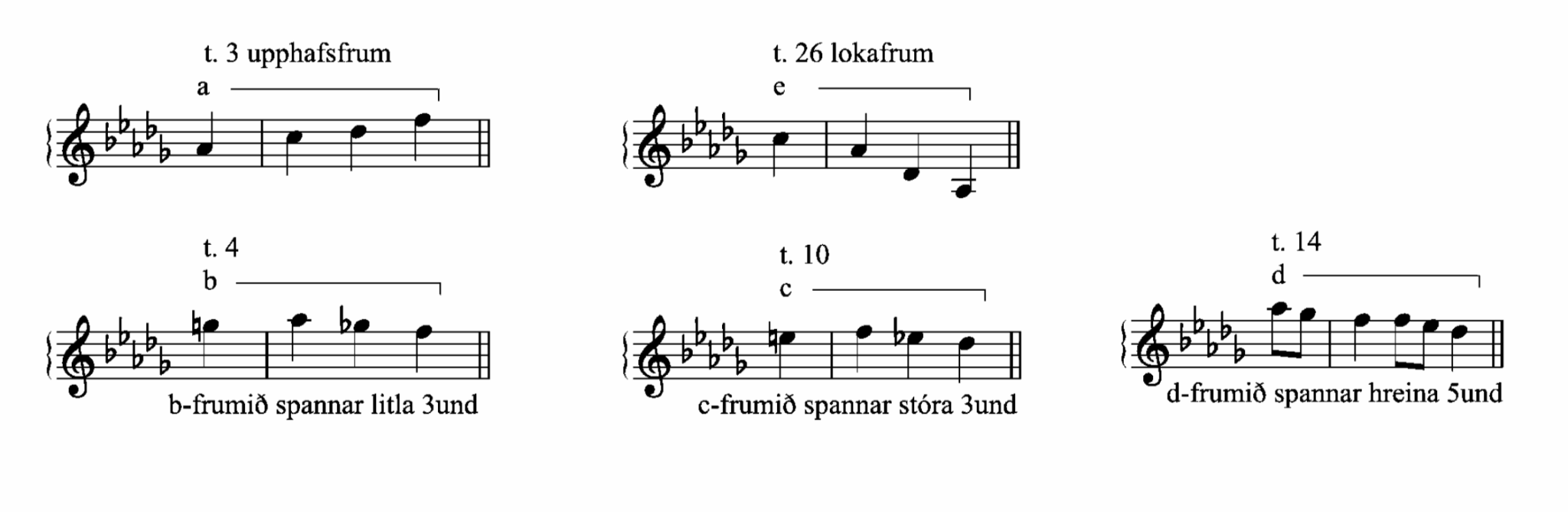
Example 4: Melody origin in the introduction of Prokofyev's Piano Concerto
In these 24 beats, the cells are divided as follows: t. 3-10 abbb-bbbc, t. 11-18 bbbd-bbbd and t. 19-26 bbbc-ccce. Interestingly, in every four-bar hand, one primal is repeated three times against one representation of another primal. How can we define the hands that clearly form eight-bar integrals?
Consider example 5. According to the classical tradition, a four-bar trigger divides into 2+2 bars; two basic ideas, or a basic idea and a contrasting idea. In t. 3-6, there are clearly not two basic ideas so we think ab (t. 3-4) be a basic idea and bb (t. 5-6) as the opposite idea. Sound entries in t. 5-6 support this although only the chord reactions are changed The result is not decisive but [EE] and the first trigger is therefore a composite basic idea.
The second part of a theme is either a continuation phase or a consequence The basic idea of the trigger should be repeated, therefore we define t. 7-10 as a continuation phase with decomposition and conclusion The result is decisive, the entry in vi64 in t. 9 and the final chords, bbVI+64 and the whole-tone chord on II that forms a mild guide chord relationship with the opening chord of the next hand Rhythm 3-10 we define it as hybrid-3, a compound basic concept, and a continuation phase.
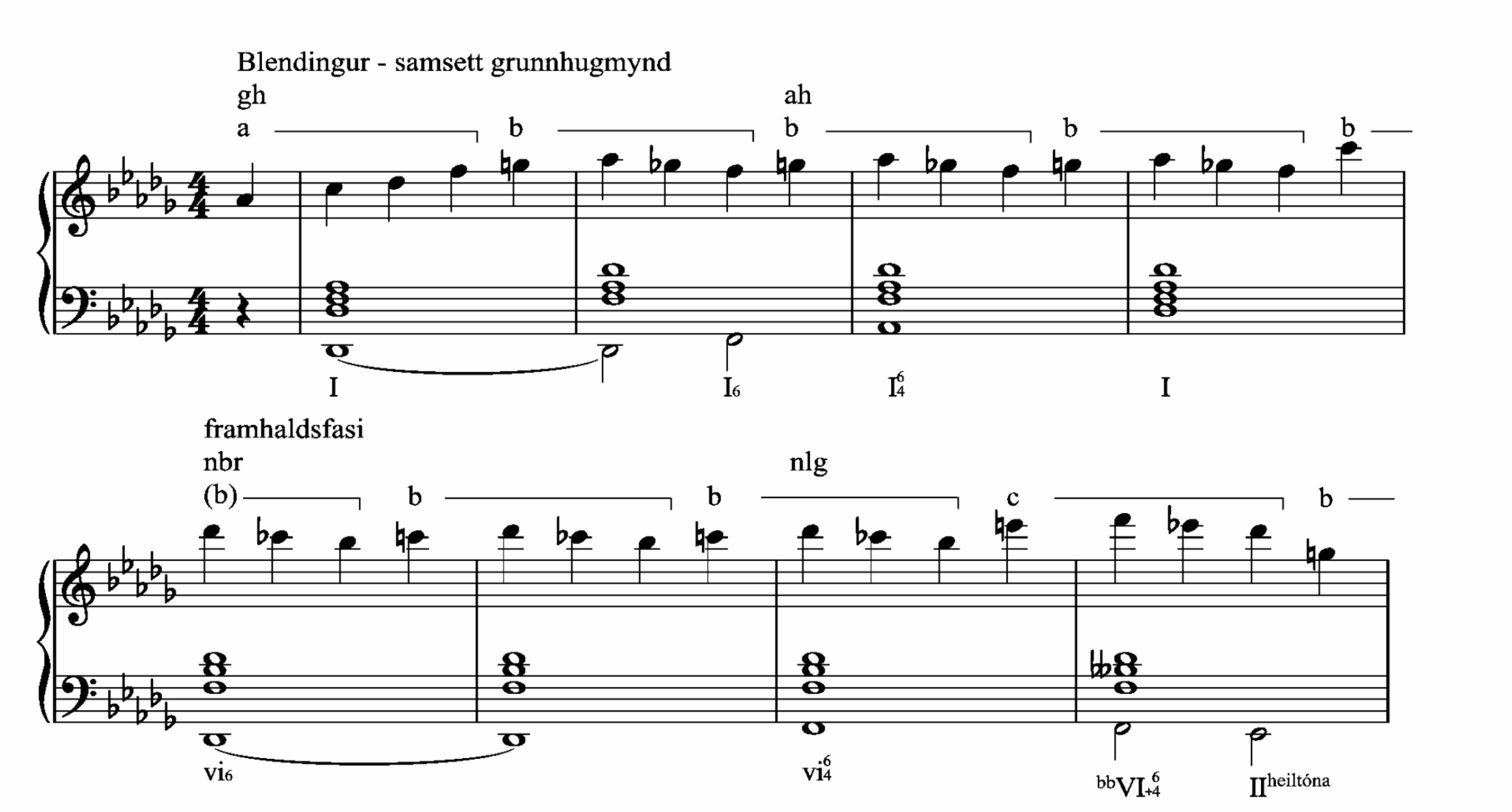
Example 5: Sergej Prokofjev, Piano Concerto No. 1, t. 3-10
Rhythms 11-18 can be defined as hybrid-4, a composite basic idea and a consequence where the basic idea in t. 11 is repeated in sekvens in t. 15. The final chord ii11 forms a mild navigation chord relationship with DD the chord, the opening chord of the third hybrid.
Sound examples 4: Samsvarar examples 5-6. (note the phoneme contains t. 3-24)
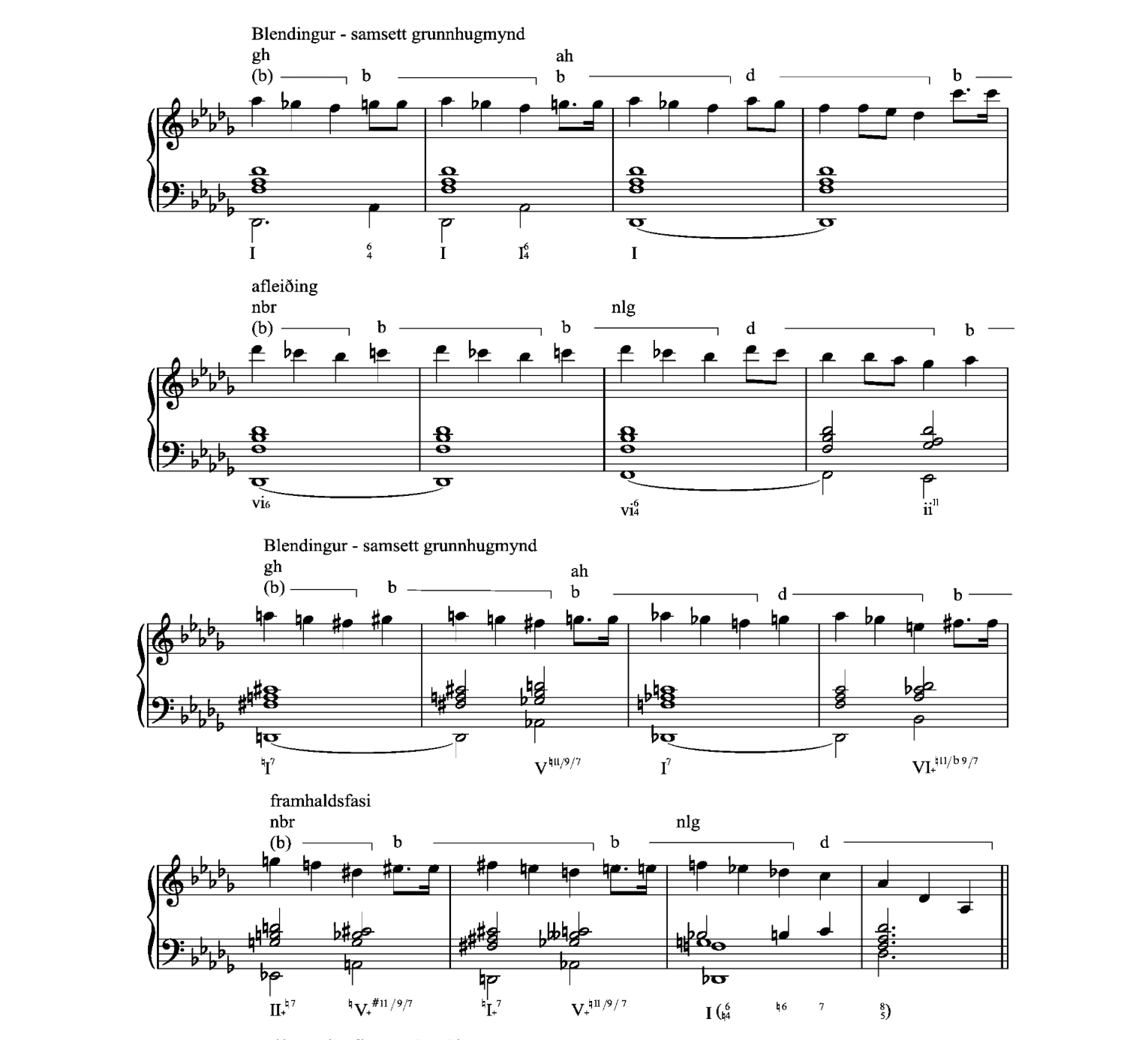
Example 6: Sergeij Prokofjev, Piano concerto No. 1, t. 11-24
The third hybrid is a composite basic concept and a continuation phase Now the continuation phase is more in line with the traditional model, with considerably more active key entriesFor fun, it can be noted that with DD the process from t. 19 has Prokofjev filled in the chromatic scale.
Sixteen-bar compound theme form
The compound cycle and the compound sentence are simply a doubling of the eight-bar schema forms, Two sentences form, for example, a compound cycle if the first sentence ends with an open conclusion, HE, FÓ and the second with a closed, FF.
The compound sentence appears to be slightly more complex, two compound basic ideas, 4+4 bars, form the predicate phase Where the basic unit, the compound basic idea, is four bars, the decomposition becomes two bars, unlike the simple sentence where the decomposition is one beat; half of the basic idea or the opposite idea.
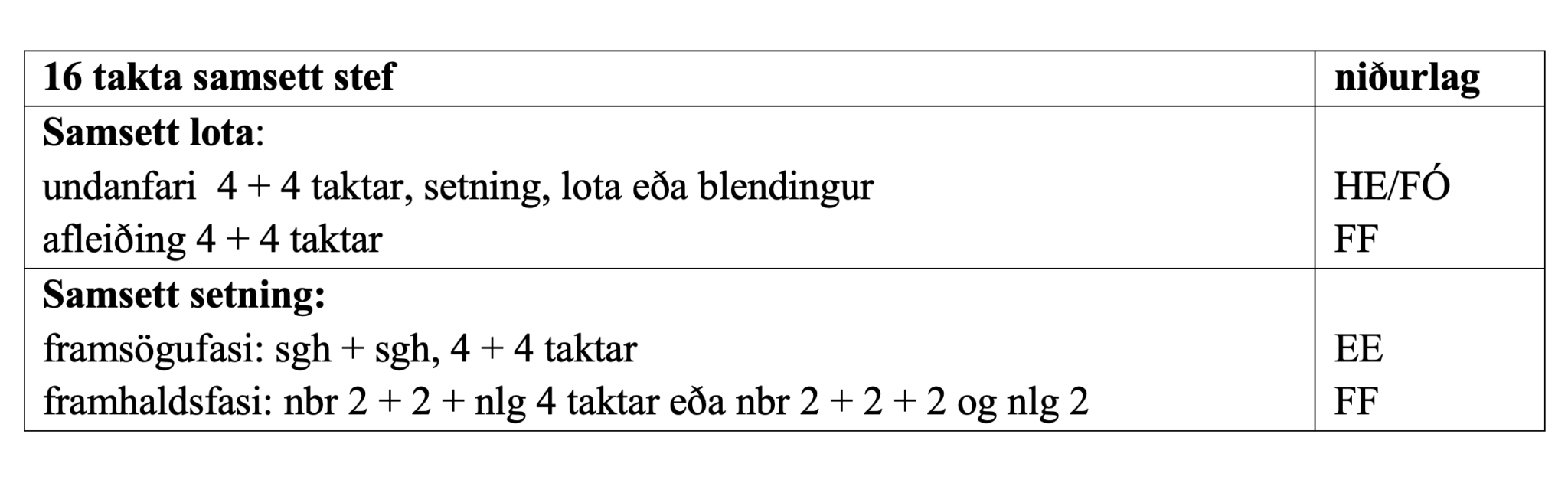 Table 2: 16-bar compound theme.
The phrase form is evident in the first concerto.[13] One theme can be distinguished that follows the model of a compound sentence in the workThe direction is marked Animato at practice number 17, t. 216-233, it closes the second theme area of the presentation[14] and prepares a different presentation of the introductory theme The introductory phase is traditional (sgh+sgh, 4+4) but the follow-up phase is irregular, 5+5 bars; decomposition to 3+2 bars which are then used as a model on the conclusion where modulating in the key of the introductory theme The direction then returns to practice number 34.
Prokofjev adds more when it comes to doubling the modalities of a theme In the same way that a simple sentence can be doubled into a compound 16-bar sentence, a 32-bar integral can be formed based on the same basic principleWe can think of the following table with different sizes of sentences:
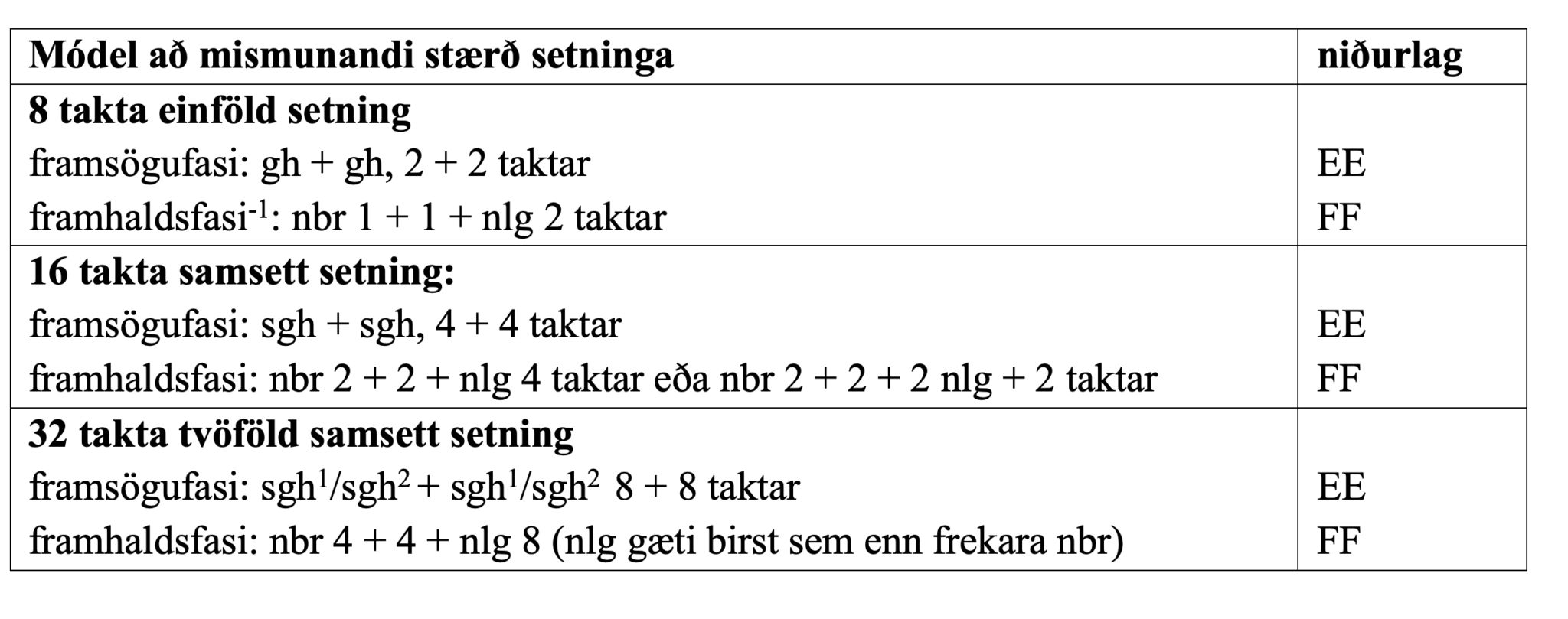
Table 3: Models of different sentences.
32ja a rhythmic double compound sentence then relies on two opposites composite basic mind-pictures where the first is a basic idea and the second an opposite idea, a total of eight bars. The breakdown is then four bars and duplicated and the conclusion eight bars according to the model, but here you may have to offer some flexibility.
Sound examples 5: SergejProkofjev, Piano concerto No. 1, 45-58 (see example 7).
Í Piano concerto no. 1 left Prokofjev come three places to consider að 32yes rhythmic compound sentence, in bar 378 (10 beats after practice number 30), a theme starts that falls exactly to 32yes beat the model. Another exciting a possibility is the piano bridge at practice number 3, here begins an impressive breakup in CD, strong contrast following the introduction and it doesn't hurt that the first stepphéd whole is irregular, or seven bars. If we try to try t. 45-51 we presentation phase 32yes rhythm modelsin we see that this works perfectly as the first part (instead of 4+4 bars there are 3+4 bars) and with the repetition, sekvensinews from the ii-seat, the presentation phase is perfected (see example 7).
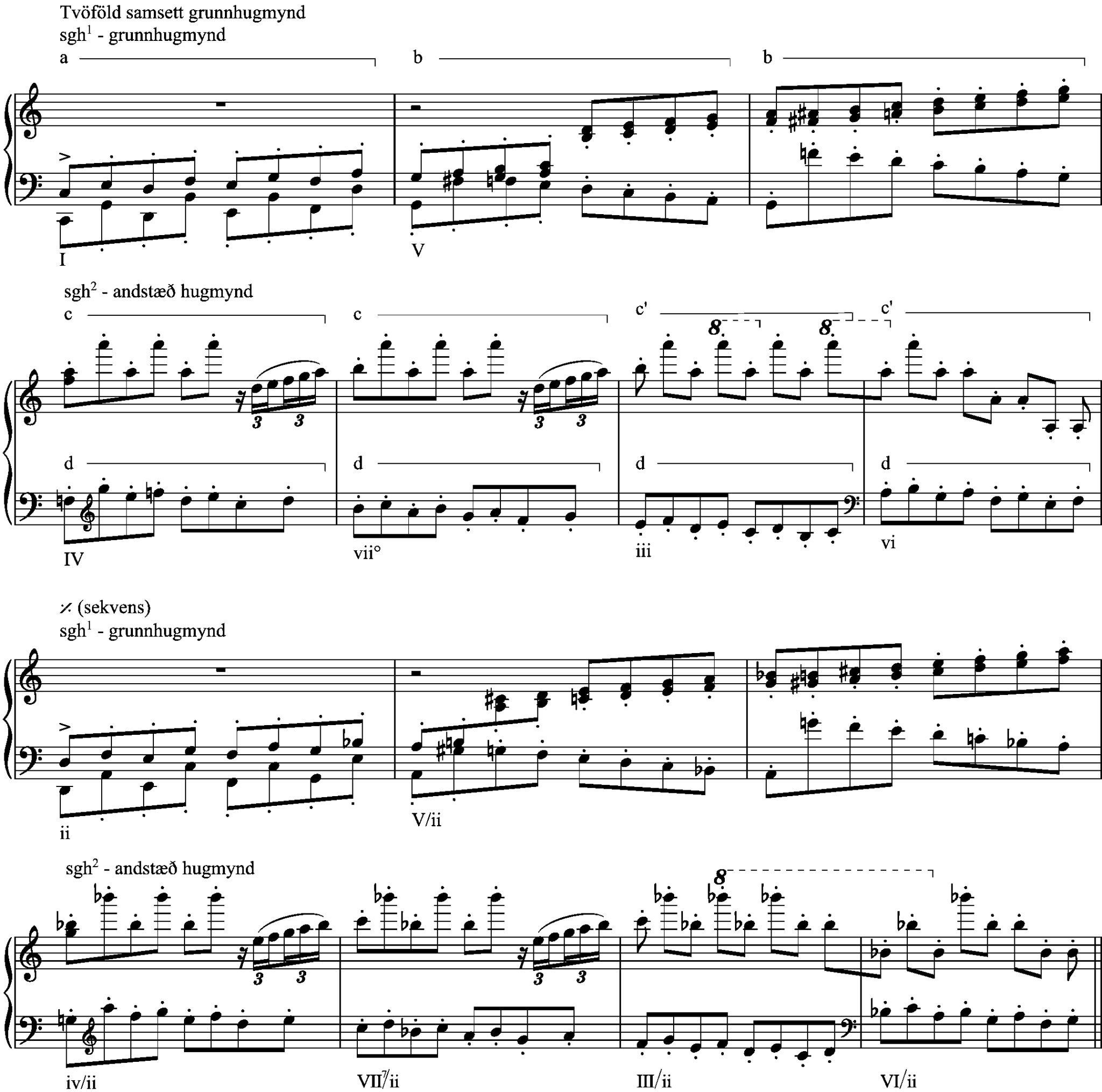
Example 7: Sergeij Prokofjev, Piano concerto No. 1, t. 45-58
In bar 59, the follow-up phase takes over with a four-bar decomposition that is repeated, then a shorter and more irregular decomposition leading to a structural foreshadowing, 32 beats after the beginning Four beats later is GE and new material takes over that prepares a modula vision home in DD since the main theme[15] The (previous theme) of the chapter appears.
The third possibility of the double compound sentence is in iteration/processing, in t. 318, two beats after practice number 27.
Final words
An attempt has been made here to analyze Prokofj's form of strategyevs in Piano Concerto No. 1 from William E. Caplin's classical theme forms and definitions of them Here is indeed an unploughed field that will be exciting to deal with in order to gain a better understanding of „key-based“ music at the beginning of the 20th centuryI would like to thank Hjalta Thor Davíðsson for her collaboration in the analysis and suggestions for reading material that were used in the preparation of the article.
Bibliography
Caplin, William E.. Analyzing Classical Form. New York: Oxford University Press, 2013, Kindle Edition.
Harley, Konrad. „Harmonic Function in the Music of Serge"iy Prokofiev.“ PhD thesis, University of Toronto, 2014.
Prokofiev, Sergey. Diaries 1907-1915: Prodigious Youth. Anthony Phillips translated. New York: Cornell University Press, 2006.
Taruskin, Richard. Music in the Early Twentieth Century. New York: Oxford University Press, 2010, Kindle Edition.
(T.O.N.
[1] Richard Taruskin, Music in the Early Twentieth Century (New York: Oxford University Press, 2010, Kindle Edition), pp. 776.
[2] William E. Caplin, Analyzing Classical Form (New York: Oxford University Press, 2013, Kindle Edition), pp. 33-157
[3] We don't have to go far into romance to wonder if this will work out there and whether need if the half-end phenomenon is to be redefined in terms of music of the second half of the 19th century and the beginning of the 20th.
[4] The presentation phase, continuation phase, precursor and result are concepts derived from Árna Heimi Ingólfsson's unpublished translation of Elements of Sonata Theory by James Hepokoski and Warren Darcy.
[5] Caplin, Analyzing Classical Form, pp. 102.
[6] See, for example, bars 5-6 of Mozart's A minor sonata, K. 310.
[7] Caplin, Analyzing Classical Form, pp. 63.
[8] All audio examples are from the notation program Dorico
[9] Konrad Harley, „Harmonic Function in the Music of Sergei Prokofiev“ (PhD-thesis, University of Toronto, 2014), p. 2.
[10] Konrad Harley, „Harmonic Function in the Music of Sergei Prokofiev,“ p. 4.
[11] Sergei Prokofiev, Diaries 1907-1915: Prodigious Youth, Anthony Phillips meant (New York: Cornell University Press, 2006), p. 237.
[12] One cell, f, is added at the end of the fifth hybrid, a kind of „by end“ original.
[13] The sentence form is more direct than the session, it calls for something that resembles traditional ablutions.
[14] Prokofiev, Diaries 1907-1915: Prodigious Youth, p. 236.
[15] Prokofiev, Diaries 1907-1915: Prodigious Youth, p. 236.