Atli Ingólfsson
THANKS FOR A CAR WRECK[1]
Covers
Anyone who has their say in talking about aliens as if they are among us, I don't think he is either an agitation reporter or a philosopher? Neither would be particularly fortunate for a reader who just wants a realistic and insightful chat about an interesting issue.
He might be mistaken for something like this. Anyone who wants to speak with an easy-to-understand sense probably has his case in some other way. And hopefully we just don't have to think about it here.
All about that, I just met an alien and thought of asking about her shoe equipment. At the same time, it was an occasion for a little Icelandic teaching.
I said, „You have a steel cover in your shoes“ Then I explained, „There's a steel cover.“.
The creature was eager to learn and said, „Yes, I understand. Yesterday I heard about an umbrella. So it's a protection from the rain.“
This I had to correct. „Actually, she's to spare rain.“
Since we were in a workshop, I pointed her to face shields if she needed to.
„Yes, I understand. To spare us from faces?“ Again, I had to correct.
Should I have managed to explain to her a steel cover, umbrella and face cover? What is a rollover cover?
Oh, words. There doesn't seem to be any default way to understand them. It's almost as if we need to understand the language in order to understand the language. The words come with a context that is necessary to understand them. A shield is, of course, an object made of some solid material that could be described in many ways, but in compounds, it takes on a different meaning, and it can be very consequential to confuse them. An umbrella cannot serve the role of a steel shield.
Let's now jump to a completely different place where a similar problem is at hand. A certain man got permission to have a junkyard on his property. No such place is a particular sight to behold or an image of order, but the owner knew his way around it well and knew where to find every single hubcap. The fun, however, ended when a caretaker for the town's cemeteries was hired. Then, inquiries began to arrive about order, registration, and planning, which our man didn't understand at all. The cemetery superintendent, in turn, didn't understand why such vague answers were being given—for example, in the „open to family“ field, it said „yes and no.“ Shortly after, the director himself ran into a similar misunderstanding when the town's head of horticulture announced proper standards for planting, thinning, and soil amendments, since this was, after all, a garden. For the „Habitat for Icelandic Flora“ field, the cemetery manager wrote: „yes and no.“.
Yes and no
Here I allowed myself to test the reader's patience and air what seem to be mere word games. They are the best of entertainment, but their subject is grave; and with that, the word games end. I would like to consider the word art school. I can find no shorter way to get to the point than the introduction above, and one more thing: An account of my interactions with an old friend who is a biochemistry researcher. He is a university professor.
We value the companionship very much, and in fact, we each feel ourselves grow from the knowledge the other provides. Our admiration for each other's specialty is constant, and we are always inspired by the other's tidbits of knowledge, as we both claim to have gained a small insight into a field we didn't major in at university. However, I have noticed certain milestones in our interactions. It's like when I pretend to have figured something out in biochemistry, I might say, „So amino acids are the passport of the genetic material?“ He then replies, „Yes and no, it's not quite that simple.“ And it's the same when he comments on music: „Aren't the beats kind of a connection to the physical in the music?“ Answer: „Yes and no, etc.“
It seems that when you have a basic knowledge of a subject, it's easy to generalize about it without being completely wrong. However, once expert skill is achieved, the context of all statements becomes so broad that they become invalid unless countless appendices and footnotes are included. They become academically useless otherwise. That's why my colleague is insufferable. And indispensable. He is indispensable because it is the expert's responsibility to maintain their field's scholarly body of work and not to settle for superficial generalizations, no matter how sensible they may be.
But our mutual admiration is not just based on curiosity about another field of study. It turns out that my specialty, art, is inherently different from biochemistry and unlike all scientific and academic disciplines. It is, in fact, a different kind of organism, like a fungus among lettuce plants. This seems to stem from the fact that while the academic disciplines all have a theoretical discourse as their goal, something different is in the pipelines of art.[2].
It has only added to my partner's fascination and surprise.
We agree that a person with his education would be reasonably quick to acquire specialized knowledge in various other physical sciences. But to find his footing in the quagmire of art's semantics would take him ages, and it's uncertain if he would succeed at all. Here, his scientific compulsory education is possibly just a hindrance.
I'm reminded in this context that the Iceland University of the Arts recently hosted a woman from the healthcare profession. She addressed the staff and said she had been unsure how to approach them. She felt she didn't have a sufficient understanding of the school's work. She said, however, that she had mustered the courage and imagined that a key concept in the work was creation, that it was about being creative. Then she sought confirmation from the audience. I felt that the audience all thought the same thing: „Yes and no, it's not quite that simple.“ Fortunately, artists are also unbearable in this regard.
But the visitor wasn't quite wrong: Creation? Well, well, that way. To a large extent, the artist's work is about creativity. But it's a creation of a special kind.
Semantic distortion
What kind of thing?! Is art really that scary different from science?
Now I'm going to try the impossible: To give an idea of what art does. This is a hypothesis. To many readers, it will seem either a gross oversimplification or some kind of mental gymnastics of absurdity. But perhaps it will be intolerable to both? Well, at least it serves a purpose.
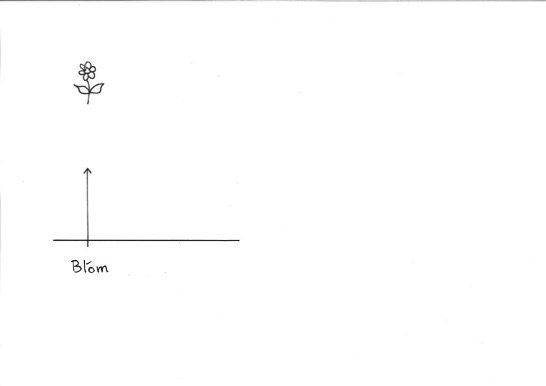
figure 1: Now draw a horizontal line. Below it we put a symbol, but above it we have the symbol, an idea, concept, or theory that the signifier refers to. In academic texts, we try to have a direct and unambiguous connection from the signifier to the signified. If I use the word „flower,“ it refers to the image that most people get in their heads when that word is used, as figure 1 shows.[3].
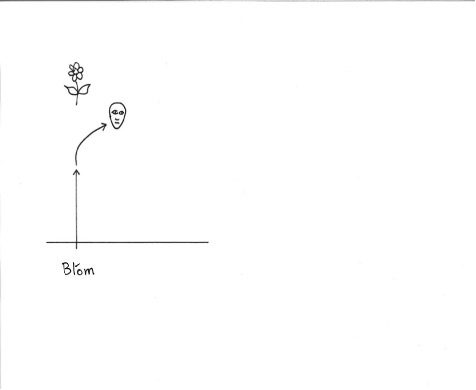
figure 2: It so happens that the artist must distort this simple connection between sign and referent. This is actually quite common in everyday speech, where it's called metaphor, but for the artist, it is a working method. We distort the direct meaning in order to evoke a derived meaning. Thus, for example, we say that the word „flower“ in figure 2 actually refers to a person. Metaphor is a very simplified picture of this phenomenon, because what the signifier refers to is often not so easily expressible. But for the sake of simplicity, it can be presented this way. If that were all, this wouldn't be remarkable. But let's see what happens next.[4].
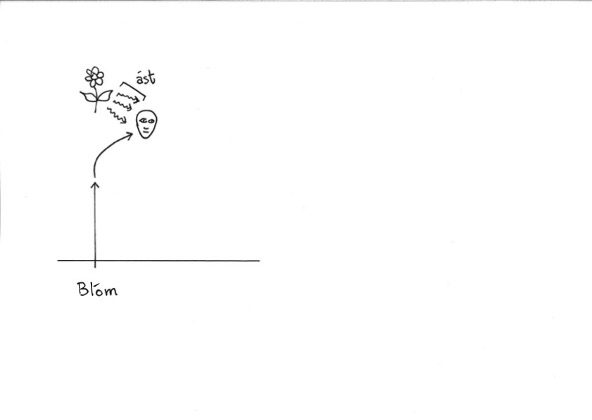
figure 3: The relationship of the direct meaning to the distorted meaning produces a new thing. There is a certain current, and in this picture let's call it love.
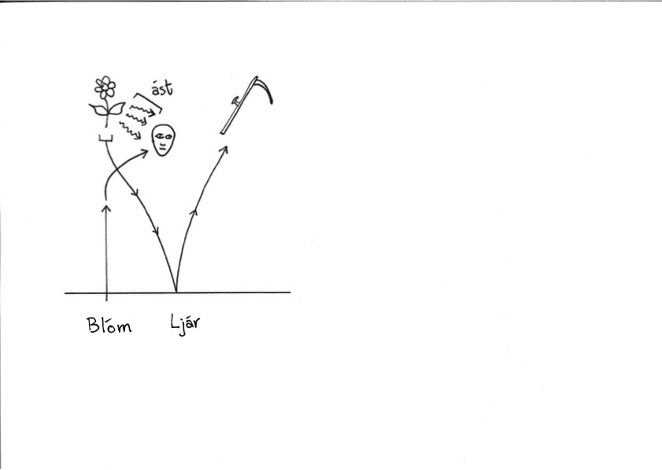
figure 4The remarkable thing is that even if the first symbol deviates from its literal meaning, its concept can influence the development of the work. We see that mysteriously, the idea of love is born in the mind, and even stranger, the first sign now casts a new idea onto the „leaf“ below the line. It is the idea of what uproots vegetation. The „scythe“ sign is used on the leaf. This time, the meaning is perhaps not distorted. Let's just say it applies to a real scythe.
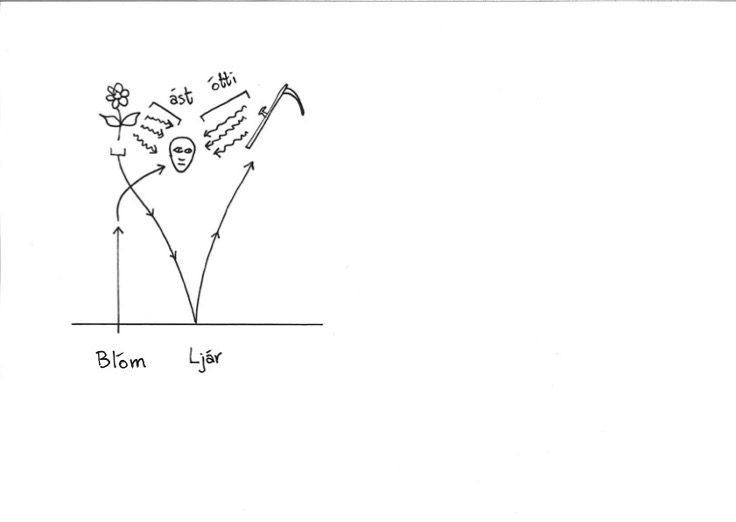
figure 5This new addition has a special effect on the mindscape that is under construction. In addition to love, a current is now generated that could be called fear. Now the reference of symbol 1 has induced symbol 2 and its reference contacts the derived meaning of symbol 1 and generates a stream.
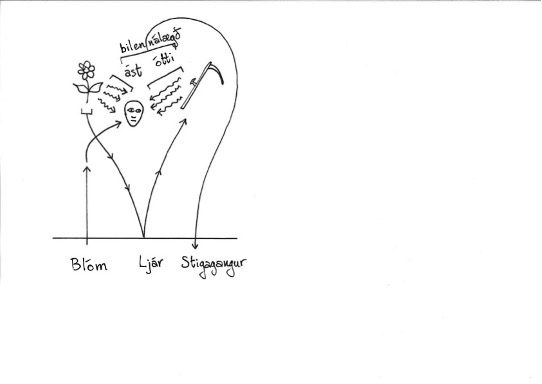
figure 6: Now here are two somewhat inverse currents, love and fear. A particular feeling is created between them. They are distant but still live in relation to a single shared space. That feeling can give rise to a new symbol: a staircase has some of the same qualities—proximity yet distance, tension or separation between neighbors, etc.—but many other things could be born there. Here, associative connections are at work., as we are used to from everyday life, here we will be like fermenting in the heartbreak, and completely free from some reasoning. One of the methods of art is to jerk the ideas hard enough so that they roll over one circle further than they would in normal communication.
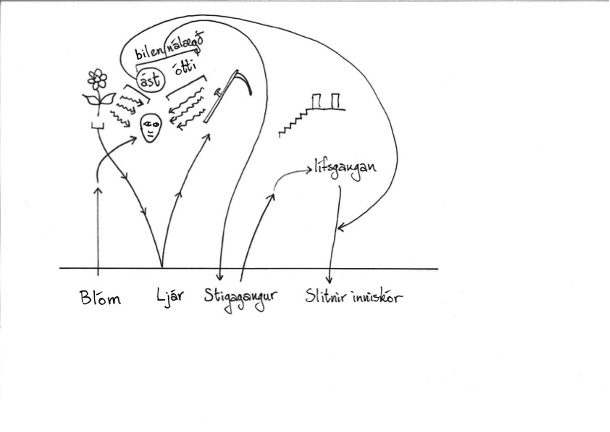
figure 7: Now we take a leap forward, as the reader is beginning to understand what kind of meaning drum we are in: Stairway has this shifted connection to love and fear, but then its direct meaning is distorted and becomes an idea of the life walk, but the idea of walking can produce a picture of worn shoes. Since we talk about stairwells, however, we switch to shoes that are often on the feet in the common: slippers. One of the concepts that came to light in the process was love. It could lead to worn slippers with embroidered hearts.[5]
Here we were looking at what could be the work of creating a work of art. A trained creative might navigate this path unconsciously in a second, but it could also be a deliberate and conscious process. It doesn't matter, because here I want to focus on what happens rather than how or when it happens.[6].
However, the pictures only show the preliminary work itself[7]. It is added to it type of the artwork. Then the work's symbols are collected and knitted, kneaded, played with, arranged, stacked, distributed, or whatever it is that makes them a work.[8]. In that work, a skill comes into play that is quite different from the muddled mess described above. Let's call it artistic craftsmanship, and it encompasses all means of representing the inner world. There, the relationship of this representation to the recipient is what matters most. The artist asks themselves how the inner world is to shine and develops methods for it to do so, whether overtly or covertly, repeatedly, on a large or small scale, and so on.
When craftsmanship comes into play, a profession is created that is completely unique and resembles no other spiritual human pursuit. Here, the logical reasoning, engineering, or rhetoric inherent in the craft meets the perfectly free improvisational engine of ideas. And it is precisely the freedom that gives meaning to the engineering, and the engineering that gives meaning to the improvisation.
The thread in between could be called intuition. Intuition is probably the soul gift that determines whether the meaning distortion above will be fruitful or just silly. It is the hardest thing to teach, but it grows through relentless practice. practice of art.
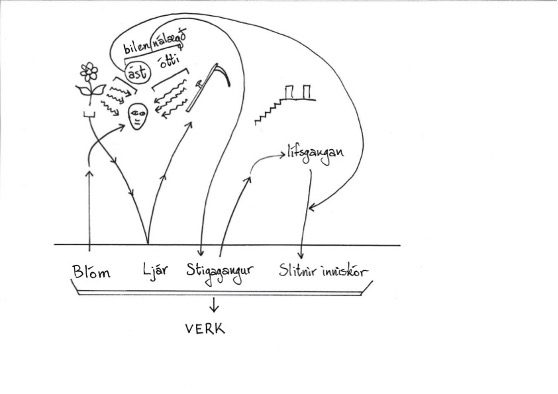
Á figure 8 has simply been added to the bottom of the map a somewhat powerful horizontal line, a kind of firewall. She describes that the step from the work of meaning to the work can be quite large, and the difficult one is the wall that separates this. However, it is not a law of nature and we often witness a beautiful osmosis of the mind to a work. But it is undoubtedly a special subject. [9]
This was all. The brazen generalization presented here is that two things are borne in art: 1. That it constantly hacks on the direct path of a sign to meaning. 2. That it uses artistic craftsmanship to reveal the resulting stir of meaning.
This must not be taken too literally, but is hopefully clear enough. Here we are not necessarily talking about simple symbols and known symbols, but rather a specific way of being artistic thought, constantly turning out in order to expand the meaning of their symbols. Some have described art as symbols without references and it is a good attempt to handle this subject.
It is not disputed here that artists of all time have routinely used symbols that audiences understand almost without question. However, the symbolic relationship is always tenuous when it comes to a work of art. It would be too long a matter to do it justice.
Electricity
Now I ask the reader for an extended license for gross simplification.
If there is anything to this above, the main difference between science and art would be this: Science is aimed at rational conclusions - temporary, blurred, limited, questionable... but always something that can be discussed in a rational way - but art is not aimed at results but at the lack of place. This is often the case that if the mind world is too smooth, the craft takes care to exaggerate it, but if it is very rude, the craft seeks to smoothen it up a little. But the result is some kind of nonsense.
Obviously it is possible to discuss about art in a theoretical way and it is an important and enriching part of learning and culture to do so. But it is not to be confused with art itself, practice her and training.
In other words: Science takes something that is incomprehensible and strives to make it understandable. Art would rather take the obvious and make it incomprehensible.[10]. Those unfamiliar with the field might think it's just a matter of being vague enough, of doing something strange (which many seem to associate with the word „creative“). It's not quite that simple. The uncertainty of art is perfectly clear. It is unrealistic in a very precise way.[11]. It is not „maybe“ or „a little“ realistic. It is a special kind of discipline at work; the conceptual work and the craftsmanship work together to achieve this result.
And it is not that there is any sense in looking at a person and thinking „flower“ But in this action, electricity is generated in the mind, precisely on the edges where these two phenomena do not coincide, and it is this electricity that drives all living thinking, also the thinking that ultimately solves the mysteries of science.
In these placelessnesses of art lies a mission, a spark of life and its dissenting power.
Athena's love affair
In many countries, the educational system of art is now being honed together with the coordinated organization of universities. This is what we see in the very name change of many institutions: those that used to be called Hochschule or Academy now pick up the name Universität, University etc.
Art universities undoubtedly benefit from community with other universities. Furthermore, scholarly discussion of art is well-suited within them; after all, the proximity to the phenomenon itself, or at least to the work involved, is greatest there. Nevertheless, the unique position of art universities is absolute and very valuable: They are the only institutions that champion the aforementioned „unreason“ of art. Therefore, care must be taken that this standardization does not threaten this most important mission of theirs.
The argument could fall prey to superficial generalizations. For example, to increase the importance of the creative disciplines, they are often grouped together into a single broad category. This can certainly have political value, but it could backfire on the artist: What if funding for the creative industries is counted as support for artistic practice? This is where the pros and cons come into play again. To say an artist works in the creative industries is like saying a carpenter is in sports. Carpentry is also a sport, but that statement says very little about their work.
Now I refer back to my colleague's communication above. He could explain and defend the importance of all academic disciplines taught in universities. Their methodologies largely overlap with his own field. But unfortunately, despite our extensive communication and his goodwill, he is not equipped to speak with authority on the methods of the art. He is university student, no art university student. In this regard, the responsibility of art universities is therefore great.
But aren't these unnecessary words? Is there anything that threatens art?
Yes and no. It has two rather aggressive admirers: the Market and Academia, and sometimes also Politics, to varying degrees. Art certainly benefits from the attention and should flirt with all of them without hesitation. The problem is that these admirers seem to want to claim her as their own and control her. That must not be allowed to happen.
We all know the love poems they send to their goddess: „She adds value to the product. She creates a new kind of knowledge. She improves society. She promotes innovation in industry.“ Unlike many love poems, everything here is true. There's just a little something to add to this:
Art is a multi-material for the market, but it does not comply with its rules.
Art is an inspiration for a better society, but it does not obey its moral principles.
Art is a fuel for business innovation, but it does not serve their purpose.
Art creates new knowledge, but it does not behave like a discipline.
Because if she did, she wouldn't be a multi-material, an inspiration or a fuel.
I'll explain this quickly with a metaphor that my partner would be proud of. It comes from physics: In order for the energy level of a system to grow, energy must therefore be received from the outside.
From the outside.
On a car wreck away
In order to have its own place in society, an art university must ensure that it does not belong to another place. This could cause some identity crisis: Doesn't an institution called university to act accordingly and do what universities do?
That can be answered with a reference to the word games here at the beginning. That something is called art college doesn't mean it's a university, any more than the name car cemetery is a cemetery. The word simply means „an institution of art education at the highest level.“.
This organization should focus on what the art does much more than what universities do.
She doesn't have to discuss something else to prove her right to exist. It just showed doubt, as if art wasn't a complex and extensive subject.
It is safe to turn the professional's responsibility to an art university: He should be responsible for maintaining the professional biomass of its industry and shouldn't accept superficial generalizations. No other educational institution can be an advocate of art.
It is apparently neither a tabloid journalist nor a philosopher who writes here, but an artist. And most of what has been said here seems obvious. And the many-century history of art seems to say the same. One who advocates for art education will hopefully take note of it. It brings us this nature described above. This is self-evident and is why we feel it is worth engaging with its world, despite its mixed outcomes.
This should be so obvious to those who organize arts education that you'd think of aliens if they don't see it. Like the one above, who is struggling with the compound words of the language. The one I was just talking about. let's protect; which does not understand that a word changes meaning depending on which word abstains from it. Just when we need solid shields from the encroachment of the hopefuls.
Otherwise, the one who should be spared hits.
PS.
Senior Reader 3: „But isn't this article just a superficial generalization?“
(T.O.N.
[1] The title may sound scary, but it primarily refers to the joy of a boy who gets to play unmolested amidst old useless cars.
[2] This wording refers here to a discourse that has meaning and deals with ideas and factsso they can be debated or disproved.
[3] This is some simplification and I am not going to claim that this relationship is unequivocal and hassle-free in science. I guess would be not correct saying the symbol „aims to“ refer to one image or concept?
[4] Hopefully the reader is aware that although a word is taken as an example of a symbol, it actually means which one phenomenon that is: Everything can become a symbol.
[5] I'll leave it to the reader to make a poem out of this. It could end with a poet in a constant state of tension – in worn-out indoor shoes with hearts on them – searching for the right spot for the potted plant her ex-lover left behind, while an old scythe hangs for decoration at one apartment.
[6] That is not the subject of this article, but this frivolous drawing of semantic distortion (and thus -formation), is marking it, removes all doubts about whether a machine can create a work of art: Semantic formation cannot happen without lives experience. That's what's behind all the turns of the example above. See also about intuition a little further down the text.
[7] It should be noted that what is called preliminary work here is in fact largely concurrent with the construction itself. Although this is „pre“ -liminary work, it does not necessarily refer to a chronological sequence of tasks.
[8] Here we are no longer talking about words but any subject, as everything can become a symbol.
[9] Although this makes it sound like first there's an idea and then the work, it's like with the preliminary work before this; you can't pin it down. This can come about more or less at the same time.
[10] Here, „unintelligible“ is used in somewhat narrow understanding. It is not at all claimed that works of art are completely incomprehensible. Our senses „understand“ they are very well.
[11] This should not be misunderstood to mean that I believe art cannot be realistic in a certain sense. This simplification also applies to realistic art.