What has the banjo seen?

Tumi Árnason
Entrance
Weston Olencki is a composer, performer and improvisational musician who currently works in Berlin, but he is from South Carolina, USA. Hán has performed both as a composer and performer at musical events around the world and recently performed his work, a vine that grew over the city and no one noticed (2020-2022), at a great concert in Mengi at Óðinsgatu.[1] Weston's works tend to revolve around the various possible manifestations of instrumental music as well as ways to control listening and improvisation, but the works often also have a kind of historical dimension, where the composer studies the artistic creation of certain cultural areas, uses in his art and puts in context various types of technology, material and more.[2] The work a vine that grew over the city and no one noticed is a good example of this, but the work is based on the environment and folk tradition of South Carolina.
Culture, memory and metaphors
The work a vine that grew over the city and no one noticed is 43 minutes long and is divided into four parts:
I. Cripple Creek//Pretty Polly
II. 10:23pm through the Saluda Grade//Moonshiner
III. interlude (Nachtmusik)
IIII. „the by and by“
As mentioned before, Weston explores and deconstructs in a way South Carolina's cultural heritage in the work, but in the performance of the work, two transformed banjos guided by quite complex technical equipment from the composer's workshop can be mentioned, among other things, home-made magnetic resonance sources and motorized ventricles that control the banjos that may resemble products from the Intelligent Instruments Lab (IIL) to a certain extent, to form the Proto long card „We are interested in exploring the cultural allusions of the instrument and in exploring the community's reception as it comes into greater use“, say IIL instrument makers who, like Weston, are in conversation with local folk culture tradition.[3]
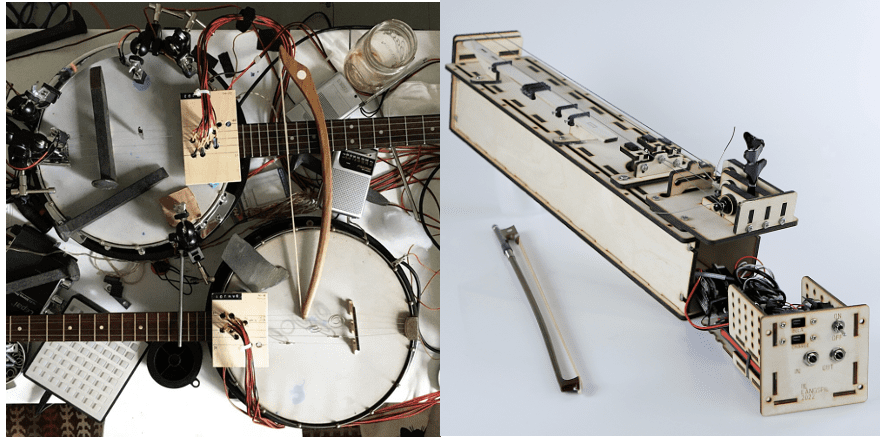
Figure 1. Left: The electrically controlled banjos used in a vine that grew over the city and no one noticed. To the right: The Icelandic Proto-long game from the Intelligent Instruments Lab workshop.
Weston's approach and method to the composition basically involves listening very actively to the environment and acquiring much material from it, as well as studying its historical connectionsThe approach of a hen is to some extent a rebellion against the accepted idea of a composition:
As I understand them, the expectations for a composer are at their core in contrast to this type of place analysisIt is accepted practice to consider that instruments, traditions, spaces and in fact people are shaped so that there is a certain acoustic worldview that can be performed and performed at will I am interested in a different kind of approach focusing on pluralism, adaptation and flexibility in our work with what is around us.[4]
Like IIL, Weston is working with the potential of artificial intelligence, but the work uses Markov chains and simple neural networks, among other things to process old recordings of banjo players from South Carolina and the Appalachians, and the technology with these methods forms a kind of re-imagining of the playing techniques of these performers of the past. Other historical raw materials include locomotive sound recordings by locomotive enthusiast and photographer O. Winston Link towards the end of locomotive haulage in America in the 1960s, and various Carolingian documentary recordings obtained from tapes, wax cylinders, vinyl records and wire.[5] Also, the composer specifies AM radio transmitters, old lamp radios, train tracks, jam jars, and distortion equipment where audio signals are sifted through a geosample of Carolingian red clay.[6] It should be noted that in the concert in Mengi, the version of the work was slightly different from the one found on the published recording, for example the version in Mengi was only performed on one of the two banjos, but in addition, not all chapters were performed in a full version.
In the fourth section, „the by and by„, the composer fed OpenAi's AI Jukebox on the Carter family's song" Can the Circle Be Unbroken and used it to transform the material with the voices and stylistic tricks of various well-known American folk and country musicians such as Johnny Cash, Elizabeth Cotten, Hank Williams, Loretta Lynn, etc.[7] In a lecture that the composer gave about his work in the seminar of composition students at the University of the Arts on February 9 last, hán pointed out, among other things, that with the neural network there was an attempt to synthesize sound (e. synthesise) the material at a much deeper level than, for example, the MIDI level that one might have first thought of in this kind of transcription The artificial intelligence works at some kind of digital atomic level, that is, it is based on something that further approaches the basic units of the digital data file.[8]
Terrible heaven
There is something ghostly about this fusion of the electrotechnical and historical The folk music that underlies the work often raises very existential questions in the composer's view, speculations about what might await us beyond the great haze Weston in his own way evokes a bizarre ghost by taking this historical raw material, sound recordings that are very firmly attached to a particular place and time, and projecting them into a digital environment that belongs to a completely different and completely different plane of existence The product sounds like some sort of preserved source that belongs to the past but is actually a brand new „mind-building“ The digital Weston recalled in his lecture that one could imagine the digital singularity (e. digital singularity) as a kind of terrifying heaven.[9] Thus, this digital haunting has come into conversation with the existential subject of the folk songs that are based on.
There are short connections to various ideas about the technical uniqueness (e. technological singularity), that is, theories that in the foreseeable future a situation will arise in which the fusion and development of new technologies, to form artificial intelligence, suddenly transforms our reality in a radical and unpredictable way There you can find ideas about so-called cyber-immortality (e. cyberimmortality), where humans envision a future where we can gain eternal digital life beyond the grave and death by loading our thoughts and feelings, the soul so to speak, into an eternal data system.[10]
Science-novel ideas such as cybernetic mortality must, however, be considered quite far from the core of Weston Olencki's compositions, which Hán defines as „a rural approach to experimental music“.[11] The composer plays with making advanced technology (which takes up more and more space in our time and in a way embodies both utopian promises about the future but also alarming foreboding) work with weathered, low-resolution materials, full of screeching and screeching that have arisen from the advance of time Weston does not seek to peer into technology-driven immortality but takes on high local elements, which often have historical references to the past, and decomposes them into particles, reads them and treats them with the tools of the day Weston deals with the setting of music in various senses: references, metaphors and meaning of the material itself In the eyes of a hair, raw material is not just a blank slate but refers all material both to its past and to other related objects. Thus, works are such as a vine grew over the city... geographically bound to the composer's surroundings and shaped by the composer's personal relationship with that environment The composer makes his relationship with his environment tangible through the mediation of the sound.[12]
The banjo as a metaphor
Weston's connections to South Carolina are complex, but he has a lot to do in a small town around there. Hán talks about how the beautiful landscape, the rich musical tradition and the gentle sense of time of the region are healed into the consciousness of a hen and inspires a taunt, but also points out how the history of the region is contaminated by bloodshed, slavery, prejudice, genocide, extremely harmful industrialization and various kinds of injustice to this day.[13] Choosing the banjo as a kind of focal point of the work is in this sense extremely appropriate given its complex cultural history, but the instrument has its origins in West Africa, where the playing tradition of related instruments can be traced all the way back to the seventh century, and even further from Africa, the banjo traveled to America in the seventeenth or eighteenth century with African slaves, first to the Caribbean and then to the southern United States.[14]
After developing and spreading with slaves throughout the southern United States, it began to be reported in the eighteenth century that white settlers learned the banjo, but this trend goes hand in hand with the advent of the minstrel shows.[15] The Minstrel tradition, a stain of reproach in American history, so much so increased the popularity of the banjo and plays a key role in the emergence of country music and the stereotype that banjo belongs primarily to white „hillbilly“ country culture Despite that, the African-American banjo music preserved in the Appalachians can also be seen to be a direct forerunner of African-American ragtime music, blues, and subsequently jazz music.[16] Another thread of this complex cultural web is precisely the acquisition, especially within the music industry, of the white „hillbilly“ or country bubbly, which had to succumb to the heroic American image of the cowboy around the 1930s. It made it easier for white middle-class American people in the United States to identify with country music within a more accepted, comfortable and invisible whiteness.[17] If it hadn't been through the radio technology and the music industry that controlled the radio, country music (and the banjo) probably wouldn't have become what it is today.[18] There we see the evolving American myth, which Weston is in his own way addressing in his work The banjo becomes a metaphor for how West African, Caribbean and South American cultures mix with currents from European settlers, branching off in these and other directions and ending up as a marginalized, nationalist, white „redneck“ culture.[19] Weston himself says that, following his mother's death, Weston began to explore his relationship with these homelands that had hán so far „tried with all his might to distinguish [himself] from artistic, cultural and geographical“[20]
Final words
Weston deliberately chooses the banjo as the centerpiece of the work as the banjo has a very complex meaning, from being a symbol of rural culture and folk music of the mountains, to being closely associated with racist racialist culture, and thus a symbol of ok - but also a strong symbol for African heritage within American culture Weston makes use of, among other things, radio equipment and recordings and relics from locomotive transport as metaphors with reference to this regional history He also uses today's technology, thus deconstructing this raw material and formulating something completely new Amusing connections can be found between Weston's use of this national instrument and IIL's long-play, but the long-play also has a complex and strange history inspired by the IIL's original use of artificial intelligence and neural networks sheds light on the creative potential of technology, raising questions. It will be intriguing to delve deeper into Weston's work and unique pleasure in performing this work.
Bibliography
Britannica. „Singularity.“ Retrieved February 12, 2024.
https://www.britannica.com/technology/singularity-technology#ref1255067.
Conway, Cecelia. „ Black Banjo Songsters in Appalachia.“ Black Music Research Journal 23, No. 1/2 (2003): 149-166.
Goodman, Glenda, and Samuel Parler. „White Noise: Historiographical Exceptionalism and the Construction of a White American Music History“ Chapter 7 of Sounding Together: Collaborative Perspectives on US Music in the 21st Century of Michigan: University of Michigan Press, 2021.
Intelligent Instruments Lab. „Proto-Langspil.“ Retrieved February 26, 2024. https://iil.is/research/long game.
O. Winston Link Productions. „Frequently Asked Questions.“ Retrieved February 18, 2024. http://owinstonlinkrailwayproductions.com/FAQ.aspx.
Olencki, Weston. „a vine that grew over the city and no one noticed [2020-22]“. Retrieved February 12, 2024. http://www.westonolencki.com/#/city-vine/.
Olencki, Weston. „About.“ Retrieved 12th Febu 2024. http://www.westonolencki.com/about.
Olencki, Weston. „Composition Students“ Seminars." Lecture delivered at the Iceland University of the Arts, Reykjavík, February 9, 2024.
Olencki, Weston. Wet Ink Archive (blog). https://archive.wetink.org/archive-02/toward-a-future-practice.
Tripticks Tapes. „Old Time Music.“ Retrieved February 12, 2024. https://triptickstapes.bandcamp.com/album/old-time-music.
Image file
Figure 1: Intelligent Instruments Lab. Retrieved February 26, 2024. https://iil.is.
Scene 2: Olencki, Weston. Retrieved February 26, 2024. http://www.westonolencki.com.
[1] Weston Olencki/ Hugi Kjartansson & Hjalti Nordal, Mengi Óðinsgatu, February 8, 2024.
[2] „About,“ Weston Olencki", retrieved February 12, 2024, http://www.westonolencki.com/about.
[3] My translation of: „We are interested in exploring the cultural connotations of the instrument, learning the cultural reception of it as it becomes used and played as part of musical practice“. „Proto-Langspil,“ Intelligent Instruments Lab, February 26, 2024, https://iil.is/research/longspil.
[4] My translation of: „The expectations for a composer, as I've understood it, are fundamental in opportunity to this kind of locality, the normal practice viewing instruments, traditions, spaces, and ultimately people to be molded a specific sonic worldview, able to be relocated and translated at will. I'm interested in taking a different approach, one that values plurality, adaptation, and flexibility in order to work with what is around us“. Weston Olencki, „Toward a future practice“,“ Wet Ink Archive (blog), July 7, 2020, https://archive.wetink.org/archive-02/toward-a-future-practice.
[5] „Frequently Asked Questions,“ O. Winston Link Productions, Retrieved February 18, 2024, http://owinstonlinkrailwayproductions.com/FAQ.aspx.
[6] „a vine that grew over the city and no one noticed [2020-22],“ Weston Olencki, retrieved February 12, 2024, http://www.westonolencki.com/#/city-vine/.
[7] „Old Time Music,“ Tripticks Tapes", retrieved February 12, 2024, https://triptickstapes.bandcamp.com/album/old-time-music.
[8] Weston Olencki, „Composition Student Seminars“ (lecture, Iceland University of the Arts, Reykjavík, February 9, 2024).
[9] Olencki, “Composition student seminars.”
[10] „Singularity,“ Britannica, Retrieved February 12, 2024, https://www.britannica.com/technology/singularity-technology#ref1255067.
[11] My translation of: „rural approach to experimental composition.“Olencki, “Compositions of composition students.”
[12] Olencki, „Toward a future practice.“
[13] Olencki, „Toward a future practice.“
[14] Cecelia Conway, „Black Banjo Songsters in Appalachia,“ Black Music Research Journal, 23, No. 1/2 (2003): 150-155.
[15] Conway, „Black Banjo Songsters in Appalachia,“ 155.
[16] Conway, „Black Banjo Songsters in Appalachia“, 163-164.
[17] Glenda Goodman and Samuel Parler, „White Noise: Historiographical Exceptionalism and the Construction of a White American Music History“, in Sounding Together: Collaborative Perspectives on US Music in the 21st Century (Michigan: University of Michigan Press, 2021), 221.
[18] Olencki, “Composition student seminars.”
[19] Goodman and Parler, „White Noise“, 228.
[20] My translation of „Sparked by my mother's sudden death in 2017, I began to personally reforge my relationship with this place I worked so hard to artistically, culturally and geographically distance myself from.“Olencki, „Toward a future practice.“