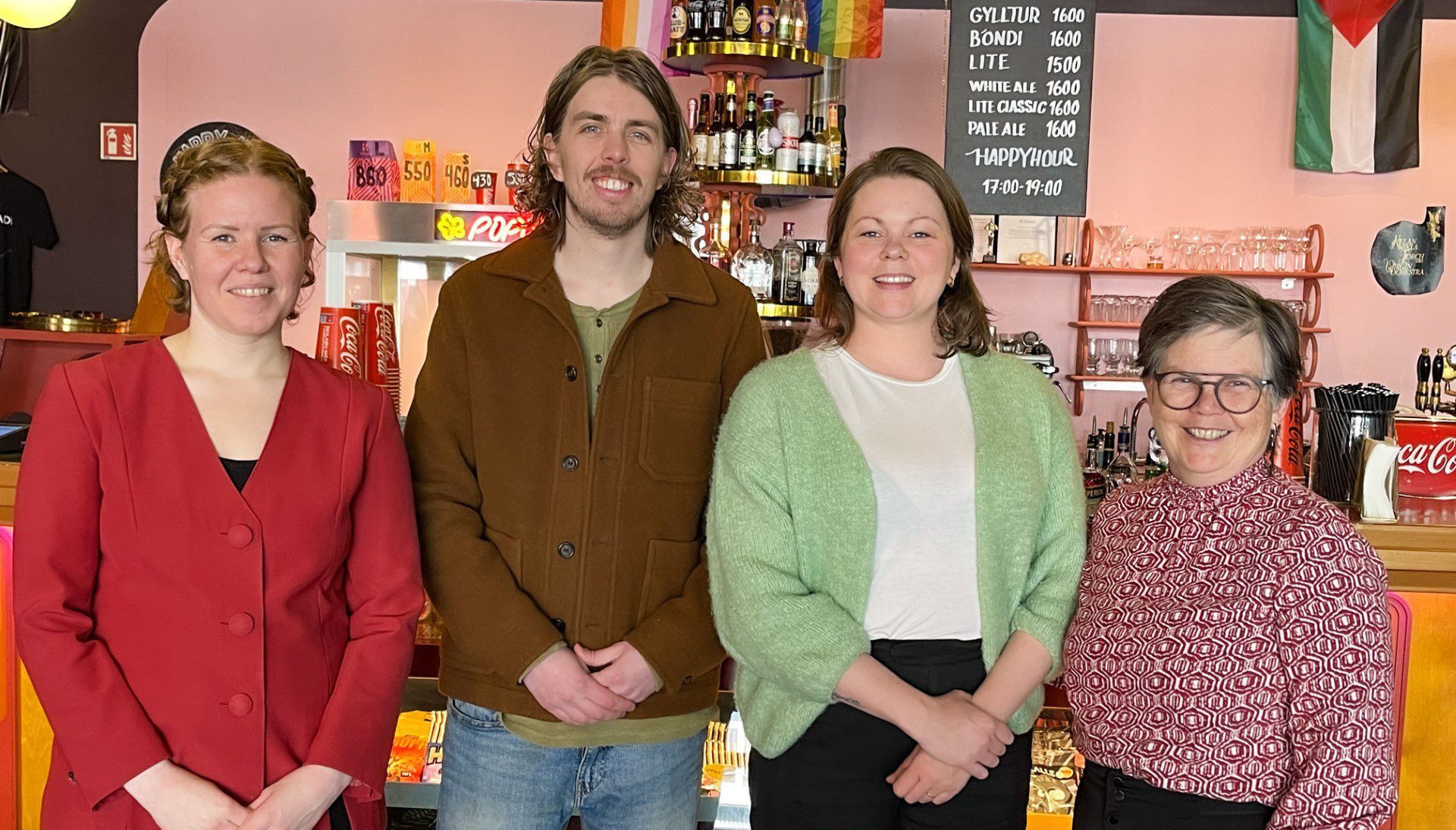
Two master's students recently received a grant from the Research Center for Creative Arts (RSG) to carry out a master's project in the field of business life culture and creative industries. One of the goals of the new center is to promote and increase research in this regard in Iceland. Anna Hildur Hildibrandsdóttir, chairman of the board of RSG, officially handed over the grants at Bíó Paradís this week, but the projects both have a clear connection to RSG's research policy. It is estimated that both projects will be completed at the beginning of June and their results will be presented at the next RSG seminar, on June 18, which will take place in the building of the new Music Center in Austurstræti 5.
„It's exciting to see these two good studies come into being, and we at RSG hope that the support Lilja and Júlíus receive will give them the start of both successfully completing their projects and no less to present the results and thus promote knowledge building in the sector. We are therefore very much looking forward to meeting them again at one of our regular seminars, which is precisely done to promote the conversation between the learned and the actors about knowledge building in the field of the business world of culture and creative industries. It is in line with our policy to promote increased research in this field, and we hope that the grant will motivate you to continue on the path you have started to follow in research, an act, said Anna Hildur on the occasion of the allocation.
First Allocation
The master's students who received funding in this first allocation are:
Lilja Björk Haraldsdóttir, master's student in cultural management at the University of Bifröst
The focus is on audience development (e. audience development) within performing arts institutions in Iceland, with a special focus on audience composition and leads to further development. The aim of the study is to gain an understanding of the cultural diversity of the audience and a survey of the groups that are not covered by institutions. Research questions aim to analyze whether performing arts institutions reflect the cultural diversity of society and how methods can be developed within audience development to reach a wider group. The research is based on statistical data from Statistics Iceland and qualitative interviews with representatives from core institutions.
Júlíus Jóhannesson, master's student in media and communication studies at the University of Iceland.
The main goal of the research is to examine the opportunities offered to Icelandic film producers for the distribution of their films in foreign markets Theory is considered Theories from Media and Messaging Theory and results are measured in terms of attendance at cinemas, distribution of films and their access to streaming providers The project aims to measure the likelihood of success of Icelandic films abroad and this is the first time that the market of Icelandic films is studied in this way Quantitative data was collected manually from several websites and databases and it reaches the years 2009-2019. In addition to these, qualitative in-depth interviews were conducted to gain insight about the Icelandic film market.
About the Creative Arts Research Center and the Master's Student Fund
The Creative Arts Research Center was founded in the summer of 2023 and is owned by the University of Bifröst, the University of Akureyri, the University of Hólum, the University of Iceland and the Iceland University of the Arts. Erla Rún Guðmundsdóttir was appointed project manager of the center on October 1 last. and has now taken over the position of its director from April 1 last.
The board of RSG decided at its meeting at the beginning of 2024 to spend 2 m. kr. on a research fund for master's students who do research projects in the field of the center An advertisement for the grants was published shortly after and the application deadline expired on March 22. All six applications were received. Three applicants were invited to an interview and the board of RSG then made a decision to grant two projects.
The next application deadline for the master's student fund is Friday, August 22. See more here.
The main objective of the Creative Arts Research Center (RSG) is to promote research on the professional life of culture and creative industries, taking into account the multifaceted effects of artistic creation and cultural production on society RSG is an independent research partner and emphasizes academic independence in all activities The research center carries out diverse research and analysis on the working life of culture and creative industries and works to strengthen research culture and infrastructure in this field.
More information about the Creative Arts Research Center can be found on the center's website.