- 180 ECTS Units
- 6 semesters - 3 years Duration of study
- BA Degree
- 13 January 2027 Application website opens
- 5 April 2027 Final deadline for applications
- August 2027 Studies begin
About the programme
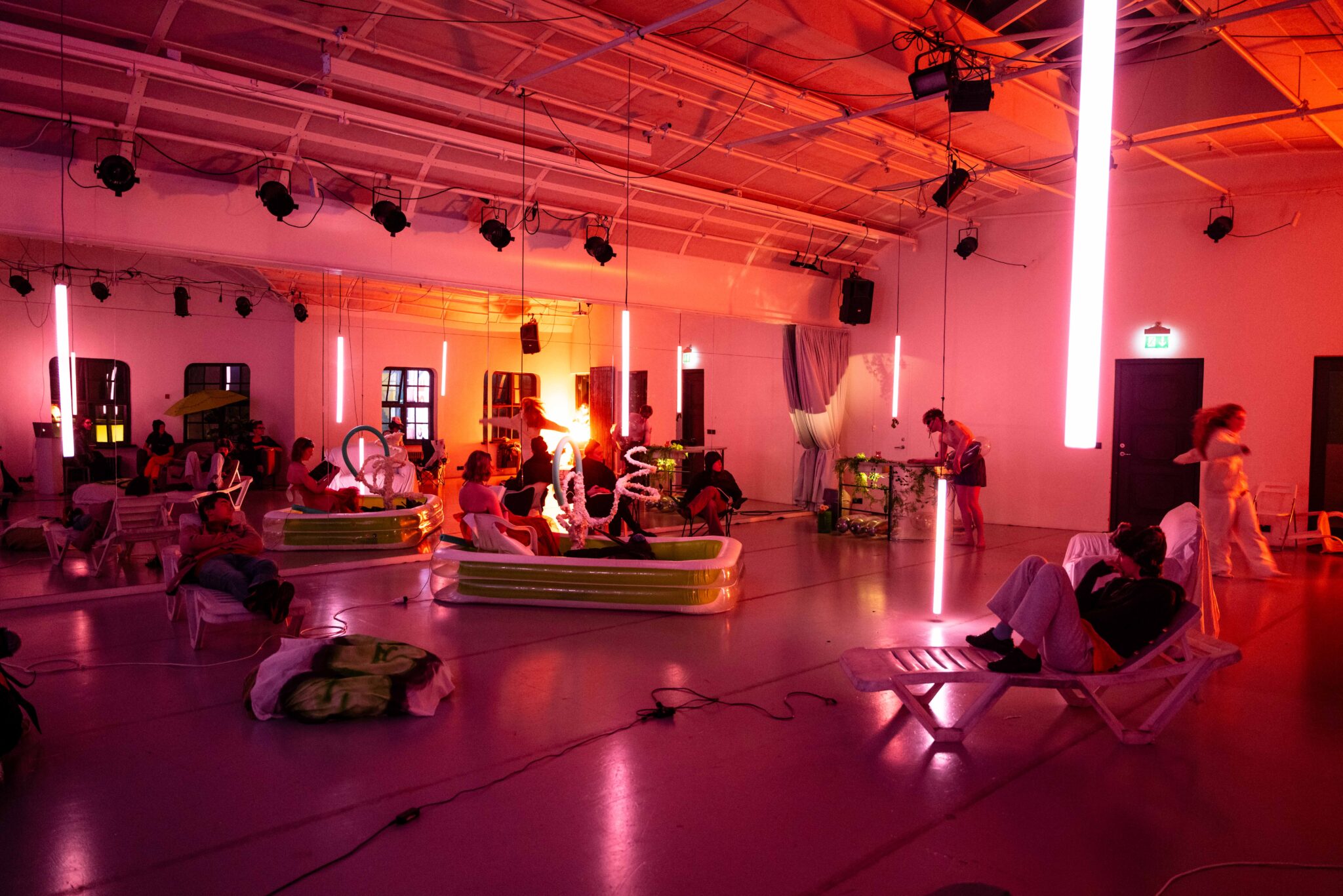
In Theatre & Performance Making the role of the performance maker/author is examined in a wide context based on presentation, staging, idea development, creation, devising, directing, playwriting, theory, and performance. Students develop an artistic vision and an independent approach to the performing arts as makers/authors. Graduates of the programme play a leading role within the national and international performing arts, as well as in many other fields; ranging from media to academic work, drama teaching, marketing, cultural management, and production.
Theatre & Performance Making is a three-year study programme consisting of 180 ECTS credits that ends with a bachelor's degree in performing arts.
Programme structure
The structure of the programme twins together practical and theoretical knowledge. The programme is a platform for experiments and research within performing arts, where students deal with the history, nature and role of the artform in a broad context. In the programme, students get to know different methods for the creation of meaning, structure and composition of theatre and performances. Students explore the boundaries and interplay of the performing arts with other art forms while simultaneously developing their own maker/author's voice, aesthetics, and methodology. In theoretical courses, students gain knowledge and understanding of the historical, social and political context of theatre and performing arts, develop their critical thinking about the profession and an awareness of the authors/makers role and vision for audience and society.
The programme is structured around a clear progression from a broad, shared foundation in the performing arts towards increasing specialization, autonomy, and artistic responsibility. Students' creative projects grow in scope and complexity, offering them opportunities to develop their own artistic voice and working methods as they move towards independent artistic practice.
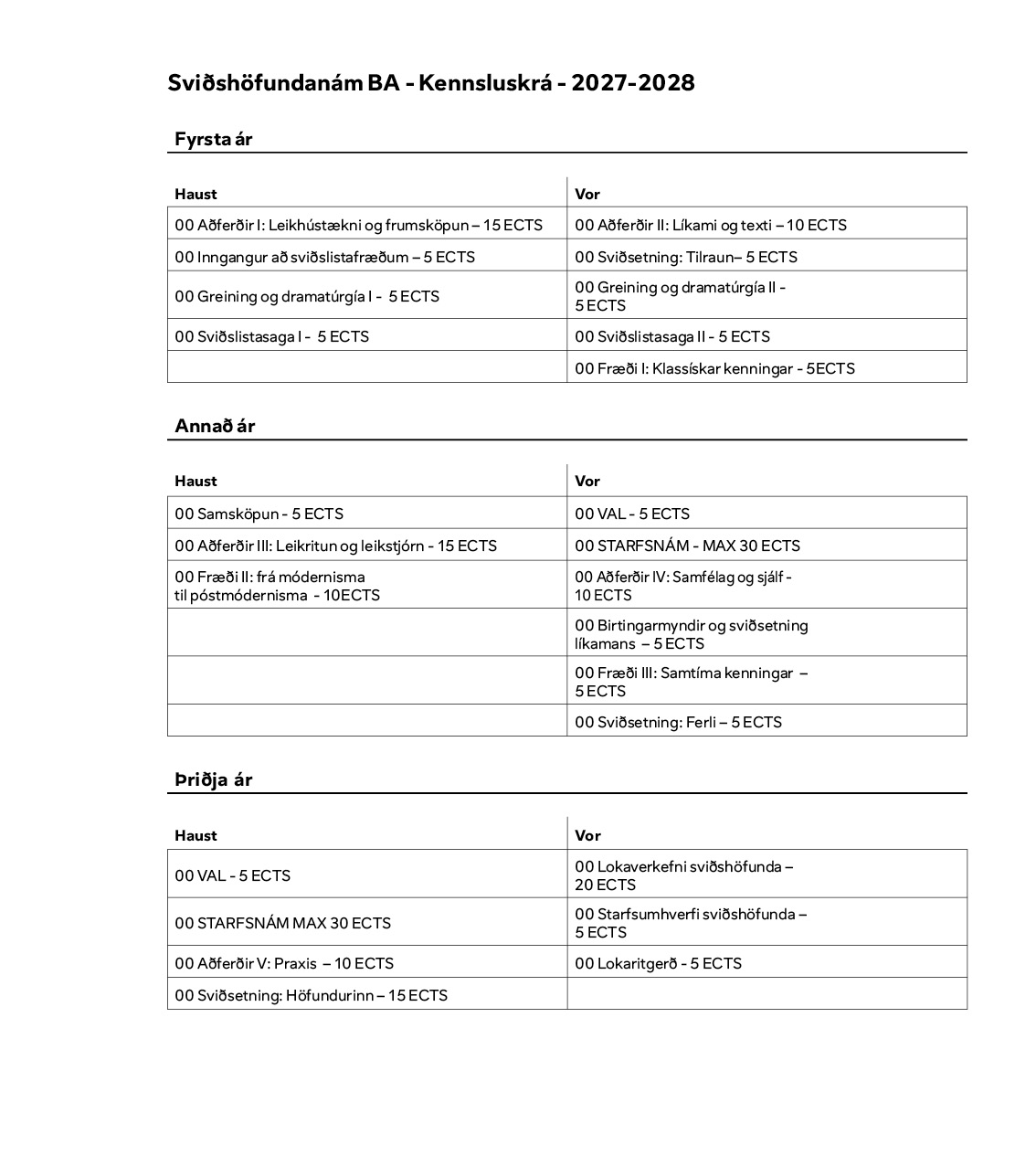
In the first year, a foundation is laid for students' knowledge and understanding, and they discover different aspects and methods of performing arts through practical and theoretical work, independently and in groups. In the second year, the emphasis is on the student experimenting, processing and searching for approaches and craftsmanship through creative projects and independent work under supervision. In the third year, the main focus is on the role of the author/maker and students realizing their own artistic vision, author's voice and emphasis in independent, creative individual projects. Throughout the course of study, students have repeated opportunities to develop and present their work to an audience.
During the fourth and fifth semesters of the programme, students have the opportunity to go on an exchange at LHÍ’s partner universities abroad, or to do an internship with artists, groups and institutions in Iceland or abroad.
Students complete their studies with a graduation project and a final thesis.
After graduation
Graduated performance makers play a leading role in national and international performing arts, work as independent artists or at theatres and cultural institutions in Iceland and abroad, as well as in other diverse fields. Graduated performance makers are also well prepared for continuing studies at a master's level.
Applications & Admission Process
The application process consists of completing an electronic application paying an application fee and finally submitting the application.
All applications for studies go through an application portal and all communications regarding the application process will take place there. An application can be saved while it is being worked on.
If the number of applicants meeting the admission criteria for a study programme falls below the minimum threshold, the programme will not be offered for the upcoming academic year. Applicants will be informed of this as soon as possible, and the registration fee will be refunded if it has already been paid.
Required Application
In order for the application to be valid, an application fee must be paid and the following documents must be received:
1. Certified copy of degree certificate(s) and programme / course transcript(s). (PDF) (Required) – note that a photocopy is not valid.
a) Scan the original of the diplomas and attach to the electronic application, or
b) Get certified copies of diplomas with a stamp from the respective institution, scan and attach to the electronic application.
2. Photograph of the applicant. (Required)
3. Motivation letter. (PDF) (Required) It is added under „Presentation Letter”".
The applicant must specify the reasons for the application, goals, future vision and more in a short text, maximum of 2 pages. Applicants must take a position on the following questions in the cover letter:
- What is it about the performing arts that sparks your interest and passion?
- Why do you want to be a Theatre & Performance Maker?
- What do you want to get out of your studies in the programme?
4. Folder/Portfolio. (Required) Applicants must collect samples of their work in a folder/portfolio.
The portfolio must contain a maximum of five samples, which should reflect the applicant, highlight their areas of interest and main interests. From the samples, it should be possible to decipher the applicant's artistic thinking and their ability to present their ideas.
In fact, everything fits within the directory which, in the applicant's own opinion, can in one way or another describe what he wants to convey about his competence, background, artistic interest and personality. Examples of the contents of the directory include: samples of performances or scenes, excerpts from stage works or short films, excerpts from written texts by the applicant, such as plays or film scripts, passages from essays, excerpts from poems and stories, or recordings with samples of works.
Please note that full-length works are not requested and applicants are encouraged to choose a rather shorter part of longer works so that the admissions committee has the opportunity to review all data in the applicants' career folders.
You can return a folder/portfolio in three ways:
- Applicants submit a folder to the office of the Performing Arts Department of the Iceland University of the Arts, Laugarnesvegi 91, 105 Reykjavík.
- Applicants submit a folder by mail addressed to: Iceland University of the Arts, Laugarnesvegi 91, 105 Reykjavík, marked APPLICATION - STAGE AUTHOR PROGRAM. The folder must be mailed no later than the advertised application deadline, but applicants are encouraged to post earlier as there may be delays in mail.
- Applicants submit a folder in electronic form. The folder must be in .pdf format and the entire folder must be returned as a single .pdf document. Audio works, video works and similar documents must be sent as active links/path inside the folder. An electronic folder is returned to the electronic application under ,, Ferilmapp”.
It is important that applicants closely monitor the progress of their application through Uglu's communication portal Through the Owl, applicants receive a message if any supporting documents are missing The application is only completed once a folder has been returned and all supporting documents in order Considering the application and folder, selected candidates will be invited to take the entrance exam.
You can find the electronic application HERE.
Entrance test
Applicants who send an adequate application with sufficient data and meet the admission requirements of the Iceland University of the Arts will be invited to the entrance exam. Applications will be answered by April 22, 2027 at the latest.
The entrance exam takes place on the days April 29 to May 1 and divided into four parts:
Day 1: First and second part.
Part one consists of a written project emphasizing the ability to analyze and creative, written processing of the candidates Applicants watch a 1-hour-long excerpt from a stage piece or recording of a stage piece, and subsequently are given 2 hours to write text which they submit to the admissions committee The form of the text is free.
The second part consists of a group project Applicants are sent data for the trial and are then divided into groups and given 2 hours to create a stage piece together The work shall not be longer than 10 minutes.
Day 2 or 3: Part Three and Four.
Part three involves the performance of a short, original item or performance presented by the applicants to the admissions committee The scene shall not exceed 5 minutes.
Part four includes an individual interview The purpose of the interview is to examine the applicant's general interest in prospective studies, their attitude, vision and attitude towards performing arts The candidate's background, circumstances, health, areas of interest, passion and expectations for performing arts in general as well as the program are also asked about ideas behind the applicant's career portfolio and discussed about the applicant's experience and contribution in the admissions process.
After the auditions, at the latest 10 May 2027 a written answer will be sent to all applicants.
Those applicants who receive an invitation to attend school must confirm their school stay by paying a registration fee no less than two weeks after the results are published. The fee is irreversible.
Procedures
The admissions committee usually consists of the professional director of the field writers' track, who is the chairman of the committee, a teacher at the track or the dean, and one working performing artist from the profession. Furthermore, the student representative sits the admissions as an observer but does not have the right to vote.
The admissions committee selects students from among the candidates who are believed to have the criteria to study in a stage author's course and who meet the conditions specified in the rules of the University of the Arts The admissions committee is guided by the fact that the person can make the best use of the program available shall not interpret the committee's assessment in such a way that it includes a judgment on the artistic talent of the applicants in general. The committee's work is confidential and it does not publish reviews on individual applications. Its decision is final and will not be referred to for review elsewhere within the school.
Factors assessed by the admissions committee include:
- Imagination: The applicant's ability to follow his intuition and find a creative way for his ideas.
- Daring: The applicant's curiosity, initiative and independent working methods are looked at in artistic work, interpretation, processing of ideas and presentation.
- Form perception: Awareness of the possibilities and boundaries of the forms of expression that
the applicant chooses.
- Structure: The applicant's ability to compile written tasks as well as practical tasks. Flow, context and dramaturgy, application of stylistic tricks and outbursts to meaning creation are considered, among other things.
- Space sensing: The applicant's ability to perceive and work with the context of body, space, time and circumstances.
- Work ethic: The applicant's attitude towards work and study and the applicant's ability to work independently and collaborate The applicant's independence and initiative are looked at. Also, how the person takes criticism and ideas of others and uses them in artistic work.
- Communication skills and critical thinking: The applicant's ability to comment on their own work, the tasks that the person chooses and that are presented. As well as the applicant's ability to express himself critically about contemporary arts, especially performing arts.
Admissions criteria
The general admissions criteria are to have completed a matriculation examination, a final examination from a secondary school at the third qualification level, a similar examination from a foreign secondary school, or a minimum of 60 ECTS credits from an accredited university Applications must be accompanied by a certified copy of the diplomas and a certified copy of the study history summary.
Admission to the school may be granted to those applicants who have knowledge and experience that is considered adequate preparation for bachelor's studies at the school. See more „Exemptions from general admission requirements“
Admission committees evaluate applications based on submitted data as well as interviews and/or entrance exams in the relevant areas. The dean appoints an admissions committee for each study programme in consultation with the subject manager and the admissions committees work according to the procedures presented to the applicants.
Exemptions from general admission requirements
Admission to the school may be granted to applicants who have knowledge and experience that is considered adequate preparation for bachelor's studies at the school.
Applicants who do not meet the general admissions criteria may apply for an exemption if they have completed, for example, numerous credits at the secondary school level, completed other final exams such as at the 4th qualification level or have other preparation that can prepare the person for studies at the university level on the relevant study programme Applications for exemption from the general admissions criteria are evaluated by professionals within the relevant department. The result of the evaluation of exemption applications is final. When evaluating applications, interacting factors are considered with regard to grades in studies at the secondary school level, education in the arts, further education, work experience and participation in social work Each case is examined separately, and the interaction of these factors may affect the outcome Applicants are encouraged to account for everything they believe may become their application for exemption from general admissions criteria for advancement.
Admission committees evaluate applications based on submitted data as well as interviews and/or entrance exams in the relevant areas. The dean appoints an admissions committee for each study programme in consultation with the subject manager and the admissions committees work according to the procedures presented to the applicants.
Admission criteria
The desired preparation is an art course in general and the third qualification level in Icelandic and English.