Date
15 November 2024
Time
12:15–13:00
Location
Dynjandi, Skipholti 31
Department
Department of Music
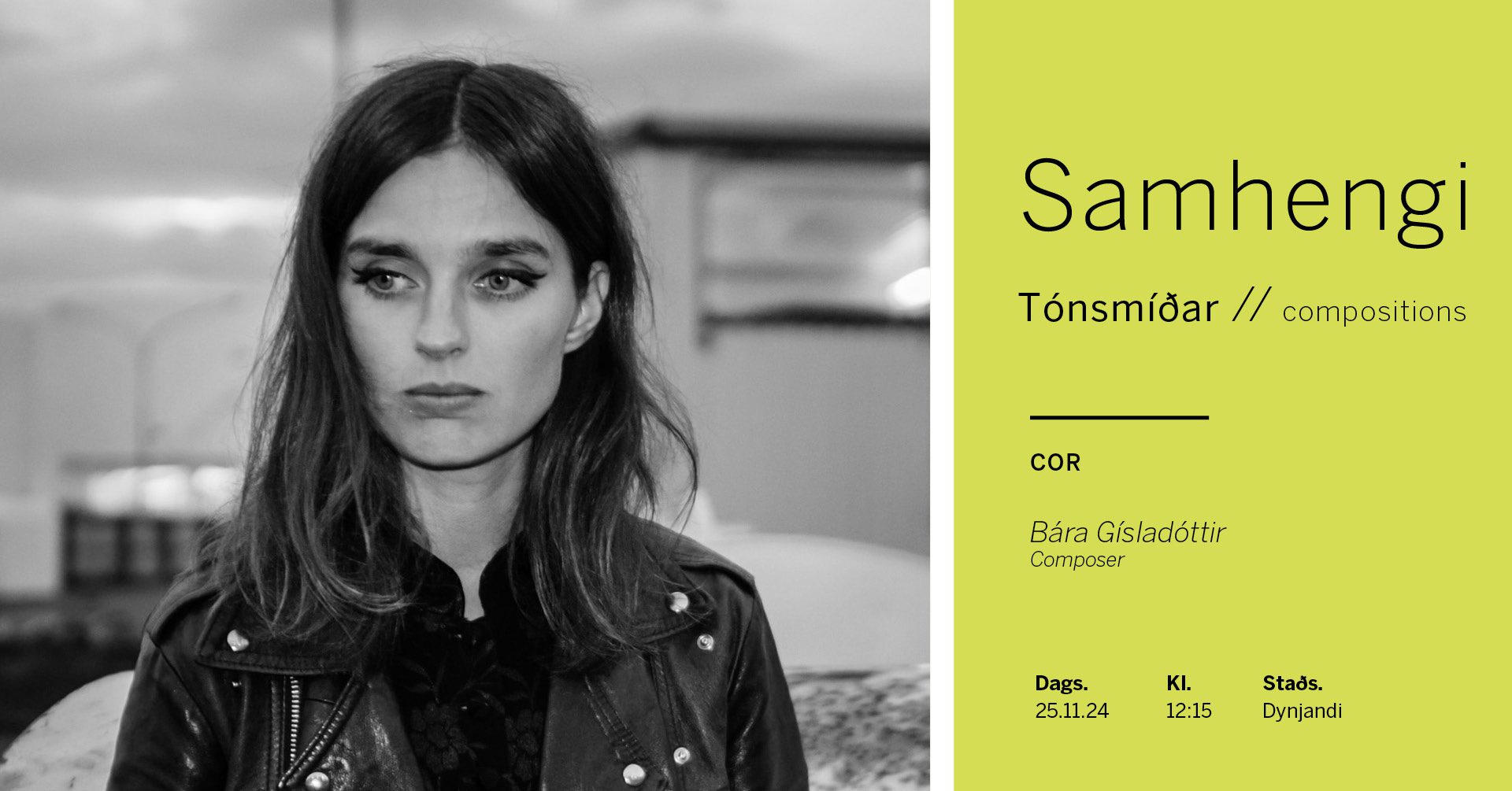
In the orchestral work COR, Bára Gísladóttir takes her starting point in an etymological curiosity and lets a multitude of means and texts melt together in a dark unity complete with an improvised climax and growing musicians.
“It seems as if the word core is of uncertain origin, etymologically speaking,” Bára Gísladóttir explains. ”It either derivatives from cuer/ cor (Old French/Latin), meaning “heart”, or cors/corpus, meaning “body”. Cor/Kor is also the word stem or word for “choir” in several languages. COR is built on a collage of these aspects, where the intention is to shed light (or darkness if you will) on their existential unity.”
While COR combines a variety of timbral texts, the darkness dominates throughout, because of the rather unusual instrumentation of the work; the only strings on stage are seven amplified double basses, and the setup for the four percussionists is immense. The core of COR is an intersection double bass and percussion solo with the musicians improvising based on an image in the score.
“The image indicates the way I see the sound,” says Bára Gísladóttir. “It is the simplest and most honest way to show it.” As a performer herself as well as a composer she prefers to avoid detailed wordy descriptions and finds that images or graphic notation often gives a better understanding of the composer's idea.
Cor in the meaning of ‘choir’ is expressed in passes of growls and voiced flutters in the brass and woodwind sections turning the orchestra into a large, distorted choir. “I try to approach the word and the work from different angles, and I believe that regardless of the number of different approaches, we eventually reach a unity, the core of it all, Bára Gísladóttir states.